

Bulk‐Like Spin Cycloid and Fast Switching in Freestanding BiFeO3
Advanced Functional Materials (2026)
Abstract:
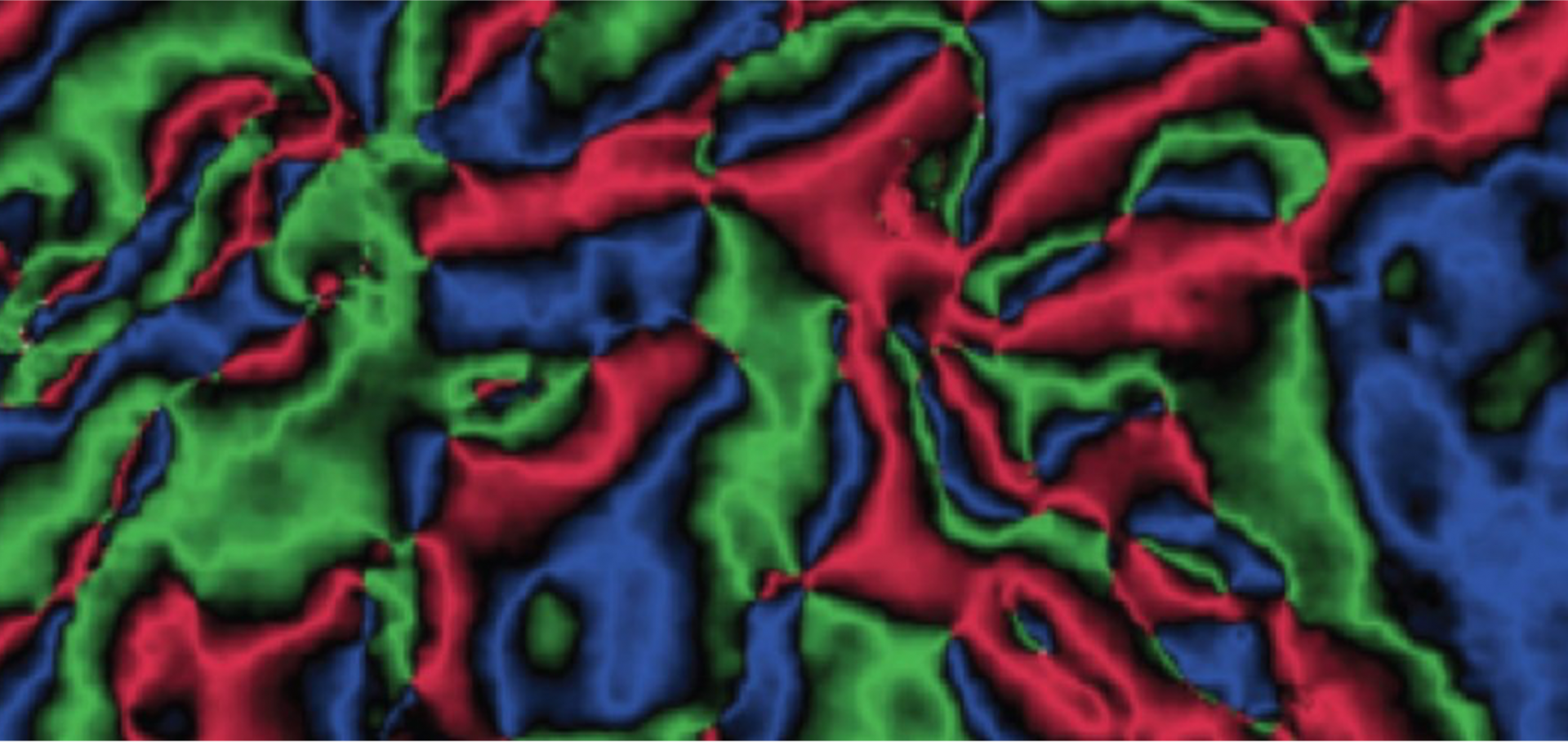
The spin cycloid characteristic of noncollinear antiferromagnets offers significant potential for energy‐efficient, magnon‐mediated spintronic applications. Multiferroic BiFeO3 is among the most promising candidate materials because its antiferromagnetic order can be controlled by an electric field. However, in epitaxial BiFeO3 thin films, substrate clamping and epitaxial strain modify the cycloidal magnetic structure while limiting efficient ferroelastic‐ferroelectric switching. Here, we show that strain‐released freestanding BiFeO3 membranes overcome these limitations. Compared with substrate‐clamped epitaxial thin films, a 100‐nm‐thick freestanding membrane exhibits ≈50% faster electric‐field‐driven ferroelectric switching and a spatially uniform, bulk‐like single spin cycloid, as revealed by resonant elastic X‐ray scattering. In contrast, the epitaxial thin film exhibits an expanded cycloid periodicity and slower ferroelectric switching dynamics, reflecting the influence of substrate‐induced strain. Freestanding BiFeO3 membranes therefore overcome substrate‐induced constraints by simultaneously restoring the intrinsic bulk‐like spin cycloid and enabling substantially faster ferroelectric switching. This combination of robust noncollinear antiferromagnetic order and efficient electric‐field switching establishes freestanding BiFeO3 membranes as a promising magnetoelectric platform for low‐power magnonic and spintronic technologies, while enabling heterogeneous integration with Si‐based devices. Freestanding BiFeO3 membranes overcome substrate‐induced constraints by simultaneously restoring the intrinsic bulk‐like spin cycloid and enabling ≈50% faster ferroelectric switching than substrate‐clamped epitaxial thin films. This combination of robust noncollinear antiferromagnetic order and efficient electric‐field switching establishes freestanding BiFeO3 membranes as a promising magnetoelectric platform for low‐power magnonic and spintronic technologies, while enabling heterogeneous integration with Si‐based devices.The piezochiral effect
Nature (2026) 1-5
Abstract:
Chirality is a pervasive property of matter that underpins many important phenomena across physics1, chemistry2 and biology3. Given its broad importance, the development of protocols for rational control of chirality in solid-state systems is highly desirable, especially if this effect can be tuned continuously and in two directions. Yet, this goal has remained elusive owing to the absence of a universal conjugate field that couples linearly to this structural order4, 5–6. Here we introduce the piezochiral effect, which enables control of chirality through mechanical strain. We show by symmetry analysis that uniaxial strain induces chirality in a broad class of achiral crystals that host fragments of opposite chirality within each unit cell7,8, an effect that has so far remained unrecognized. The strain-induced handedness can be tuned either by changing the strain direction or by switching between compressive and tensile strain. We experimentally verify this effect in AgGaS2, using measurements of the optical activity under strain. Our discovery establishes a new scheme for chirality control, with potential applications that range from spintronics to asymmetric catalysis, and enantioselective interactions in biosystems.Multimodal analysis reveals hydrolysis as a shared mechanism in magnetic tape degradation
(2026)