Home
Department Of Physics text logo
  • Research
    • Our research
    • Our research groups
    • Our research in action
    • Research funding support
    • Summer internships for undergraduates
  • Study
    • Undergraduates
    • Postgraduates
  • Engage
    • For alumni
    • For business
    • For schools
    • For the public
  • Support
Menu
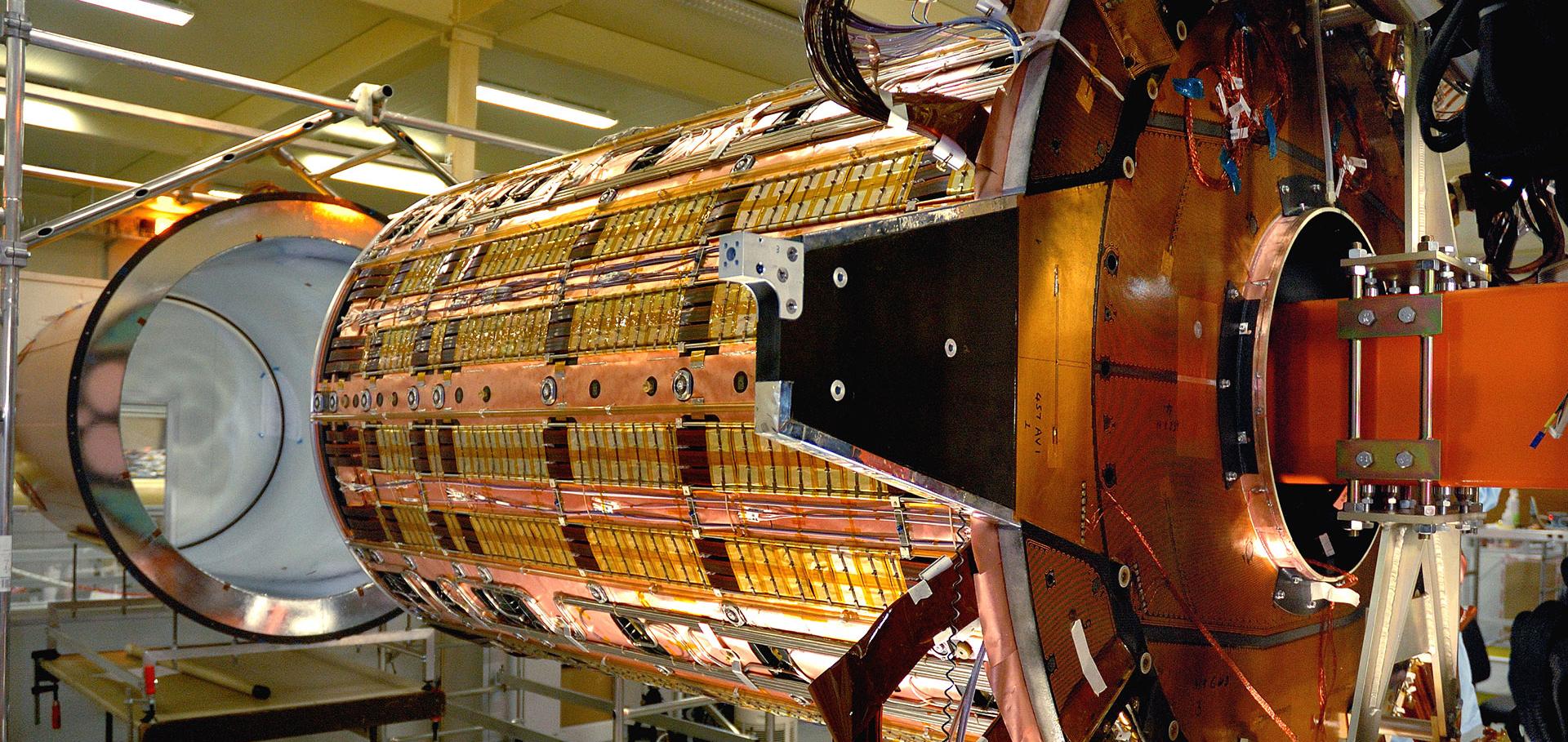
Insertion of STC into TRT at the Department of Physics, Oxford
Credit: CERN

Philip Burrows

Professor of Physics

Sub department

  • Particle Physics
Philip.Burrows@physics.ox.ac.uk
Telephone: 01865 (2)73451
Denys Wilkinson Building, room 615a
  • About
  • Publications

Test beam studies at SLAC End Station A, for the International Linear Collider

EPAC 2006 - Contributions to the Proceedings (2006) 700-702

Authors:

M Woods, C Adolphsen, R Arnold, G Bowden, B Bower, R Erickson, T Fieguth, J Frisch, C Hast, R Iverson, Z Li, T Markiewicz, D McCormick, S Molloy, J Nelson, M Pivi, M Ross, S Seletskiy, A Seryi, S Smith, Z Szalata, P Tenenbaum, D Angal-Kalinin, C Beard, C Densham, L Fernandez-Hernando, G Ellwood, J Greenhalgh, F Jackson, A Kalinin, J O'Dell, F Zimmerman, JH Brownell, HJ Schreiber, M Viti, I Zagorodnov, M Wendt, V Duginov, S Kostromin, N Morozov, S Boogert, Y Sugimoto, S Walston, D Burton, N Shales, J Smith, A Sopczak, R Tucker, R Barlow, A Bungau, A Mercer, G Kurevlev, M Albrecht, M Hildreth, W Allison, V Blackmore, P Burrows, G Christian, C Clarke, G Doucas, A Hartin, M Johnston, B Ottewell, C Perry, C Swinson, G White, P Huggard, W Mueller, T Weiland, D Adey, M Stockton, N Watson, B Chickering, O Khainovski, Y Kolomensky, T Orimoto, C Thu Hlaing, M Slater, M Thomson, D Ward, M Kimmitt, F Gournaris, A Liapine, B Maiheu, S Malton, DJ Miller, M Wing, N Sinev, E Torrence

Abstract:

The SLAC Linac can deliver to End Station A (ESA) a high-energy test beam with similar beam parameters as for the International Linear Collider (ILC) for bunch charge, bunch length and bunch energy spread.[1] ESA beam tests run parasitically with PEP-II with single damped bunches at 10Hz, beam energy of 28.5 GeV and bunch charge of (1.5-2.0) 1010 electrons. A 5-day commissioning run was performed in January 2006, followed by a 2-week run in April. We describe the beamline configuration and beam setup for these runs, and give an overview of the tests being carried out. [2] These tests include studies of collimator wakefields, prototype energy spectrometers, prototype beam position monitors (BPMs) for the ILC Linac, and characterization of beam-induced electro-magnetic interference (EMI) along the ESA beamline.

The electromagnetic background environment for the Interaction-Point beam feedback system at the International Linear Collider

EPAC 2006 - Contributions to the Proceedings (2006) 2997-2999

Authors:

G Christian, P Burrows, C Clarke, T Hartin, C Swinson, G White, A Kalinin, R Arnold, C Hast, S Smith, M Woods

Abstract:

The Interaction Point (IP) feedback system is essential for maintaining the luminosity at the International Linear Collider (ILC). It is necessary to demonstrate the performance of the feedback beam position monitor (BPM) in an electron-positron pair background similar to that expected in the ILC interaction region (IR). We have simulated the ILC beam-beam interactions and used a GEANT model of the IR to evaluate the pair and photon flux incident on the BPM, for both the 2 mrad and 20 mrad crossing angle geometries. We present results as a function of the proposed machine parameter schemes, as well as for various system layouts within the IR. We plan to study the degradation of BPM resolution, and the long term survivability, in beam tests at End Station A at SLAC. To simulate the background environment of the ILC a 'spray beam' will be produced, which will scatter from a mechanical mock-up of the forward region of the IR, and irradiate the BPM with realistic flux of secondary pairs. We present the proposed experimental layout and planned beam tests.

Interaction point feedback system R&D

Lcws 2005 2005 International Linear Collider Workshop (2005)

Abstract:

The status of R&D on hardware components of fast beam-based feedback systems is described. The main developments are being pursued by the Feedback On Nanosecond Timescales (FONT) and Feedback at High Energy Requirements (FEATHER) groups based in the UK/SLAC and in Japan, respectively. The FONT2 and FONT3 experimental results are summarised, and plans are outlined for FONT4.

Tests of the FONT3 linear collider intra-train beam feedback system at the ATF

Proceedings of the IEEE Particle Accelerator Conference 2005 (2005) 1359-1361

Authors:

PN Burrows, G Christian, C Clarke, HD Khah, T Hartin, S Molloy, GR White, A Kalinin, C Perry, J Frisch, T Markiewicz, D McCormick, M Ross, S Smith, T Smith

Abstract:

We report preliminary results of beam tests of the FONT3 Linear Collider intra-train position feedback system prototype at the Accelerator Test Facility at KEK. The feedback system incorporates a novel beam position monitor (BPM) processor with a latency below 5 nanoseconds, and a kicker driver amplifier with similar low latency. The 56 nanosecond-long bunchtrain in the ATF extraction line was used to test the prototype BPM processor. The achieved latency will allow a demonstration of intra-train feedback on timescales relevant even for the CLIC Linear Collider design. © 2005 IEEE.
More details from the publisher

QCD

Chapter in Linear Collider Physics in the New Millennium, World Scientific Publishing 19 (2005) 383-408
More details
More details from the publisher

Pagination

  • First page First
  • Previous page Prev
  • …
  • Page 44
  • Page 45
  • Page 46
  • Page 47
  • Current page 48
  • Page 49
  • Page 50
  • Page 51
  • Page 52
  • …
  • Next page Next
  • Last page Last

Footer Menu

  • Contact us
  • Giving to the Dept of Physics
  • Work with us
  • Media

User account menu

  • Log in

Follow us

FIND US

Clarendon Laboratory,

Parks Road,

Oxford,

OX1 3PU

CONTACT US

Tel: +44(0)1865272200

University of Oxfrod logo Department Of Physics text logo
IOP Juno Champion logo Athena Swan Silver Award logo

© University of Oxford - Department of Physics

Cookies | Privacy policy | Accessibility statement

Built by: Versantus

  • Home
  • Research
  • Study
  • Engage
  • Our people
  • News & Comment
  • Events
  • Our facilities & services
  • About us
  • Giving to Physics
  • Current students
  • Staff intranet