Home
Department Of Physics text logo
  • Research
    • Our research
    • Our research groups
    • Our research in action
    • Research funding support
    • Summer internships for undergraduates
  • Study
    • Undergraduates
    • Postgraduates
  • Engage
    • For alumni
    • For business
    • For schools
    • For the public
  • Support
Menu
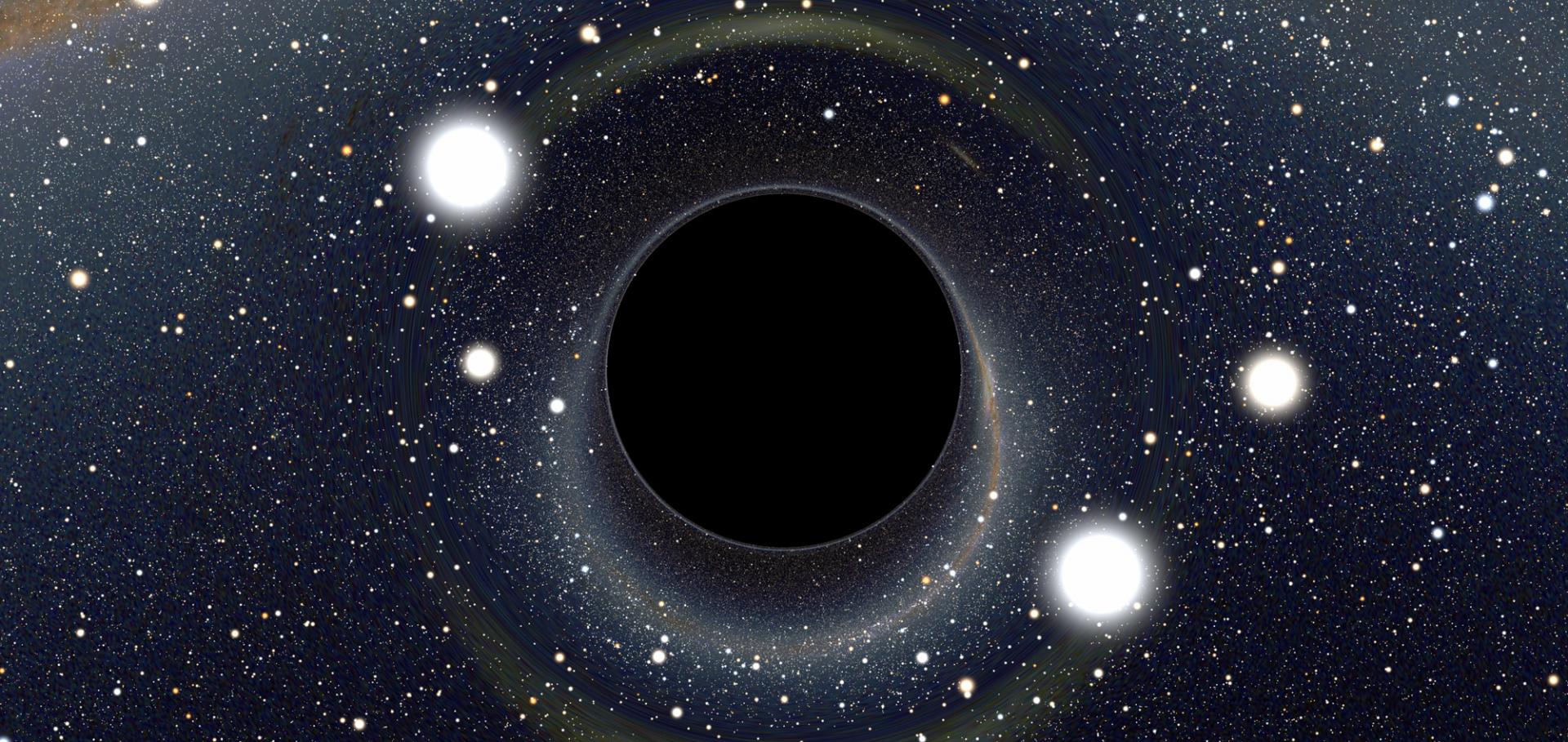
Black Hole

Lensing of space time around a black hole. At Oxford we study black holes observationally and theoretically on all size and time scales - it is some of our core work.

Credit: ALAIN RIAZUELO, IAP/UPMC/CNRS. CLICK HERE TO VIEW MORE IMAGES.

Aprajita Verma

Associate Professor

Research theme

  • Astronomy and astrophysics

Sub department

  • Astrophysics

Research groups

  • Zooniverse
  • Astronomical instrumentation
  • Galaxy formation and evolution
  • Hintze Centre for Astrophysical Surveys
  • MeerKAT
  • Rubin-LSST
  • Extremely Large Telescope
aprajita.verma@physics.ox.ac.uk
Telephone: 01865 (2)73374
Denys Wilkinson Building, room 760
  • About
  • Outreach
  • Teaching
  • Publications

Gravitational lens modelling in a citizen science context

Monthly Notices of the Royal Astronomical Society Oxford University Press (OUP) 447:3 (2015) 2170-2180

Authors:

Rafael Küng, Prasenjit Saha, Anupreeta More, Elisabeth Baeten, Jonathan Coles, Claude Cornen, Christine Macmillan, Phil Marshall, Surhud More, Jonas Odermatt, Aprajita Verma, Julianne K Wilcox
More details from the publisher
More details

HIGH-LYING OH ABSORPTION, [C ii] DEFICITS, AND EXTREME LFIR/MH2 RATIOS IN GALAXIES

The Astrophysical Journal American Astronomical Society 800:1 (2015) 69

Authors:

E González-Alfonso, J Fischer, E Sturm, J Graciá-Carpio, S Veilleux, M Meléndez, D Lutz, A Poglitsch, S Aalto, N Falstad, HWW Spoon, D Farrah, A Blasco, C Henkel, A Contursi, A Verma, M Spaans, HA Smith, MLN Ashby, S Hailey-Dunsheath, S García-Burillo, J Martín-Pintado, P van der Werf, R Meijerink, R Genzel
More details from the publisher
More details

STRONG C+ EMISSION IN GALAXIES AT z ∼ 1–2: EVIDENCE FOR COLD FLOW ACCRETION POWERED STAR FORMATION IN THE EARLY UNIVERSE

The Astrophysical Journal American Astronomical Society 799:1 (2015) 13

Authors:

Drew Brisbin, Carl Ferkinhoff, Thomas Nikola, Stephen Parshley, Gordon J Stacey, Henrik Spoon, Steven Hailey-Dunsheath, Aprajita Verma
More details from the publisher
More details

The second-generation z (redshift) and early universe spectrometer. I. First-light observation of a highly lensed local-ulirg analog at high-z

Astrophysical Journal 780:2 (2014)

Authors:

C Ferkinhoff, D Brisbin, S Parshley, T Nikola, GJ Stacey, J Schoenwald, JL Higdon, SJU Higdon, A Verma, D Riechers, S Hailey-Dunsheath, KM Menten, R Güsten, A Weiß, K Irwin, HM Cho, M Niemack, M Halpern, M Amiri, M Hasselfield, DV Wiebe, PAR Ade, CE Tucker

Abstract:

We recently commissioned our new spectrometer, the second-generation z(Redshift) and Early Universe Spectrometer (ZEUS-2) on the Atacama Pathfinder Experiment telescope. ZEUS-2 is a submillimeter grating spectrometer optimized for detecting the faint and broad lines from distant galaxies that are redshifted into the telluric windows from 200 to 850 μm. It uses a focal plane array of transition-edge sensed bolometers, the first use of these arrays for astrophysical spectroscopy. ZEUS-2 promises to be an important tool for studying galaxies in the years to come because of its synergy with Atacama Large Millimeter Array and its capabilities in the short submillimeter windows that are unique in the post-Herschel era. Here, we report on our first detection of the [C II] 158 μm line with ZEUS-2. We detect the line at z ∼ 1.8 from H-ATLAS J091043.1-000322 with a line flux of (6.44 ± 0.42) × 10-18 W m-2. Combined with its far-IR luminosity and a new Herschel-PACS detection of the [O I] 63 μm line, we model the line emission as coming from a photo-dissociation region with far-ultraviolet radiation field, G ∼ 2 × 10⁴ G 0, gas density, n ∼ 1 × 103 cm-3 and size between ∼0.4 and 1 kpc. On the basis of this model, we conclude that H-ATLAS J091043.1-000322 is a high-redshift analog of a local ultra-luminous IR galaxy; i.e., it is likely the site of a compact starburst caused by a major merger. Further identification of these merging systems is important for constraining galaxy formation and evolution models. © 2014. The American Astronomical Society. All rights reserved.
More details from the publisher
More details

The Mrk 231 molecular outflow as seen in OH

Astronomy and Astrophysics 561 (2014)

Authors:

E González-Alfonso, J Fischer, J Graciá-Carpio, N Falstad, E Sturm, M Meléndez, HWW Spoon, A Verma, RI Davies, D Lutz, S Aalto, E Polisensky, A Poglitsch, S Veilleux, A Contursi

Abstract:

We report on the Herschel/PACS observations of OH in Mrk 231, with detections in nine doublets observed within the PACS range, and present radiative-transfer models for the outflowing OH. Clear signatures of outflowing gas are found in up to six OH doublets with different excitation requirements. At least two outflowing components are identified, one with OH radiatively excited, and the other with low excitation, presumably spatially extended and roughly spherical. Particularly prominent, the blue wing of the absorption detected in the in-ladder 2Π3/2J= 9/2 - 7/2 OH doublet at 65 μm, with Elower = 290 K, indicates that the excited outflowing gas is generated in a compact and warm (circum)nuclear region. Because the excited, outflowing OH gas in Mrk 231 is associated with the warm, far-infrared continuum source, it is most likely more compact (diameter of ~200-300 pc) than that probed by CO and HCN. Nevertheless, its mass-outflow rate per unit of solid angle as inferred from OH is similar to that previously derived from CO, ≥ 70 × (2.5 × 10-6/XOH) M yr-1 sr-1, where XOH is the OH abundance relative to H nuclei. In spherical symmetry, this would correspond to ≥850 × (2.5 × 10-6/XOH) M yr-1, though significant collimation is inferred from the line profiles. The momentum flux of the excited component attains ~15 LAGN/c, with an OH column density of (1.5-3) × 1017 cm-2 and a mechanical luminosity of ~1011L. In addition, the detection of very excited, radiatively pumped OH peaking at central velocities indicates the presence of a nuclear reservoir of gas rich in OH, plausibly the 130 pc scale circumnuclear torus previously detected in OH megamaser emission, that may be feeding the outflow. An exceptional 18OH enhancement, with OH/18OH ≤ 30 at both central and blueshifted velocities, is most likely the result of interstellar-medium processing by recent starburst and supernova activity within the circumnuclear torus or thick disk. © ESO, 2013.
More details from the publisher
More details

Pagination

  • First page First
  • Previous page Prev
  • …
  • Page 12
  • Page 13
  • Page 14
  • Page 15
  • Current page 16
  • Page 17
  • Page 18
  • Page 19
  • Page 20
  • …
  • Next page Next
  • Last page Last

Footer Menu

  • Contact us
  • Giving to the Dept of Physics
  • Work with us
  • Media

User account menu

  • Log in

Follow us

FIND US

Clarendon Laboratory,

Parks Road,

Oxford,

OX1 3PU

CONTACT US

Tel: +44(0)1865272200

University of Oxfrod logo Department Of Physics text logo
IOP Juno Champion logo Athena Swan Silver Award logo

© University of Oxford - Department of Physics

Cookies | Privacy policy | Accessibility statement

Built by: Versantus

  • Home
  • Research
  • Study
  • Engage
  • Our people
  • News & Comment
  • Events
  • Our facilities & services
  • About us
  • Giving to Physics
  • Current students
  • Staff intranet