

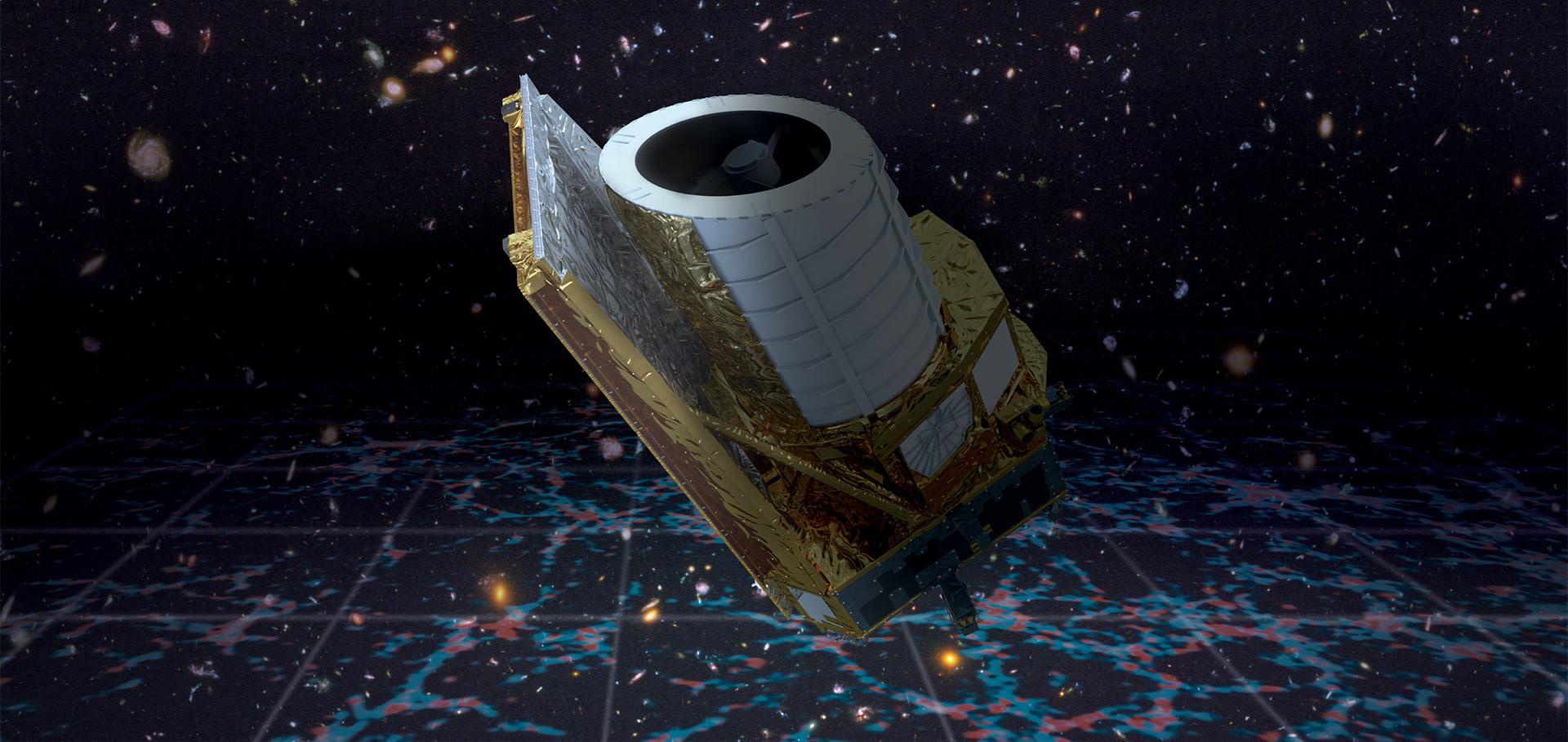
Euclid Quick Data Release (Q1)
Astronomy & Astrophysics EDP Sciences 711 (2025) A29-A29
Abstract:
Strong gravitational-lensing systems with multiple source planes are powerful tools for probing the density profiles and dark matter substructure of galaxies. The ratio of the Einstein radii is related to the dark energy equation of state through the cosmological scaling factor β . Galaxy-scale double-source-plane lenses (DSPLs) are extremely rare, however. We report the discovery of four new galaxy-scale DSPL candidates in the Euclid Quick Release 1 (Q1) data. These systems were initially identified through a combination of machine-learning lens-finding models and subsequent visual inspection from citizens and experts. We applied the widel -used LensPop lens-forecasting model to predict that the full Euclid survey will discover 1700 DSPLs. This scales to 6 ± 3 DSPLs in 63 deg 2 , which is the area of Q1. The number of discoveries in this work is broadly consistent with this forecast. We present lens models for each DSPL and infer their β values. Our initial Q1 sample demonstrates that Euclid promises to discover these rare objects.Euclid preparation
Astronomy & Astrophysics EDP Sciences 698 (2025) ARTN A233
Abstract:
We study the constraint on f(R) gravity that can be obtained by photometric primary probes of the Euclid mission. Our focus is the dependence of the constraint on the theoretical modelling of the nonlinear matter power spectrum. In the Hu–Sawicki f(R) gravity model, we consider four different predictions for the ratio between the power spectrum in f(R) and that in Λ cold dark matter (ΛCDM): a fitting formula, the halo model reaction approach, ReACT, and two emulators based on dark matter only N-body simulations, FORGE and e-Mantis. These predictions are added to the MontePython implementation to predict the angular power spectra for weak lensing (WL), photometric galaxy clustering, and their cross-correlation. By running Markov chain Monte Carlo, we compare constraints on parameters and investigate the bias of the recovered f(R) parameter if the data are created by a different model. For the pessimistic setting of WL, one-dimensional bias for the f(R) parameter, log<inf>10</inf>| f<inf>R</inf><inf>0</inf>|, is found to be 0.5σ when FORGE is used to create the synthetic data with log<inf>10</inf>| f<inf>R</inf><inf>0</inf>| = −5.301 and fitted by e-Mantis. The impact of baryonic physics on WL is studied by using a baryonification emulator, BCemu. For the optimistic setting, the f(R) parameter and two main baryonic parameters are well constrained despite the degeneracies among these parameters. However, the difference in the nonlinear dark matter prediction can be compensated for the adjustment of baryonic parameters, and the one-dimensional marginalised constraint on log<inf>10</inf>| f<inf>R</inf><inf>0</inf>| is biased. This bias can be avoided in the pessimistic setting at the expense of weaker constraints. For the pessimistic setting, using the ΛCDM synthetic data for WL, we obtain the prior-independent upper limit of log<inf>10</inf>| f<inf>R</inf><inf>0</inf>| < −5.6. Finally, we implement a method to include theoretical errors to avoid the bias due to inaccuracies in the nonlinear matter power spectrum prediction.Euclid Quick Data Release (Q1). Photometric redshifts and physical properties of galaxies through the PHZ processing function
Astronomy & Astrophysics EDP Sciences (2025)
Euclid : Quick Data Release (Q1) – Photometric studies of known transients
Astronomy & Astrophysics EDP Sciences 711 (2025) A38-A38
Abstract:
We report on serendipitous Euclid observations of previously known transients, using the Euclid Q1 data release. By cross-matching with the Transient Name Server (TNS) we identify 164 transients that coincide with the data release. Although the Euclid Q1 release only includes single-epoch data, we are able to make Euclid photometric measurements at the location of 161 of these transients where 67 had a significant flux measurement in at least one band . Euclid obtained deep photometric measurements or upper limits of these transients in the and bands at various phases of the transient light curves, including before, during, and after the observations of ground-based transient surveys. Approximately 70% of known transients reported in the six months before the Euclid observation date and with a discovery magnitude brighter than 24 were detected in Euclid IE images. Our observations include one of the earliest near-infrared detections of a Type Ia supernova (SN 2024pvw) 15 days prior to its peak brightness, and the late-phase (435.9 days post peak) observations of the enigmatic core-collapse SN 2023aew. Euclid deep photometry provides valuable information on the nature of these transients such as their progenitor systems and power with late-time observations being a uniquely powerful contribution . In addition, Euclid is able to detect the host galaxies of some transients that were previously classed as hostless. The Q1 data demonstrate the power of the Euclid data even with only single-epoch observations available, as will be the case for much larger areas of sky in the Euclid Wide SurveyEuclid: Early Release Observations The intracluster light of Abell 2390
Astronomy and Astrophysics 698 (2025)