

On cosmological bias due to the magnification of shear and position samples in modern weak lensing analyses
ArXiv 2111.09867 (2021)
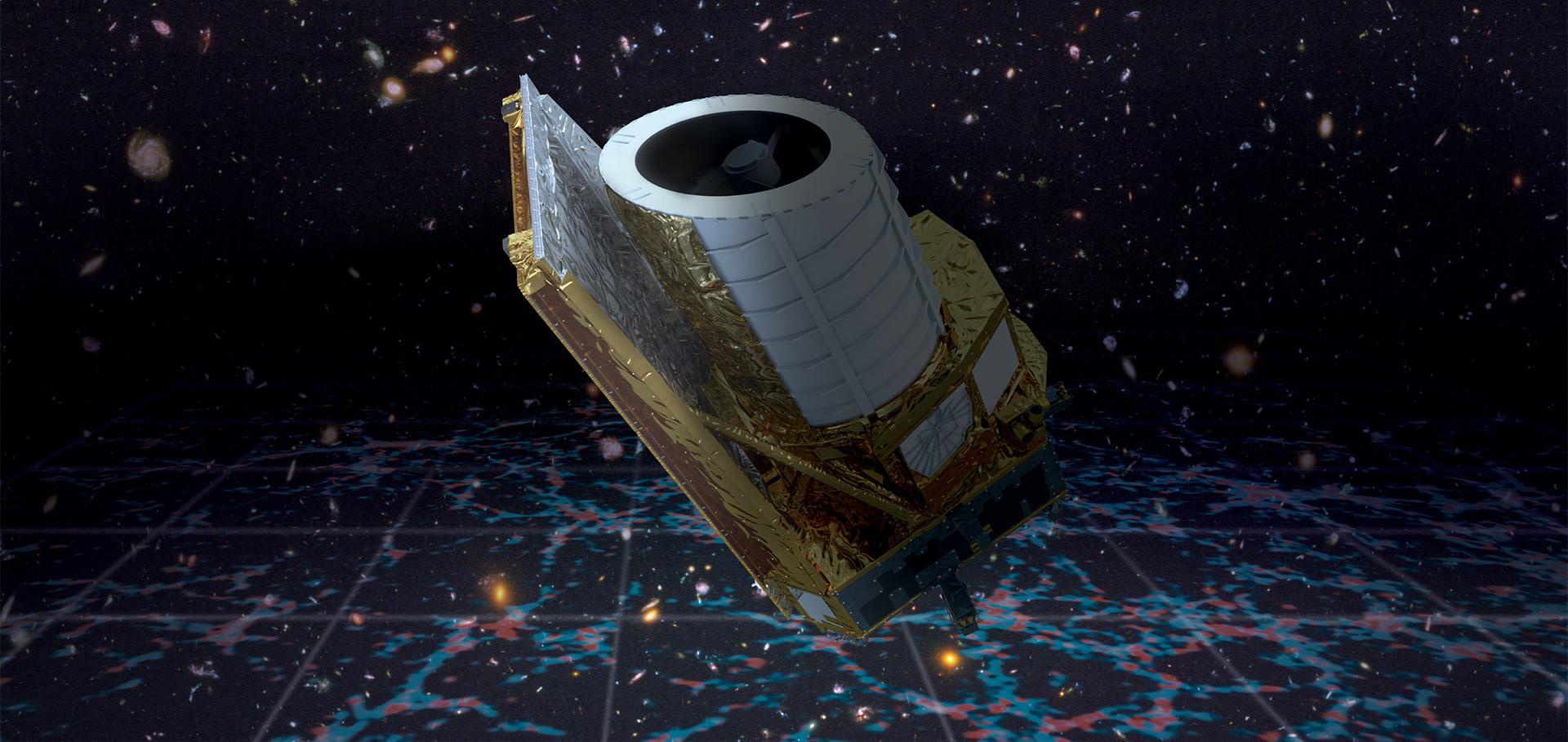
Euclid: Forecasts from redshift-space distortions and the Alcock–Paczynski test with cosmic voids
Astronomy & Astrophysics EDP Sciences 658 (2021) A20-A20
Abstract:
Euclid is poised to survey galaxies across a cosmological volume of unprecedented size, providing observations of more than a billion objects distributed over a third of the full sky. Approximately 20 million of these galaxies will have their spectroscopy available, allowing us to map the three-dimensional large-scale structure of the Universe in great detail. This paper investigates prospects for the detection of cosmic voids therein and the unique benefit they provide for cosmological studies. In particular, we study the imprints of dynamic (redshift-space) and geometric (Alcock-Paczynski) distortions of average void shapes and their constraining power on the growth of structure and cosmological distance ratios. To this end, we made use of the Flagship mock catalog, a state-of-the-art simulation of the data expected to be observed with Euclid. We arranged the data into four adjacent redshift bins, each of which contains about 11000 voids and we estimated the stacked void-galaxy cross-correlation function in every bin. Fitting a linear-theory model to the data, we obtained constraints on f/b and DMH, where f is the linear growth rate of density fluctuations, b the galaxy bias, D-M the comoving angular diameter distance, and H the Hubble rate. In addition, we marginalized over two nuisance parameters included in our model to account for unknown systematic effects in the analysis. With this approach, Euclid will be able to reach a relative precision of about 4% on measurements of f/b and 0.5% on DMH in each redshift bin. Better modeling or calibration of the nuisance parameters may further increase this precision to 1% and 0.4%, respectively. Our results show that the exploitation of cosmic voids in Euclid will provide competitive constraints on cosmology even as a stand-alone probe. For example, the equation-of-state parameter, w, for dark energy will be measured with a precision of about 10%, consistent with previous more approximate forecasts.Peer revieweMIGHTEE: total intensity radio continuum imaging and the COSMOS/XMM-LSS Early Science fields
Monthly Notices of the Royal Astronomical Society Oxford University Press 509:2 (2021) 2150-2168
Abstract:
MIGHTEE is a galaxy evolution survey using siltaneous radio continuum, spectropolarimetry, and spectral line observations from the South African MeerKAT telescope. When complete, the survey will image 20 deg2 over the COSMOS, E-CDFS, ELAIS-S1, and XMM-Newton Large Scale Structure field (XMM-LSS) extragalactic deep fields with a central frequency of 1284 MHz. These were selected based on the extensive ltiwavelength data sets from numerous existing and forthcoming observational campaigns. Here, we describe and validate the data processing strategy for the total intensity continuum aspect of MIGHTEE, using a single deep pointing in COSMOS (1.6 deg2) and a three-pointing mosaic in XMM-LSS (3.5 deg2). The processing includes the correction of direction-dependent effects, and results in theal noise levels below 2 ${}$Jy beam-1 in both fields, limited in the central regions by classical confusion at 8 arcsec angular resolution, and meeting the survey specifications. We also produce images at 5 arcsec resolution that are 3 times shallower. The resulting image products fo the basis of the Early Science continuum data release for MIGHTEE. From these images we extract catalogues containing 9896 and 20 274 radio components in COSMOS and XMM-LSS, respectively. We also process a close-packed mosaic of 14 additional pointings in COSMOS and use these in conjunction with the Early Science pointing to investigate methods for primary beam correction of broad-band radio images, an analysis that is of relevance to all full-band MeerKAT continuum observations, and wide-field interferometric imaging in general. A public release of the MIGHTEE Early Science continuum data products accompanies this article.
EuCAPT White Paper: Opportunities and Challenges for Theoretical Astroparticle Physics in the Next Decade
ArXiv preprint. White paper of the European Consortium for Astroparticle Theory (EuCAPT). 135 authors, 400 endorsers, 133 pages, 1382 references
Abstract:
Astroparticle physics is undergoing a profound transformation, due to a series of extraordinary new results, such as the discovery of high-energy cosmic neutrinos with IceCube, the direct detection of gravitational waves with LIGO and Virgo, and many others. This white paper is the result of a collaborative effort that involved hundreds of theoretical astroparticle physicists and cosmologists, under the coordination of the European Consortium for Astroparticle Theory (EuCAPT). Addressed to the whole astroparticle physics community, it explores upcoming theoretical opportunities and challenges for our field of research, with particular emphasis on the possible synergies among different subfields, and the prospects for solving the most fundamental open questions with multi-messenger observations.
MIGHTEE: total intensity radio continuum imaging and the COSMOS / XMM-LSS Early Science fields
ArXiv 2110.00347 (2021)