

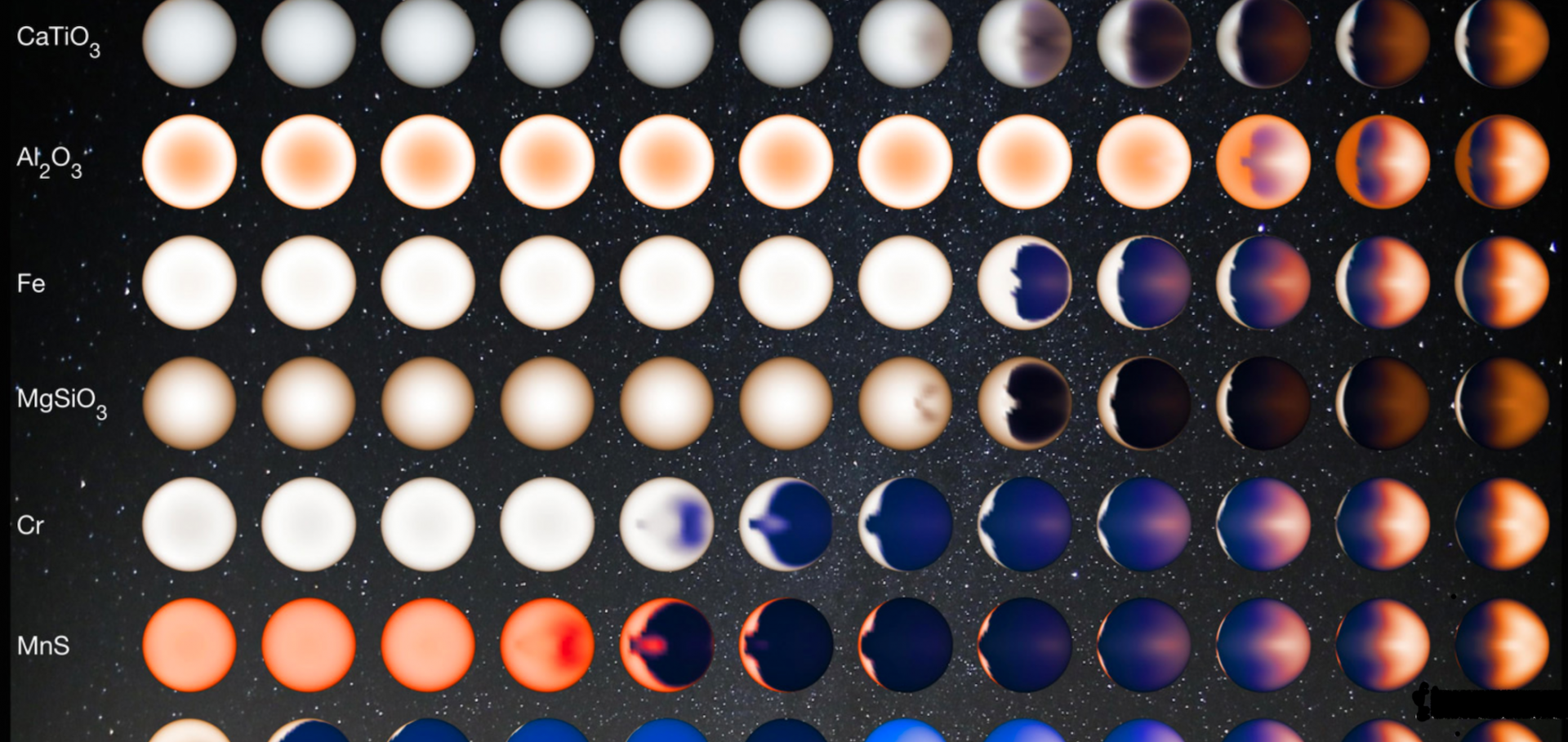
Cloudy mornings and clear evenings on a gas giant exoplanet
Science, Volume 392, 858-862 (2026)
Abstract:
The spectra of exoplanet atmospheres are affected byaerosols (clouds and hazes) of uncertain origin. Proposedaerosol formation mechanisms include gas condensation orphotochemical reactions. We measured the transmissionspectrum of the tidally locked gas giant exoplanet WaSP- 94a band identified asymmetry in its atmosphere. The morning limbis cooler and cloudy, whereas the evening limb is hotter andexhibits gaseous water absorption features. We interpret thisdifference as being due to the formation of cloud droplets nearthe morning limb, which evaporate during circulation to theevening limb. The dominant aerosols are clouds cyclingbetween the day and night sides of the atmosphere, notphotochemical hazes. The resulting asymmetry can severelybias chemical abundance measurements, unless limb-resolvedspectroscopy is available.
Exoplanet characterization with NASA's Habitable Worlds Observatory
White paper submitted to the UK Space Agency's initiative "UK Space Frontiers 2035"
Abstract:
Exoplanet atmosphere characterization has seen revolutionary advances over the last few years, providing us with unique insights into atmospheric chemistry, dynamics and planet formation mechanisms. However, true solar system analog planets remain inaccessible. A major goal for exoplanet science over the coming decades is to observe, and characterize, temperate rocky planets and cool gas giants in orbit around solar-type stars, with the prospect of detecting signs of habitability or even life. Characterization and categorization of these planets relies on direct spectroscopic observations capable of identifying molecular species in their atmospheres; however, these observations represent a substantial engineering challenge due to the extreme contrast between a temperate, Earth-sized exoplanet and its parent star. NASA's next flagship mission, the Habitable Worlds Observatory (HWO) - planned for launch in the mid-2040s - will boast a coronagraphic instrument capable of reaching the needed 10−10 contrast, on an ultrastable platform enabling long integration times to achieve the required signal to noise. HWO will cover near-ultraviolet to the near-infrared wavelengths, enabling detections of key biosignature molecules and habitability indicators such as ocean glint and a vegetation `red edge'. Via early involvement in this groundbreaking observatory, including a potential UK instrument contribution, the UK exoplanet community now has an important opportunity to influence the telescope's design. To maintain our international competitiveness, we must be at the forefront of observational campaigns with HWO when it eventually launches, and this comes with the need for parallel development in laboratory astrophysics and computational modelling. Maximising our exploitation of this transformative NASA mission requires consistent financial support in these areas across the next two decades.
Gaussian Process Latent Factor Regression for Low-Data, High-Dimensional Output Problems
Machine Learning (cs.LG)
Abstract:
In the sciences, regression tasks often require predicting high-dimensional outputs from few training examples. Multi-output Gaussian processes excel in low-data regimes but typically struggle with high-dimensional outputs. Compress-then-predict pipelines such as PCA-GP (principal component analysis plus Gaussian process regression) handle high dimensionality, but rely on bases optimized for reconstruction rather than prediction. To address this gap, we propose a model that represents each output as a linear-Gaussian decoding of a low-dimensional latent state drawn from a Gaussian process prior. By analytically marginalizing the decoder weights, we couple compression and prediction in a single objective that scales to high-dimensional outputs. We refer to this model as Gaussian process latent factor regression (GPLFR). We demonstrate GPLFR by building the first spatially resolved emulator of global climate models for rocky exoplanets.
The power of polarimetry for characterising exoplanet atmospheres, clouds, and surfaces with NASA's Habitable Worlds Observatory
White paper submitted to the UK Space Agency's initiative "UK Space Frontiers 2035"
Abstract:
The Habitable Worlds Observatory (HWO), planned for launch in the 2040s, represents the next major step in exoplanet characterisation. HWO will, for the first time, enable detailed studies of the atmospheres and surfaces of Earth-like exoplanets through high-contrast reflection spectroscopy across the UV, optical, and near-infrared. These wavelength ranges provide access to key molecular absorption features, including O2, O3, H2O, CO2, and CH4, as well as potential surface biosignatures such as the vegetation red edge or ocean glint, making HWO a cornerstone mission for assessing planetary habitability.
Clouds are a dominant factor in determining planetary climate and observability, yet their properties remain highly degenerate when constrained using reflected flux alone. Spectropolarimetry, a measure of the polarisation state of reflected light as a function of wavelength and orbital phase, provides a powerful complementary diagnostic. Polarisation is highly sensitive to cloud particle size, composition, shape, vertical distribution, and surface type, enabling degeneracies between atmospheric and surface models to be broken. Numerous studies have demonstrated the value of polarimetry for characterising a wide range of exoplanets, from hot Jupiters to cooler potentially habitable worlds.
HWO's proposed instrument suite includes a coronagraph, a high-resolution imager, and a candidate high-resolution spectropolarimeter, offering multiple pathways to exploit polarimetry across diverse planetary regimes. This white paper argues that incorporating polarimetric capability into HWO instruments would significantly enhance the mission's scientific return. We highlight the unique opportunity for UK leadership in both instrument development and theoretical modelling, and advocate for a strong UK role in shaping HWO's polarimetric capabilities to maximise its impact on exoplanet science.
Clouds are a dominant factor in determining planetary climate and observability, yet their properties remain highly degenerate when constrained using reflected flux alone. Spectropolarimetry, a measure of the polarisation state of reflected light as a function of wavelength and orbital phase, provides a powerful complementary diagnostic. Polarisation is highly sensitive to cloud particle size, composition, shape, vertical distribution, and surface type, enabling degeneracies between atmospheric and surface models to be broken. Numerous studies have demonstrated the value of polarimetry for characterising a wide range of exoplanets, from hot Jupiters to cooler potentially habitable worlds.
HWO's proposed instrument suite includes a coronagraph, a high-resolution imager, and a candidate high-resolution spectropolarimeter, offering multiple pathways to exploit polarimetry across diverse planetary regimes. This white paper argues that incorporating polarimetric capability into HWO instruments would significantly enhance the mission's scientific return. We highlight the unique opportunity for UK leadership in both instrument development and theoretical modelling, and advocate for a strong UK role in shaping HWO's polarimetric capabilities to maximise its impact on exoplanet science.
ThousandWorlds: A benchmark for climate emulation of potentially habitable exoplanets
Machine Learning (cs.LG)
Abstract:
The search for life beyond Earth will depend on detecting faint signatures in the atmospheres of potentially habitable exoplanets. Interpreting those signatures requires understanding the host planet's climate: the same molecule may signal life on one planet and abiotic chemistry on another. Global climate models (GCMs) provide this understanding, but individual runs can require up to millions of core-hours and substantial domain expert time. Machine-learning emulators could remove this bottleneck, but progress has been limited by the absence of a curated, multi-model exoclimate dataset. We introduce ThousandWorlds, an ML-ready benchmark for exoclimate emulation and for the broader regime of low-data, multi-simulator, parameter-to-field regression. The dataset contains approximately 1800 simulations from five GCMs, mapping eight planet parameters to 3D atmospheric fields including temperature, humidity, winds, clouds, and radiation. Three nested subsets define progressively harder challenges: single-simulator regression, multi-simulator regression with complete observations, and multi-simulator regression with structured missingness. We propose two evaluation protocols: one for ranking methods, and one that measures performance relative to the disagreement between GCMs themselves. We evaluate seven baselines spanning simple methods, deep learning, and Gaussian processes. GP-based methods perform best, suggesting that ThousandWorlds exposes a regime where off-the-shelf deep learning does not yet succeed.