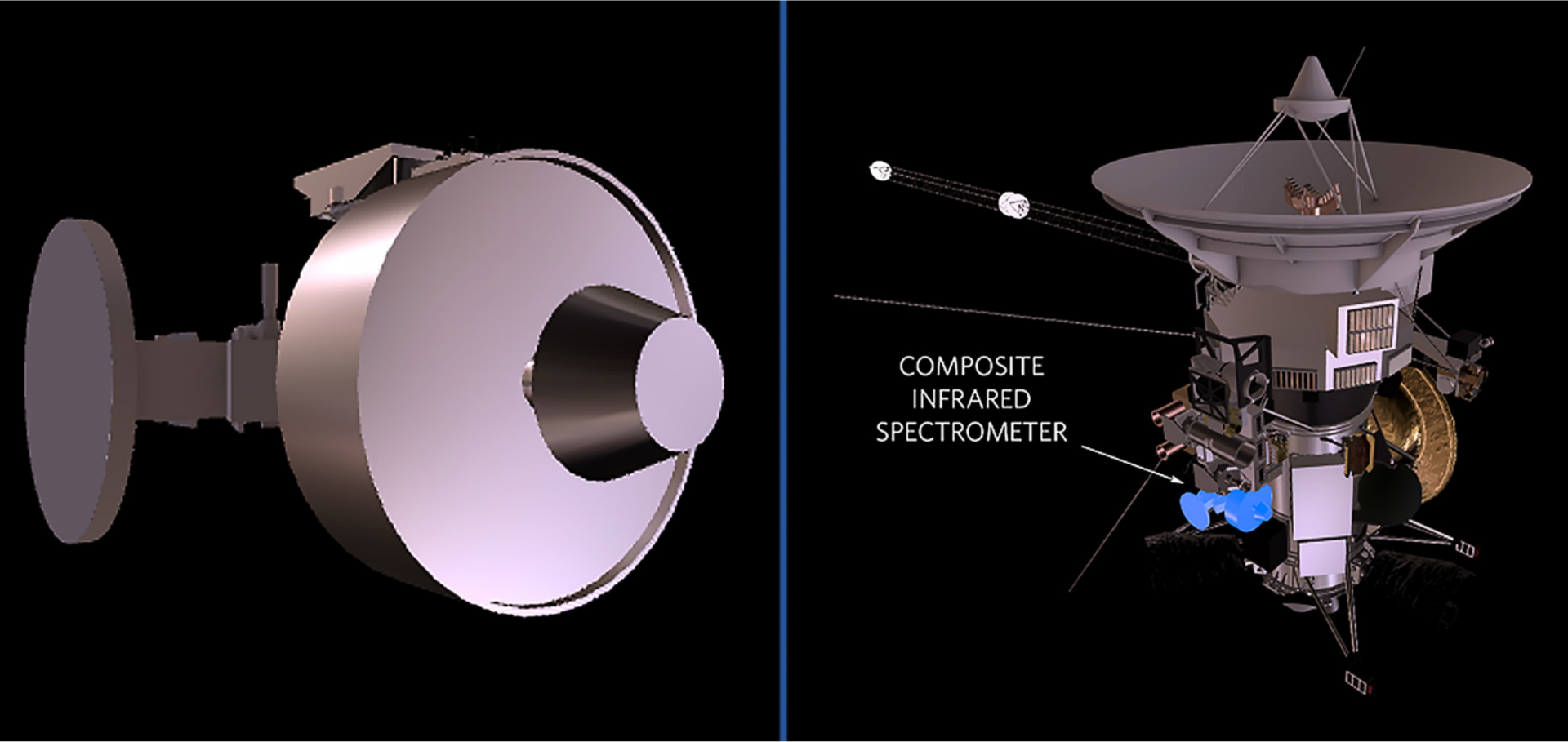
Infrared limb sounding of Titan with the Cassini Composite InfraRed Spectrometer: effects of the mid-IR detector spatial responses.

Appl Opt 48:10 (2009) 1912-1925

Authors:

Conor A Nixon, Nicholas A Teanby, Simon B Calcutt, Shahid Aslam, Donald E Jennings, Virgil G Kunde, F Michael Flasar, Patrick G Irwin, Fredric W Taylor, David A Glenar, Michael D Smith

Abstract:

The composite infrared spectrometer (CIRS) instrument on board the Cassini Saturn orbiter employs two 1x10 HgCdTe detector arrays for mid-infrared remote sensing of Titan's and Saturn's atmospheres. In this paper we show that the real detector spatial response functions, as measured in ground testing before launch, differ significantly from idealized "boxcar" responses. We further show that neglecting this true spatial response function when modeling CIRS spectra can have a significant effect on interpretation of the data, especially in limb-sounding mode, which is frequently used for Titan science. This result has implications not just for CIRS data analysis but for other similar instrumental applications.

European Venus Explorer (EVE): An in-situ mission to Venus

Experimental Astronomy 23:3 (2009) 741-760

Authors:

E Chassefière, O Korablev, T Imamura, KH Baines, CF Wilson, DV Titov, KL Aplin, T Balint, JE Blamont, CG Cochrane, C Ferencz, F Ferri, M Gerasimov, JJ Leitner, J Lopez-Moreno, B Marty, M Martynov, SV Pogrebenko, A Rodin, JA Whiteway, LV Zasova, J Michaud, R Bertrand, JM Charbonnier, D Carbonne, P Raizonville

Abstract:

The European Venus Explorer (EVE) mission was proposed to the European Space Agency in 2007, as an M-class mission under the Cosmic Vision Programme. Although it has not been chosen in the 2007 selection round for programmatic reasons, the EVE mission may serve as a useful reference point for future missions, so it is described here. It consists of one balloon platform floating at an altitude of 50-60 km, one descent probe provided by Russia, and an orbiter with a polar orbit which will relay data from the balloon and descent probe, and perform science observations. The balloon type preferred for scientific goals is one which oscillates in altitude through the cloud deck. To achieve this flight profile, the balloon envelope contains a phase change fluid, which results in a flight profile which oscillates in height. The nominal balloon lifetime is 7 days-enough for one full circumnavigation of the planet. The descent probe's fall through the atmosphere takes 60 min, followed by 30 min of operation on the surface. The key measurement objectives of EVE are: (1) in situ measurement from the balloon of noble gas abundances and stable isotope ratios, to study the record of the evolution of Venus; (2) in situ balloon-borne measurement of cloud particle and gas composition, and their spatial variation, to understand the complex cloud-level chemistry; (3) in situ measurements of environmental parameters and winds (from tracking of the balloon) for one rotation around the planet, to understand atmospheric dynamics and radiative balance in this crucial region. The portfolio of key measurements is complemented by the Russian descent probe, which enables the investigation of the deep atmosphere and surface. © Springer Science+Business Media B.V. 2008.

The DODO Survey II: A Gemini Direct Imaging Search for Substellar and Planetary Mass Companions around Nearby Equatorial and Northern Hemisphere White Dwarfs

(2009)

Authors:

E Hogan, MR Burleigh, FJ Clarke

Spatial variability of carbon monoxide in venus' mesosphere from venus express/visible and infrared thermal imaging spectrometer measurements

Journal of Geophysical Research Planets 114:5 (2009) E00-B01

Authors:

PGJ Irwin, R De Kok, A Negrão, CCC Tsang, CF Wilson, P Drossart, G Piccioni, D Grassi, FW Taylor

Abstract:

[1] Observations of Venus' mesosphere by the Visible and Infrared Thermal Imaging Spectrometer (VIRTIS)-M instrument of Venus Express have been used to investigate the spatial distribution of CO above Venus' nightside cloud tops by fitting the CO absorption in the (1-0) CO band around 4.7 μm. We find little spatial variation in the abundance of CO at midlatitudes, with a retrieved abundance of approximately 40 ± 10 ppm just above the cloud tops between 65 and 70 km altitude. Unfortunately, we find it very difficult to constrain the abundance of CO in the cold polar collar, centered at about 70°S, as the retrieved temperature structure in the CO line-forming region masks the absorption lines. However, there is a possibility that CO increases toward the poles, as we detect a significant signature of high levels of CO over Venus' south polar dipole feature in all the observations analyzed so far. To constrain the abundance of CO more closely will require the analysis of higher-resolution VIRTIS-H observations. In addition, limb observations would greatly help to resolve any possible temperature/cloud ambiguities and allow us to assess vertical variations in the abundance of CO. Copyright 2008 by the American Geophysical Union.

The DODO survey - II. A Gemini direct imaging search for substellar and planetary mass companions around nearby equatorial and Northern hemisphere white dwarfs

Monthly Notices of the Royal Astronomical Society 396:4 (2009) 2074-2086

Authors:

E Hogan, MR Burleigh, FJ Clarke

Abstract:

The aim of the Degenerate Objects around Degenerate Objects (DODO) survey is to search for very low-mass brown dwarfs and extrasolar planets in wide orbits around white dwarfs via direct imaging. The direct detection of such companions would allow the spectroscopic investigation of objects with temperatures much lower (<500 K) than the coolest brown dwarfs currently observed. These ultra-low-mass substellar objects would have spectral types >T8.5, and so could belong to the proposed Y dwarf spectral sequence. The detection of a planet around a white dwarf would prove that such objects can survive the final stages of stellar evolution and place constraints on the frequency of planetary systems around their progenitors (with masses between 1.5 and 8 M, i.e. early B to mid-F). This paper presents the results of a multi epoch J band common proper motion survey of 23 nearby equatorial and Northern hemisphere white dwarfs. We rule out the presence of any common proper motion companions, with limiting masses determined from the completeness limit of each observation, to 18 white dwarfs. For the remaining five targets, the motion of the white dwarf is not sufficiently separated from the non-moving background objects in each field. These targets require additional observations to conclusively rule out the presence of any common proper motion companions. From our completeness limits, we tentatively suggest that ≲5 per cent of white dwarfs have substellar companions with T eff ≳ 500 K between projected physical separations of 60-200 au. © 2009 The Authors. © 2009 RAS.