

Revised upper limits for abundances of NH3, HCN and HC3N in the Martian atmosphere
Icarus Elsevier 407 (2023) 115789
Abstract:
The Atmospheric Chemistry Suite (ACS) onboard the ExoMars Trace Gas Orbiter (TGO) spacecraft has been studying Mars' atmosphere since 2018. The sensitivity of the middle infrared channel (MIR) allows it to address many ardent topics and it is capable of improving and establishing upper limits for many trace species. In this work we present analysis of transmittance spectra in the 3332.5–3338.6 cm−1 range with 30,000 resolution (λ∕Δλ), covering absorptions lines of three nitrogen-bearing species: ammonia (NH3), hydrogen cyanide (HCN) and cyanoacetylene (HC3N). According to existing models, all of those are not expected to be present in a CO2-rich Martian atmosphere, but outgassing or unknown chemistry sources cannot be discounted. The upper limits of 14, 1.5 and 11 ppbv are obtained for NH3, HCN and HC3N from individual occultation measurements during the warm and dusty perihelion season of martian year 36. For the ammonia and hydrogen cyanide the upper limits are improved compared to previously published results. A search for cyanoacetylene on Mars is reported for the first time.Cassini composite infrared spectrometer: correcting an offset error and refining the pointing parameters for the midinfrared detectors: publisher's note.
Applied Optics Optica Publishing Group 62:23 (2023) 6298
High-resolution SOFIA/EXES Spectroscopy of Water Absorption Lines in the Massive Young Binary W3 IRS 5
The Astrophysical Journal American Astronomical Society 953:1 (2023) 103-103
Abstract:
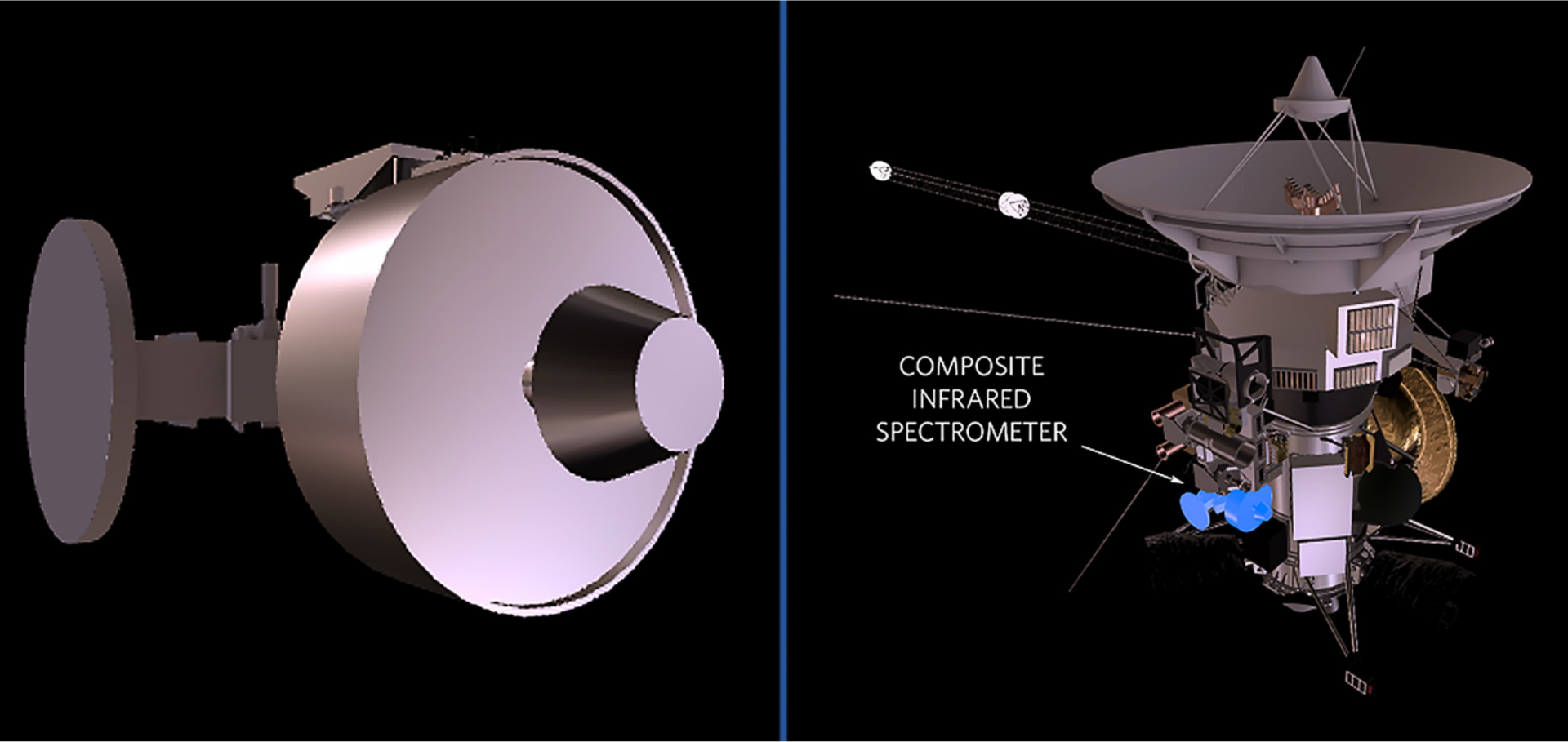
We present in this paper mid-infrared (5-8~$\mu$m) spectroscopy toward the massive young binary W3~IRS~5, using the EXES spectrometer in high-resolution mode ($R\sim$50,000) from the NASA Stratospheric Observatory for Infrared Astronomy (SOFIA). Many ($\sim$180) $\nu_2$=1--0 and ($\sim$90) $\nu_2$=2-1 absorption rovibrational transitions are identified. Two hot components over 500 K and one warm component of 190 K are identified through Gaussian fittings and rotation diagram analysis. Each component is linked to a CO component identified in the IRTF/iSHELL observations ($R$=88,100) through their kinematic and temperature characteristics. Revealed by the large scatter in the rotation diagram, opacity effects are important, and we adopt two curve-of-growth analyses, resulting in column densities of $\sim10^{19}$ cm$^{-2}$. In one analysis, the model assumes a foreground slab. The other assumes a circumstellar disk with an outward-decreasing temperature in the vertical direction. The disk model is favored because fewer geometry constraints are needed, although this model faces challenges as the internal heating source is unknown. We discuss the chemical abundances along the line of sight based on the CO-to-H$_2$O connection. In the hot gas, all oxygen not locked in CO resides in water. In the cold gas, we observe a substantial shortfall of oxygen and suggest that the potential carrier could be organics in solid ice.Comment: Accepted for publication in ApJ. 34 pages, 13 figures, and 14 tables. Comments are more than welcomeCassini composite infrared spectrometer: correcting an offset error and refining the pointing parameters for the midinfrared detectors.
Applied Optics Optica Publishing Group 62:22 (2023) 5882-5888
Abstract:
Based on preflight laboratory testing, an unexpectedly large positional offset between the two midinfrared (mid-IR) detector arrays in the Cassini composite infrared spectrometer (CIRS) instrument has been noted in the literature. A much smaller offset was measured in-flight. We investigate this discrepancy by estimating several spatial relationships among the detectors and comparing these results with three independent data sets. This enables us to infer the probable cause of this offset and to derive a new reduced value. We comment on the effect that this change could have on previously published results involving CIRS data. We also present a graphical display of the arrays projected on the sky as CIRS would see it.Solar Energetic Particle Events Detected in the Housekeeping Data of the European Space Agency's Spacecraft Flotilla in the Solar System
Space Weather American Geophysical Union (AGU) 21:8 (2023)