

A very simple derivation of the periastron advance to all post-Newtonian orders of perturbation in Schwarzschild geometry
American Journal of Physics American Association of Physics Teachers (AAPT) 93:11 (2025) 887-890
Abstract:
We present an extremely simple derivation of the general relativistic periastron advance for Schwarzschild geometry. The method lends itself to iteration, and so in principle may achieve an arbitrary level of accuracy with relative ease. Our technique involves no analysis of differential equations beyond that of a simple harmonic oscillator. The practical utility of the calculation is limited by its neglect of frame-dragging rotational effects.Non-Maxwellianity of ion velocity distributions in the Earth's magnetosheath.
Physical review. E 112:5 (2025) L053201
Abstract:
We analyze the deviations from local thermodynamic equilibrium (LTE) of the ion velocity distribution function (iVDF) in collisionless plasma turbulence. Using data from the magnetospheric multiscale (MMS) mission, we examine the non-Maxwellianity of 439 685 iVDFs in the Earth's magnetosheath. We find that the iVDFs' anisotropies and the high-order non-bi-Maxwellian features are widespread and can be significant. Our results show that the complexity of the iVDFs is strongly influenced by the ion plasma beta and turbulence intensity, with high-order non-LTE features emerging in the presence of large-amplitude magnetic field fluctuations. Furthermore, our analysis indicates that turbulence-driven magnetic curvature contributes to the isotropization of the iVDFs by scattering the ions, emphasizing the complex interaction between turbulence and the velocity distribution of charged particles in collisionless plasmas.Large-scale-structure observables in general relativity validated at second order
Journal of Cosmology and Astroparticle Physics IOP Publishing 2025:10 (2025) 105
Abstract:
We present a second-order calculation of relativistic large-scale-structure observables in cosmological perturbation theory, specifically the “cosmic rulers and clock”, which are the building-blocks of any other large-scale-structure observable, including galaxy number counts, on large scales. We calculate the scalar rulers (longitudinal perturbation and magnification) and the cosmic clock to second order, using a fully non-linear covariant definition of the observables. We validate our formulæ on three non-trivial space-time metrics: two of them are null tests on metrics which are obtained by applying a gauge transformation to the background space-time, while the third is the “separate universe” curved background, for which we can also compute the observables exactly. We then illustrate the results by evaluating the second-order observables in a simplified symmetric setup. On large scales, they are suppressed over the linear contributions by ∼10-4, while they become comparable to the linear contributions on mildly non-linear scales. The results of this paper form a significant (and the most complicated) part of the relativistic galaxy number density at second order.Finding Local Parallel Electric Fields in Magnetotail Reconnection Using a Two-Spacecraft Method
(2025)
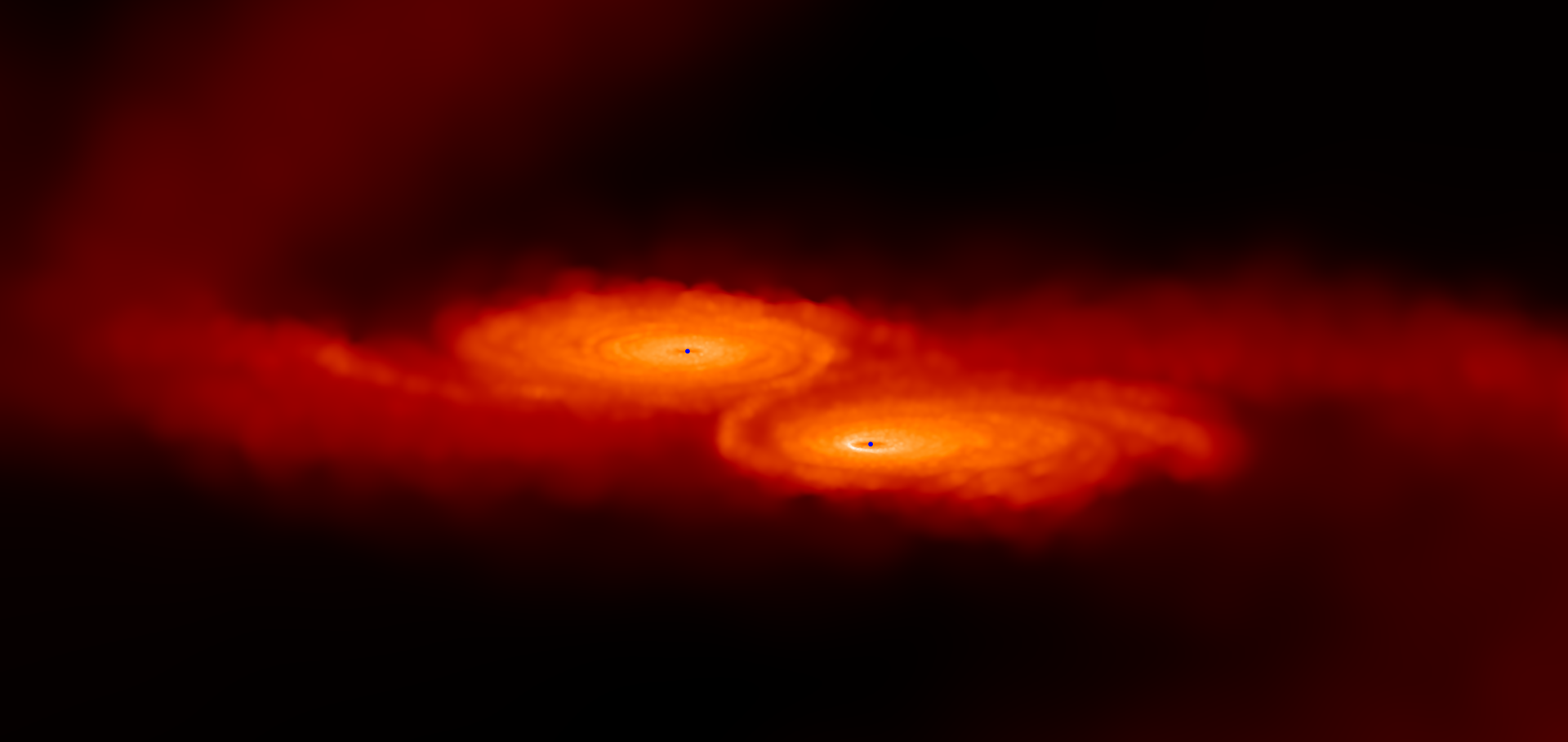
Hydrodynamic simulations of black hole evolution in AGN discs II: inclination damping for partially embedded satellites
Monthly Notices of the Royal Astronomical Society Oxford University Press 543:4 (2025) 3768-3782