Home
Department Of Physics text logo
  • Research
    • Our research
    • Our research groups
    • Our research in action
    • Research funding support
    • Summer internships for undergraduates
  • Study
    • Undergraduates
    • Postgraduates
  • Engage
    • For alumni
    • For business
    • For schools
    • For the public
  • Support
Menu
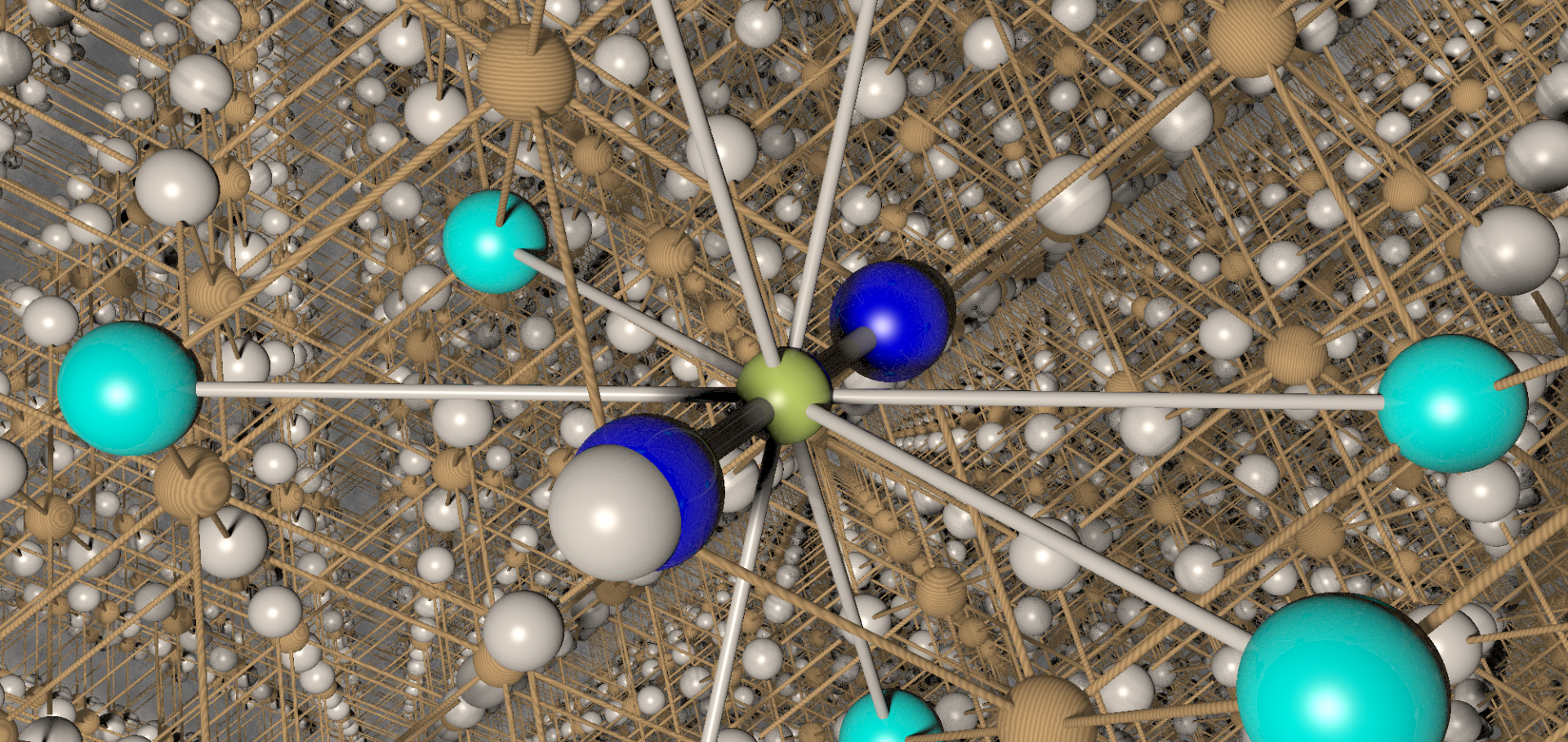
Crystal structure inside calcium fluoride with an implanted muon
Credit: SJB

Professor Stephen Blundell

Professor of Physics

Research theme

  • Quantum materials

Sub department

  • Condensed Matter Physics

Research groups

  • Muons and magnets
Stephen.Blundell@physics.ox.ac.uk
Telephone: 01865 (2)72347
Clarendon Laboratory, room 108
  • About
  • Books
  • Teaching
  • Research
  • Publications

Microscopic effects of Dy doping in the topological insulator Bi2Te3

Physical Review B American Physical Society 97:17 (2018) 174427

Authors:

LB Duffy, N-J Steinke, JA Krieger, AI Figueroa, K Kummer, T Lancaster, Giblin, FL Pratt, SJ Blundell, T Prokscha, A Suter, S Langridge, VN Strocov, Z Salman, G van der Laan, Thorsten Hesjedal

Abstract:

Magnetic doping with transition metal ions is the most widely used approach to break time-reversal symmetry in a topological insulator (TI)—a prerequisite for unlocking the TI’s exotic potential. Recently, we reported the doping of Bi2Te3 thin films with rare-earth ions, which, owing to their large magnetic moments, promise commensurately large magnetic gap openings in the topological surface states. However, only when doping with Dy has a sizable gap been observed in angle-resolved photoemission spectroscopy, which persists up to room temperature. Although disorder alone could be ruled out as a cause of the topological phase transition, a fundamental understanding of the magnetic and electronic properties of Dy-doped Bi2Te3 remained elusive. Here, we present an x-ray magnetic circular dichroism, polarized neutron reflectometry, muon-spin rotation, and resonant photoemission study of the microscopic magnetic and electronic properties. We find that the films are not simply paramagnetic but that instead the observed behavior can be well explained by the assumption of slowly fluctuating, inhomogeneous, magnetic patches with increasing volume fraction as the temperature decreases. At liquid helium temperatures, a large effective magnetization can be easily introduced by the application of moderate magnetic fields, implying that this material is very suitable for proximity coupling to an underlying ferromagnetic insulator or in a heterostructure with transition-metal-doped layers. However, the introduction of some charge carriers by the Dy dopants cannot be excluded at least in these highly doped samples. Nevertheless, we find that the magnetic order is not mediated via the conduction channel in these samples and therefore magnetic order and carrier concentration are expected to be independently controllable. This is not generally the case for transition-metal-doped topological insulators, and Dy doping should thus allow for improved TI quantum devices.
More details from the publisher
Details from ORA
More details
Details from ArXiV

LaSr3 NiRuO4 H4 : A 4d Transition-Metal Oxide-Hydride Containing Metal Hydride Sheets

Angewandte Chemie Wiley (2018)

Authors:

L Jin, M Lane, D Zeng, FKK Kirschner, F Lang, P Manuel, SJ Blundell, JE McGrady, MICHAEL Hayward
More details from the publisher

Proposal for the detection of magnetic monopoles in spin ice via nanoscale magnetometry

Physical Review B American Physical Society 97:14 (2018) 140402(R)

Authors:

Franziska KK Kirschner, F Flicker, A Yacoby, NY Yao, Stephen Blundell

Abstract:

We present a proposal for applying nanoscale magnetometry to the search for magnetic monopoles in the spin ice materials holmium and dysprosium titanate. Employing Monte Carlo simulations of the dipolar spin ice model, we find that when cooled to below 1.5K these materials exhibit a sufficiently low monopole density to enable the direct observation of magnetic fields from individual monopoles. At these temperatures we demonstrate that noise spectroscopy can capture the intrinsic fluctuations associated with monopole dynamics, allowing one to isolate the qualitative e↵ects associated with both the Coulomb interaction between monopoles and the topological constraints implied by Dirac strings. We describe in detail three di↵erent nanoscale magnetometry platforms (muon spin rotation, nitrogen vacancy defects, and nanoSQUID arrays) that can be used to detect monopoles in these experiments, and analyze the advantages of each.
More details from the publisher
Details from ORA
More details
Details from ArXiV

Observation of a crossover from nodal to gapped superconductivity in Lu$_x$Zr$_{1-x}$B$_{12}$

(2018)

Authors:

Franziska KK Kirschner, Nikolay E Sluchanko, Vladimir B Filipov, Francis L Pratt, Chris Baines, Natalya Yu Shitsevalova, Stephen J Blundell
More details from the publisher

Implications of bond disorder in a S=1 kagome lattice.

Scientific reports 8:1 (2018) 4745-4745

Authors:

JL Manson, J Brambleby, PA Goddard, PM Spurgeon, JA Villa, J Liu, S Ghannadzadeh, F Foronda, J Singleton, T Lancaster, SJ Clark, IO Thomas, F Xiao, RC Williams, FL Pratt, SJ Blundell, CV Topping, C Baines, C Campana, B Noll

Abstract:

Strong hydrogen bonds such as F···H···F offer new strategies to fabricate molecular architectures exhibiting novel structures and properties. Along these lines and, to potentially realize hydrogen-bond mediated superexchange interactions in a frustrated material, we synthesized [H2F]2[Ni3F6(Fpy)12][SbF6]2 (Fpy = 3-fluoropyridine). It was found that positionally-disordered H2F+ ions link neutral NiF2(Fpy)4 moieties into a kagome lattice with perfect 3-fold rotational symmetry. Detailed magnetic investigations combined with density-functional theory (DFT) revealed weak antiferromagnetic interactions (J ~ 0.4 K) and a large positive-D of 8.3 K with ms = 0 lying below ms = ±1. The observed weak magnetic coupling is attributed to bond-disorder of the H2F+ ions which leads to disrupted Ni-F···H-F-H···F-Ni exchange pathways. Despite this result, we argue that networks such as this may be a way forward in designing tunable materials with varying degrees of frustration.
More details from the publisher
Details from ORA
More details
More details

Pagination

  • First page First
  • Previous page Prev
  • …
  • Page 41
  • Page 42
  • Page 43
  • Page 44
  • Current page 45
  • Page 46
  • Page 47
  • Page 48
  • Page 49
  • …
  • Next page Next
  • Last page Last

Footer Menu

  • Contact us
  • Giving to the Dept of Physics
  • Work with us
  • Media

User account menu

  • Log in

Follow us

FIND US

Clarendon Laboratory,

Parks Road,

Oxford,

OX1 3PU

CONTACT US

Tel: +44(0)1865272200

University of Oxfrod logo Department Of Physics text logo
IOP Juno Champion logo Athena Swan Silver Award logo

© University of Oxford - Department of Physics

Cookies | Privacy policy | Accessibility statement

Built by: Versantus

  • Home
  • Research
  • Study
  • Engage
  • Our people
  • News & Comment
  • Events
  • Our facilities & services
  • About us
  • Giving to Physics
  • Current students
  • Staff intranet