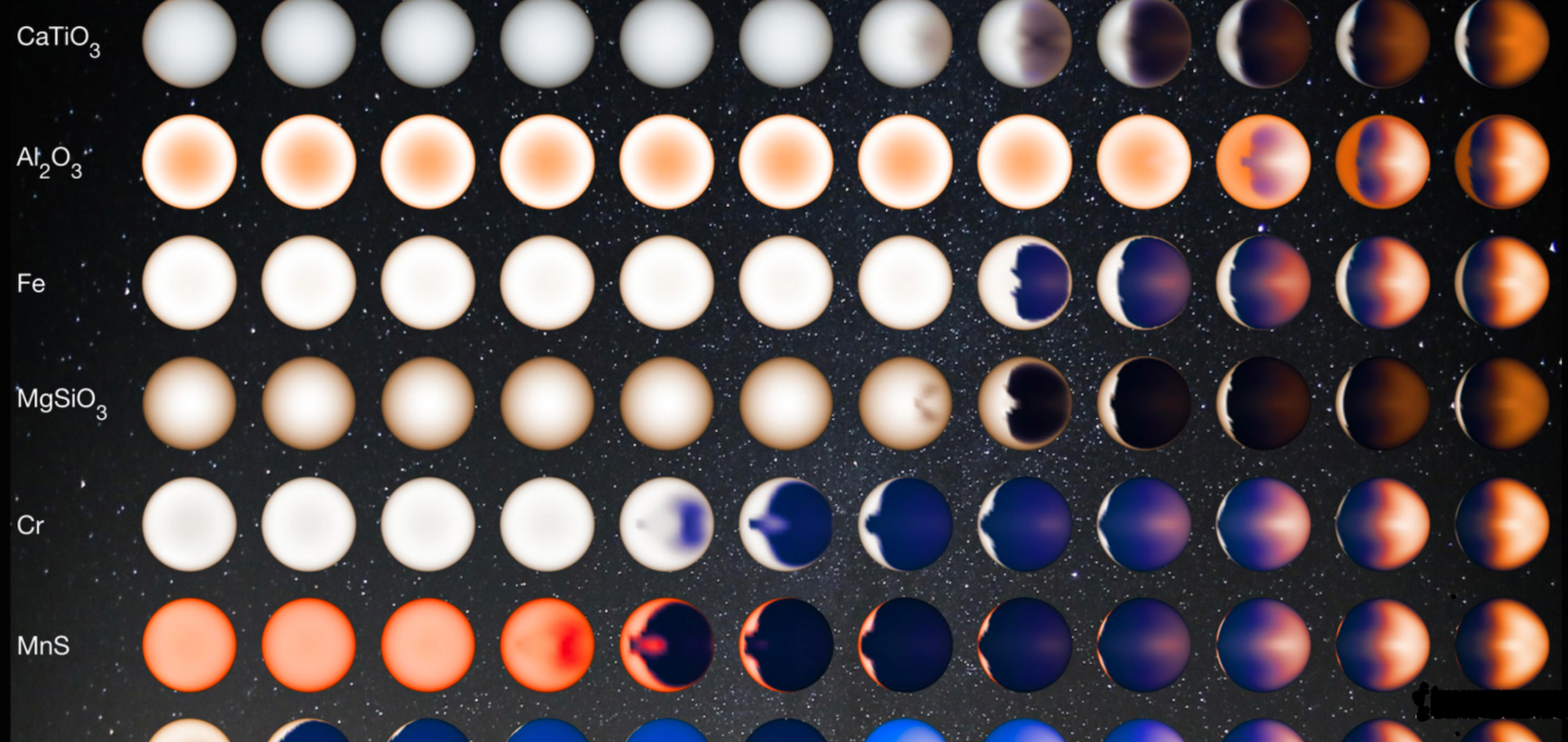
Analogous response of temperate terrestrial exoplanets and Earth's climate dynamics to greenhouse gas supplement

(2023)

Authors:

Assaf Hochman, Thaddeus D Komacek, Paolo De Luca

Awesome SOSS: atmospheric characterization of WASP-96 b using the JWST early release observations

Monthly Notices of the Royal Astronomical Society Oxford University Press (OUP) 524:1 (2023) 817-834

Authors:

Jake Taylor, Michael Radica, Luis Welbanks, Ryan J MacDonald, Jasmina Blecic, Maria Zamyatina, Alexander Roth, Jacob L Bean, Vivien Parmentier, Louis-Philippe Coulombe, Adina D Feinstein, Néstor Espinoza, Björn Benneke, David Lafrenière, René Doyon, Eva-Maria Ahrer

Awesome SOSS: transmission spectroscopy of WASP-96b with NIRISS/SOSS

Monthly Notices of the Royal Astronomical Society Oxford University Press (OUP) 524:1 (2023) 835-856

Authors:

Michael Radica, Luis Welbanks, Néstor Espinoza, Jake Taylor, Louis-Philippe Coulombe, Adina D Feinstein, Jayesh Goyal, Nicholas Scarsdale, Loïc Albert, Priyanka Baghel, Jacob L Bean, Jasmina Blecic, David Lafrenière, Ryan J MacDonald, Maria Zamyatina, Romain Allart1, Étienne Artigau, Natasha E Batalha, Neil James Cook, Nicolas B Cowan, Lisa Dang, René Doyon, Marylou Fournier-Tondreau, Doug Johnstone, Michael R Line, Sarah E Moran, Sagnick Mukherjee, Stefan Pelletier, Pierre-Alexis Roy, Geert Jan Talens, Joseph Filippazzo, Klaus Pontoppidan, Kevin Volk

The extremely high albedo of LTT 9779 b revealed by CHEOPS

Astronomy & Astrophysics EDP Sciences 675 (2023) a81

Authors:

S Hoyer, JS Jenkins, V Parmentier, M Deleuil, G Scandariato, TG Wilson, MR Díaz, IJM Crossfield, D Dragomir, T Kataria, M Lendl, R Ramirez, PA Peña Rojas, JI Vinés

Spitzer IRS Observations of Titan as a Precursor to JWST MIRI Observations

PLANETARY SCIENCE JOURNAL American Astronomical Society 4:6 (2023) ARTN 114

Authors:

Brandon Park Coy, Conor A Nixon, Naomi Rowe-Gurney, Richard Achterberg, Nicholas A Lombardo, Leigh N Fletcher, Patrick Irwin

Abstract:

<jats:title>Abstract</jats:title> <jats:p>In this work, we present for the first time infrared spectra of Titan from the Spitzer Space Telescope (2004–2009). The data are from both the short wavelength–low resolution (SL; 5.13–14.29 <jats:italic>μ</jats:italic>m, <jats:italic>R</jats:italic> ∼ 60–127) and short wavelength–high resolution (SH; 9.89–19.51 <jats:italic>μ</jats:italic>m, <jats:italic>R</jats:italic> ∼ 600) channels showing the emissions of CH<jats:sub>4</jats:sub>, C<jats:sub>2</jats:sub>H<jats:sub>2</jats:sub>, C<jats:sub>2</jats:sub>H<jats:sub>4</jats:sub>, C<jats:sub>2</jats:sub>H<jats:sub>6</jats:sub>, C<jats:sub>3</jats:sub>H<jats:sub>4</jats:sub>, C<jats:sub>3</jats:sub>H<jats:sub>6</jats:sub>, C<jats:sub>3</jats:sub>H<jats:sub>8</jats:sub>, C<jats:sub>4</jats:sub>H<jats:sub>2</jats:sub>, HCN, HC<jats:sub>3</jats:sub>N, and CO<jats:sub>2</jats:sub>. We compare the results obtained for Titan from Spitzer to those of the Cassini Composite Infrared Spectrometer (CIRS) for the same time period, focusing on the 16.35–19.35 <jats:italic>μ</jats:italic>m wavelength range observed by the SH channel but impacted by higher noise levels in the CIRS observations. We use the SH data to provide estimated haze extinction cross sections for the 16.67–17.54 <jats:italic>μ</jats:italic>m range that are missing in previous studies. We conclude by identifying spectral features in the 16.35–19.35 <jats:italic>μ</jats:italic>m wavelength range that could be analyzed further through upcoming James Webb Space Telescope Cycle 1 observations with the Mid-Infrared Instrument (5.0–28.3 <jats:italic>μ</jats:italic>m, <jats:italic>R</jats:italic> ∼ 1500–3500). We also highlight gaps in the current spectroscopic knowledge of molecular bands, including candidate trace species such as C<jats:sub>60</jats:sub> and detected trace species such as C<jats:sub>3</jats:sub>H<jats:sub>6</jats:sub>, that could be addressed by theoretical and laboratory study.</jats:p>