

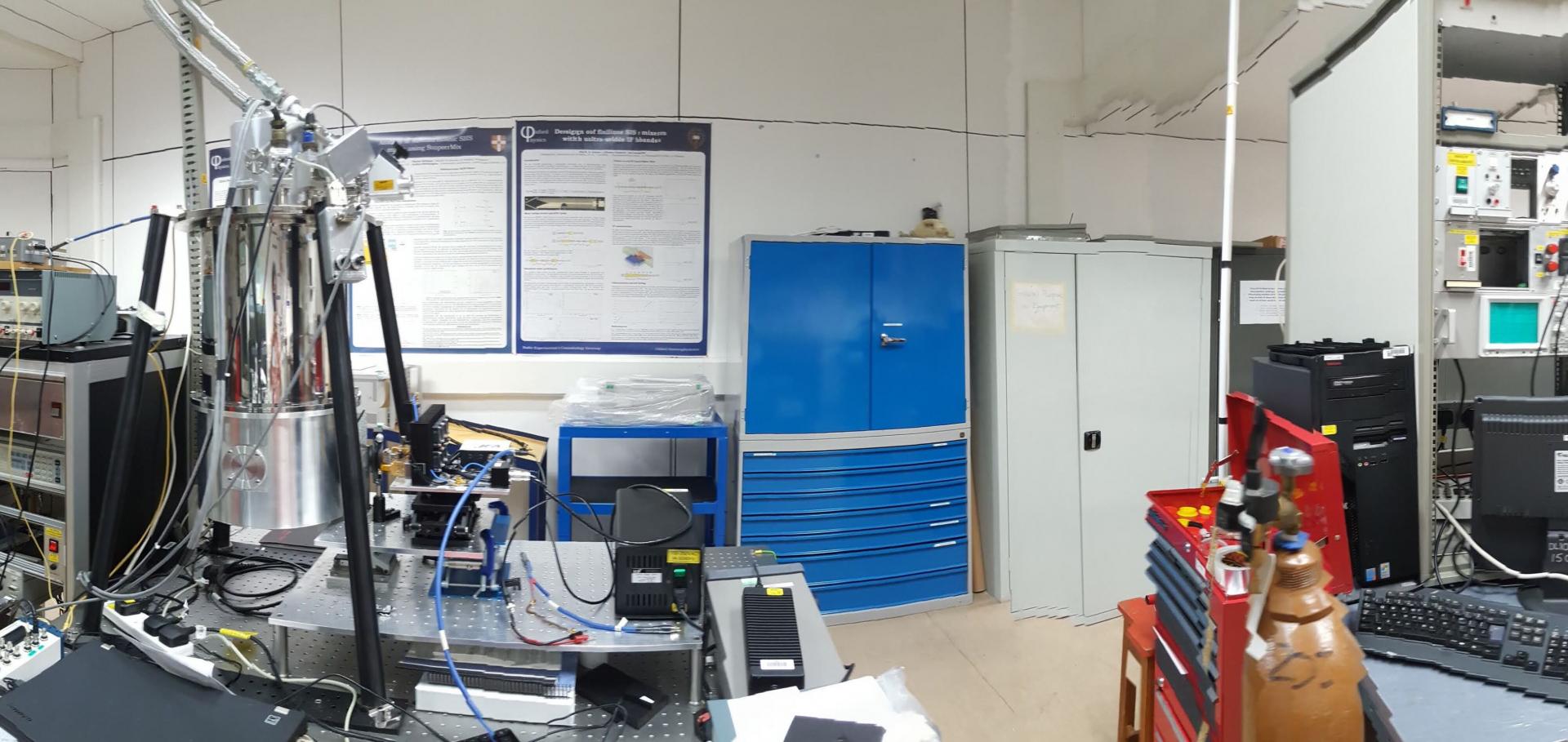
The influence of LO power heating of the tunnel junction on the performance of THz SIS mixers
IEEE Transactions on Terahertz Science & Technology IEEE 10:6 (2020) 721-730
Abstract:
We describe the performance of a superconductor- insulator-superconductor (SIS) mixer operating in the frequency range of 780-950 GHz. Unlike most SIS mixers, the tunnel junction employs two different superconductors, a niobium nitride top and a niobium bottom electrode sandwiching an aluminum nitride barrier layer, fabricated on a niobium titanium nitride ground plane. The mixer was tested in a pulse tube cryostat, with all the optical components, in the signal path, mounted inside the vacuum environment to avoid attenuation of the RF signal as it propagates from the hot/cold loads to the mixer. With this setup, we have measured an RF-corrected noise temperature of ~220 K. In this article, we focus on investigating the influence of local oscillator (LO) power heating on the performance of the terahertz mixer. The increase in the junction's physical temperature can be observed experimentally by noting the suppression of the gap voltage in the pumped current-voltage (I-V ) curve as the LO pumping level is increased. Similar observation has already been reported, and attempts were made to estimate the effective temperature of the device using equations of heat transfer between the mixer chip layers. Here, we present an experimental method of quantifying this effect by recovering the effective temperature of the junction through comparing the pumped I-V curves at different pumping levels and fixed bath temperature, with the unpumped I-V curves obtained at varying bath temperatures. We also estimate, for the first time, the effect of heating on the noise temperature as a function of bath temperature and frequency. We show that for typical experimental parameters, the LO heating can increase the double-sideband receiver noise temperature by as much as 20%, and that in the frequency range of the measurements, the effective temperature of the junction at fixed LO power increases linearly with frequency at a rate of 0.5 K/100 GHz.A Closed-Cycle Miniature Dilution Refrigerator for a Fast-Cooldown 100 mK Detector Wafer Test Cryostat
JOURNAL OF LOW TEMPERATURE PHYSICS 199:3-4 (2020) 771-779
Abstract:
© 2020, The Author(s). The forthcoming generation of cosmic microwave background polarization observatories is developing large format detector arrays which will operate at 100 mK. Given the volume of detector wafers that will be required, fast-cooldown 100 mK test cryostats are increasingly needed. A miniature dilution refrigerator (MDR) has been developed for this purpose and is reported. The MDR is precooled by a double-stage 3He –4He Chase Research Cryogenics sorption refrigerator. The test cryostat based on this MDR will enable fast cooldown to 100 mK to support rapid feedback testing of detector wafers fabricated for the Simons Observatory. The MDR has been designed to provide a 100 mK stage to be retrocompatible with existing CRC10 sorption coolers, reducing the base temperature from 250 mK for the new generation of detectors. Other 250 mK cryostats can be retrofitted in the same way. This configuration will meet the cryogenic requirements for single-wafer testing, providing 5–10 μ W of cooling power at 100 mk for over 8 h. The system operates in a closed cycle, thereby avoiding external gas connections and cold o-rings. No moving parts are required, with the system operated entirely by heaters.A nonlinear transmission line model for simulating distributed SIS frequency multipliers
IEEE Transactions on Terahertz Science and Technology IEEE 10:3 (2020) 246-255
Abstract:
Superconductor/Insulator/Superconductor (SIS) junctions have extremely nonlinear electrical properties, which makes them ideal for a variety of applications, including heterodyne mixing and frequency multiplication. With SIS mixers, the SIS junctions normally have circular cross-sections, but they can also be fabricated in the form of microstrip transmission lines, known as distributed SIS junctions (DSJs). By using a DSJ as an open-circuit stub, it is possible to create a large SIS junction with a low effective input reactance. This is beneficial for SIS frequency multipliers because their output power is proportional to the area of the junction. It is challenging, however, to simulate the behavior of DSJs because (a) they have to be modeled as transmission lines and (b) the model has to take into account the quasiparticle tunneling current, which is a nonlinear function of the AC voltage. In this paper, we present a new nonlinear transmission line model to accurately describe the behavior of DSJs and to simulate the performance of distributed SIS frequency multipliers (DSMs). This model is compared to experimental data from a recent DSM device and good agreement is found between the DC tunneling currents and the output powers at the second harmonic. Based on this success, an improved DSM design is proposed that has a higher output power and a higher conversion efficiency than previous designs.A new concept for multi-beam phased array
2019 12th UK-Europe-China Workshop on Millimeter Waves and Terahertz Technologies (UCMMT) Institute of Electrical and Electronics Engineers (2020) 1-4
Abstract:
We present a new concept for constructing a compact linear 1 × n multi-beam phased array transceiver system that can be scaled to operate from radio to millimetre wavelength. In this design, all the components required to form the phased array are fabricated on a single printed circuit board, where both the input antenna array and the readout arrays are integrated on the same platform. This is made possible by using a novel planar power splitter/combiners technology, which allows the input signal from each antenna to be split simultaneously through these components arranged in horizontal, and re-combined vertically to form individual beam. This compact single-platform phased array system could be important for many applications that required compact and light-weight design such as 4G/5G wireless telecommunications, inter-satellite (CubeSat) or satellite-base station communication links, space-based remote sensing, vehicle transceiver system and astronomical receivers.Simulating the behavior of a 230-GHz SIS mixer using multitone spectral domain analysis
IEEE Transactions on Terahertz Science and Technology Institute of Electrical and Electronics Engineers 9:6 (2019) 540-548