Home
Department Of Physics text logo
  • Research
    • Our research
    • Our research groups
    • Our research in action
    • Research funding support
    • Summer internships for undergraduates
  • Study
    • Undergraduates
    • Postgraduates
  • Engage
    • For young people
    • For teachers
    • For the public
    • For alumni
    • For business
  • Support
Menu
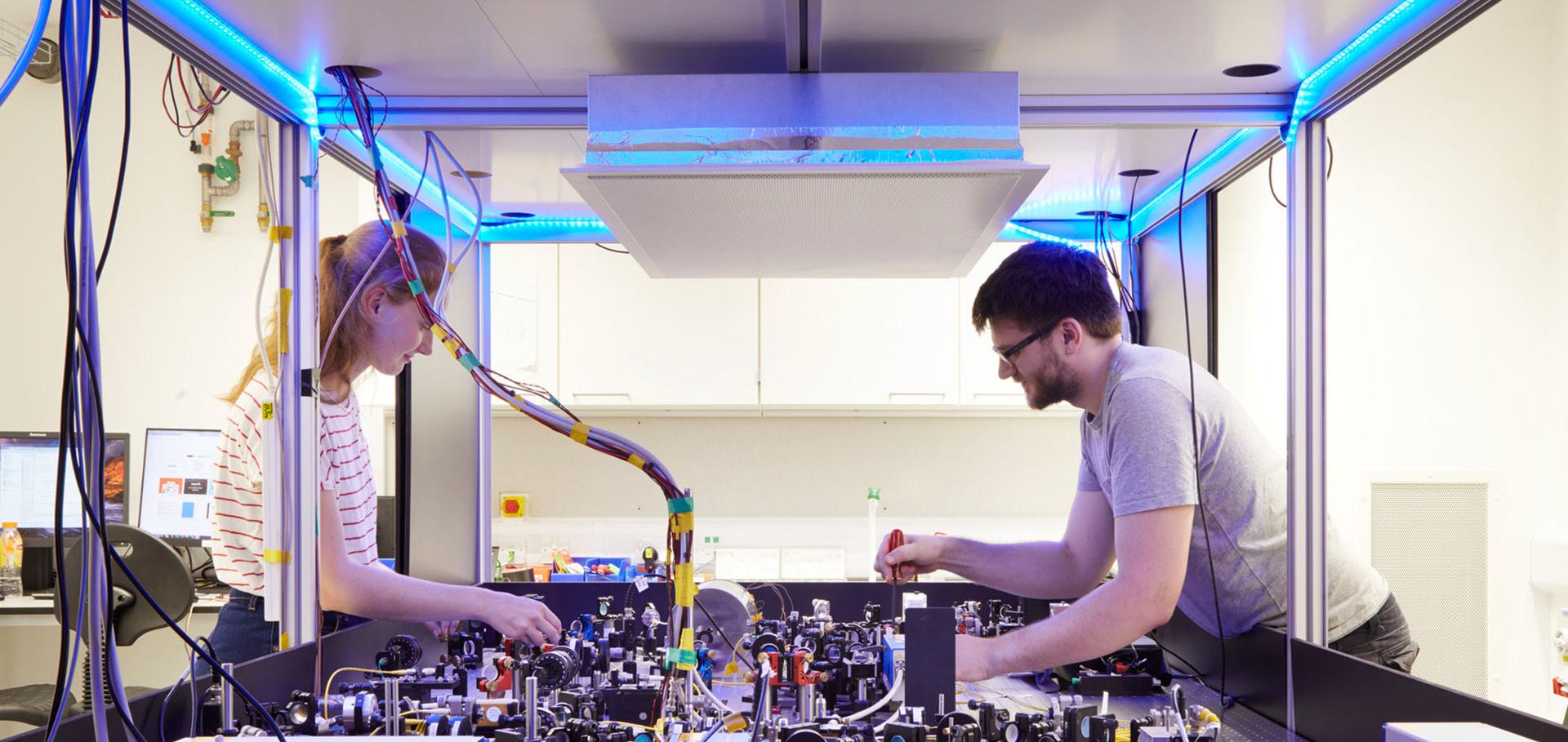
Atomic and Laser Physics
Credit: Jack Hobhouse

Jiaxuan Zhang

Graduate Student

Sub department

  • Atomic and Laser Physics

Research groups

  • Frontiers of quantum physics
jiaxuan.zhang@physics.ox.ac.uk
Clarendon Laboratory, room 241.7
  • About
  • Publications

Summing to uncertainty: On the necessity of additivity in deriving the Born rule

Physical Review A American Physical Society (APS) 114:4 (2026) 042208

Abstract:

The emergence of intrinsic probability is one of the central problems in quantum mechanics, and investigating the origin of the Born rule provides the most direct approach to this problem. Many derivations of the Born rule have been proposed based on different postulates and frameworks. Identifying which postulates are genuinely necessary is therefore essential for understanding the origin of quantum probability. Here we prove that two postulates commonly employed in derivations of the Born rule, additivity and noncontextuality, are not equivalent and thus cannot be unified into a single postulate. We further show that the additivity postulate is indispensable in five major derivations of the Born rule: Gleason's theorem, Busch's extension of Gleason's theorem, the Deutsch-Wallace theorem, Zurek's envariance derivation, and the Finkelstein-Hartle theorem. We demonstrate that these derivations rely either on explicit additivity assumptions or on implicit forms of additivity embedded in the original arguments and that removing or weakening additivity gives rise to significant problems in the derivations. Our results support the view that additional postulates with intrinsic probabilistic properties should be introduced to derive the Born rule.
More details from the publisher

Summing to Uncertainty: On the Necessity of Additivity in Deriving the Born Rule

ArXiv 2603.06211 (2026)
Details from ArXiV

Sleeping Beauty in One or Many Worlds: A Defense of the Halfer Position

ArXiv 2603.03553 (2026)
Details from ArXiV

Cost of Simulating Entanglement in Steering Scenarios

Quantum Verein zur Forderung des Open Access Publizierens in den Quantenwissenschaften 9 (2025) 1902

Authors:

Yujie Zhang, Jiaxuan Zhang, Eric Chitambar

Abstract:

Quantum entanglement is a fundamental feature of quantum mechanics, yet certain entangled states that are unsteerable can be classically simulated in steering scenarios, making them unable to exhibit quantum steering. Despite their significance, a systematic comparison of such entangled states has not been explored. In this work, we quantify the resource content of unsteerable quantum states in terms of the amount of shared randomness required to simulate the assemblages they generate in the steering scenario. We rigorously demonstrate that the simulation cost is unbounded even for certain unsteerable two-qubit states. Moreover, the simulation cost of entangled two-qubit states is always strictly larger than that for any separable state. A significant portion of our results rests on the relationship between the simulation cost of two-qubit Werner states and that of noisy spin measurements. Using noisy spin measurements as our central example, we also investigate the minimum number of outcomes a parent measurement requires to simulate a given set of compatible measurements. Although certain continuous measurement families admit a finite-outcome parent measurement, we identify scenarios where the simulation cost is unbounded. Our results establish previously unknown lower bounds and upper bounds on the shared randomness simulation cost, supported by connections between the simulation cost of noisy spin measurements and various geometric inequalities, including ones from the zonotope approximation problem in Banach space theory.
More details from the publisher

Footer Menu

  • Contact us
  • Giving to the Dept of Physics
  • Work with us
  • Media

User account menu

  • Log in

Follow us

FIND US

Clarendon Laboratory,

Parks Road,

Oxford,

OX1 3PU

CONTACT US

Tel: +44(0)1865272200

University of Oxfrod logo Department Of Physics text logo
IOP Juno Champion logo Athena Swan Silver Award logo

© University of Oxford - Department of Physics

Cookies | Privacy policy | Accessibility statement

Built by: Versantus

  • Home
  • Research
  • Study
  • Engage
  • Our people
  • News & Comment
  • Events
  • Our facilities & services
  • About us
  • Giving to Physics
  • Current students
  • Staff intranet