

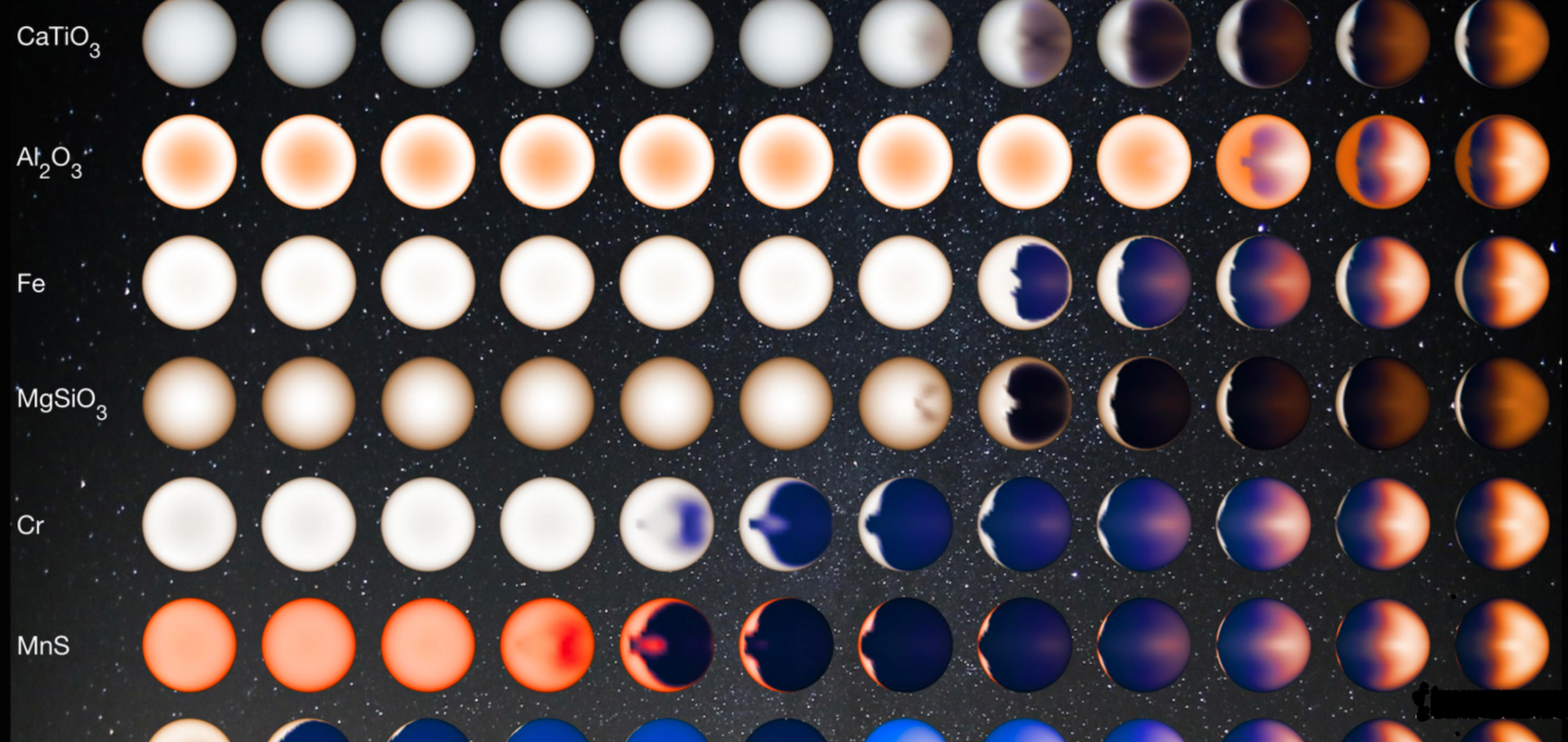
The Roasting Marshmallows Program with IGRINS on Gemini South. II. WASP-121 b has Superstellar C/O and Refractory-to-volatile Ratios
The Astronomical Journal American Astronomical Society 168:6 (2024) 293
Geodynamics of Super‐Earth GJ 486b
Journal of Geophysical Research: Planets American Geophysical Union 129:10 (2024) e2024JE008491
Abstract:
Many super‐Earths are on very short orbits around their host star and, therefore, more likely to be tidally locked. Because this locking can lead to a strong contrast between the dayside and nightside surface temperatures, these super‐Earths could exhibit mantle convection patterns and tectonics that could differ significantly from those observed in the present‐day solar system. The presence of an atmosphere, however, would allow transport of heat from the dayside toward the nightside and thereby reduce the surface temperature contrast between the two hemispheres. On rocky planets, atmospheric and geodynamic regimes are closely linked, which directly connects the question of atmospheric thickness to the potential interior dynamics of the planet. Here, we study the interior dynamics of super‐Earth GJ 486b ( R = 1.34 $R=1.34$ R ⊕ ${R}_{\oplus }$ , M = 3.0 $M=3.0$ M ⊕ ${M}_{\oplus }$ , T eq ≈ 700 ${\mathrm{T}}_{\text{eq}}\approx 700$ K), which is one of the most suitable M‐dwarf super‐Earth candidates for retaining an atmosphere produced by degassing from the mantle and magma ocean. We investigate how the geodynamic regime of GJ 486b is influenced by different surface temperature contrasts by varying possible atmospheric circulation regimes. We also investigate how the strength of the lithosphere affects the convection pattern. We find that hemispheric tectonics, the surface expression of degree‐1 convection with downwellings forming on one hemisphere and upwelling material rising on the opposite hemisphere, is a consequence of the strong lithosphere rather than surface temperature contrast. Anchored hemispheric tectonics, where downwellings und upwellings have a preferred (day/night) hemisphere, is favored for strong temperature contrasts between the dayside and nightside and higher surface temperatures.BOWIE-ALIGN: how formation and migration histories of giant planets impact atmospheric compositions
Monthly Notices of the Royal Astronomical Society Oxford University Press (OUP) 535:1 (2024) 171-186
BOWIE-ALIGN: A JWST comparative survey of aligned versus misaligned hot Jupiters to test the dependence of atmospheric composition on migration history
RAS Techniques and Instruments Oxford University Press 3:1 (2024) 691-704
Abstract:
A primary objective of exoplanet atmosphere characterization is to learn about planet formation and evolution, however, this is challenged by degeneracies. To determine whether differences in atmospheric composition can be reliably traced to differences in evolution, we are undertaking a transmission spectroscopy survey with JWST to compare the compositions of a sample of hot Jupiters that have different orbital alignments around F stars above the Kraft break. Under the assumption that aligned planets migrate through the inner disc, while misaligned planets migrate after disc dispersal, the act of migrating through the inner disc should cause a measurable difference in the C/O between aligned and misaligned planets. We expect the amplitude and sign of this difference to depend on the amount of planetesimal accretion and whether silicates accreted from the inner disc release their oxygen. Here, we identify all known exoplanets that are suitable for testing this hypothesis, describe our JWST survey, and use noise simulations and atmospheric retrievals to estimate our survey’s sensitivity. With the selected sample of four aligned and four misaligned hot Jupiters, we will be sensitive to the predicted differences in C/O between aligned and misaligned hot Jupiters for a wide range of model scenarios.A Detailed Study of Jupiter’s Great Red Spot over a 90-day Oscillation Cycle
The Planetary Science Journal IOP Publishing 5:10 (2024) 223