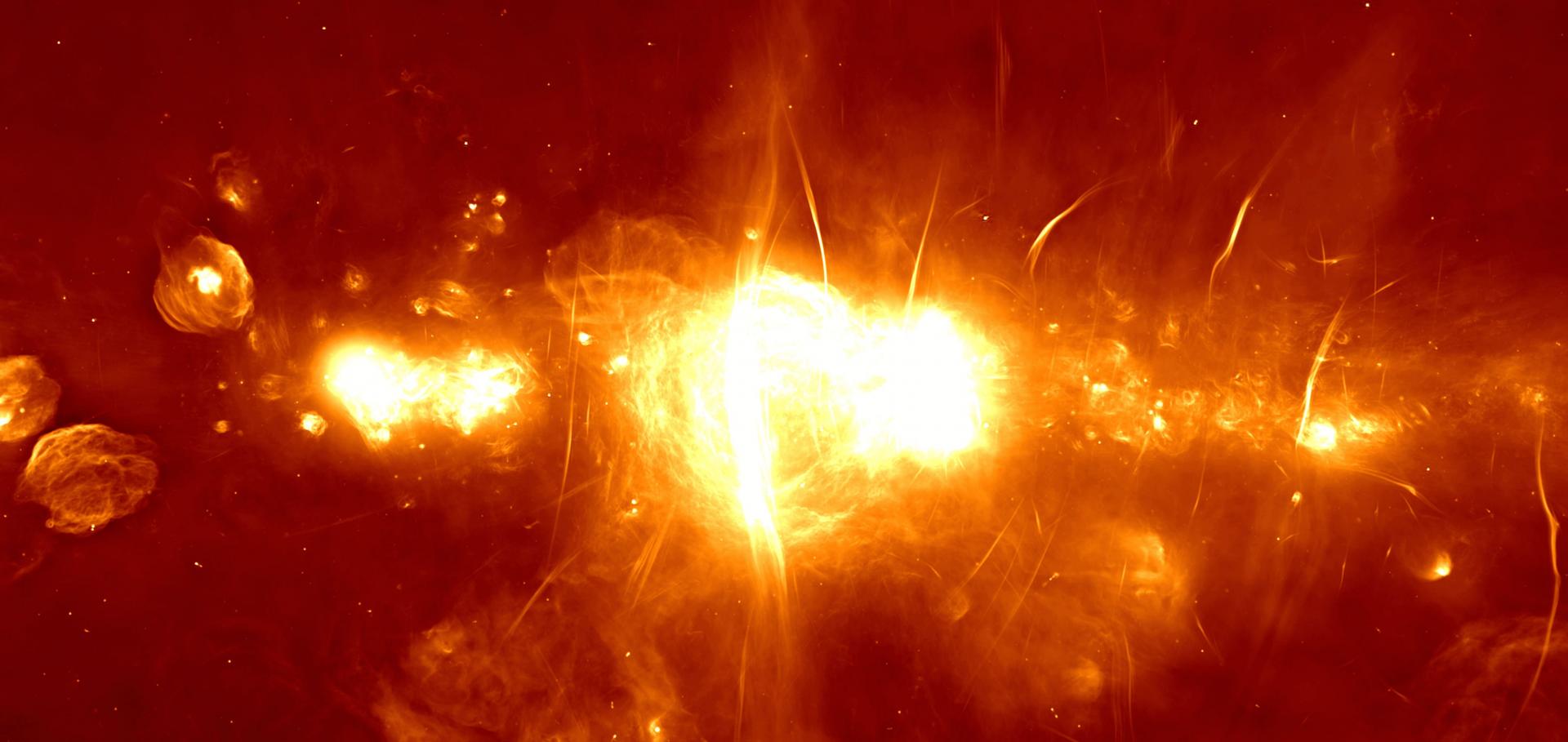
The jet paths of radio active galactic nuclei and their cluster weather

Astronomy & Astrophysics EDP Sciences 695 (2025) a178

Authors:

E Vardoulaki, V Backöfer, A Finoguenov, F Vazza, J Comparat, G Gozaliasl, IH Whittam, CL Hale, JR Weaver, AM Koekemoer, JD Collier, B Frank, I Heywood, S Sekhar, AR Taylor, S Pinjarkar, MJ Hardcastle, T Shimwell, M Hoeft, SV White, F An, F Tabatabaei, Z Randriamanakoto, MD Filipovic

ZTF SN Ia DR2: High-velocity components in the Si IIλ6355

Astronomy & Astrophysics EDP Sciences 695 (2025) a264

Authors:

L Harvey, K Maguire, U Burgaz, G Dimitriadis, J Sollerman, A Goobar, J Johansson, J Nordin, M Rigault, M Smith, M Aubert, R Cartier, P Chen, M Deckers, S Dhawan, L Galbany, M Ginolin, WD Kenworthy, Y-L Kim, C Liu, AA Miller, P Rosnet, R Senzel, JH Terwel, L Tomasella, M Kasliwal, RR Laher, J Purdum, B Rusholme, R Smith

Abstract:

The Zwicky Transient Facility SN Ia Data Release 2 provides a perfect opportunity to perform a thorough search for and subsequent analysis of Si  II λ 6355 high-velocity features (HVFs) in the pre-peak regime. The source of such features remains unclear, but potential origins include circumstellar material, as well as enhancements to the abundances or densities intrinsic to the supernova (SN) ejecta. Therefore, they may provide clues to the elusive progenitor and explosion scenarios of Type Ia SNe (SNe Ia). We employed a Markov chain Monte Carlo fitting method followed by Bayesian information criterion testing to classify single and double Si  II λ 6355 components in the DR2. The detection efficiency of our classification method was investigated through the fitting of simulated features, which allowed us to place cuts on the spectral quality required for reliable classification. These simulations were also used to perform an analysis of the recovered parameter uncertainties and potential biases in the measurements. Within the 329 spectra sample we investigated, we identified 85 spectra exhibiting Si  II λ 6355 HVFs. We find that HVFs decrease in strength with phase relative to their photospheric counterparts; however, this decrease can occur at different phases for different objects. HVFs with larger velocity separations from the photosphere were observed to fade earlier, leaving only the double components with smaller separations as we moved towards maximum light. Our findings suggest that around three quarters of SN Ia spectra before −11 d show high-velocity components in the Si  II λ 6355, with this dropping to around one third in the six days before maximum light. We observed no difference between the populations of SNe Ia that do and do not form Si  II λ 6355 HVFs in terms of the SALT2 light curve parameter x 1 , peak magnitude, decline rate, host mass, or host colour, supporting the idea that these features are ubiquitous across the SN Ia population.

Multiwavelength analysis of AT 2023sva: a luminous orphan afterglow with evidence for a structured jet

Monthly Notices of the Royal Astronomical Society Oxford University Press (OUP) 538:1 (2025) 351-372

Authors:

Gokul P Srinivasaragavan, Daniel A Perley, Anna YQ Ho, Brendan O’Connor, Antonio de Ugarte Postigo, Nikhil Sarin, S Bradley Cenko, Jesper Sollerman, Lauren Rhodes, David A Green, Dmitry S Svinkin, Varun Bhalerao, Gaurav Waratkar, AJ Nayana, Poonam Chandra, M Coleman Miller, Daniele B Malesani, Geoffrey Ryan, Suryansh Srijan, Eric C Bellm, Eric Burns, David J Titterington, Maria B Stone, Josiah Purdum, Tomás Ahumada, GC Anupama, Sudhanshu Barway, Michael W Coughlin, Andrew Drake, Rob Fender, José F Agüí Fernández, Dmitry D Frederiks, Stefan Geier, Matthew J Graham, Mansi M Kasliwal, SR Kulkarni, Harsh Kumar, Maggie L Li, Russ R Laher, Alexandra L Lysenko, Gopal Parwani, Richard A Perley, Anna V Ridnaia, Anirudh Salgundi, Roger Smith, Niharika Sravan, Vishwajeet Swain, Christina C Thöne, Anastasia E Tsvetkova, Mikhail V Ulanov, Jada Vail, Jacob L Wise, Avery Wold

Reduction of the type Ia supernova host galaxy step in the outer regions of galaxies

Monthly Notices of the Royal Astronomical Society Oxford University Press (OUP) 538:1 (2025) 181-197

Authors:

M Toy, P Wiseman, M Sullivan, D Scolnic, M Vincenzi, D Brout, TM Davis, C Frohmaier, L Galbany, C Lidman, J Lee, L Kelsey, R Kessler, A Möller, B Popovic, BO Sánchez, P Shah, M Smith, M Aguena, S Allam, O Alves, D Bacon, D Brooks, DL Burke, A Carnero Rosell, J Carretero, LN da Costa, MES Pereira, S Desai, HT Diehl, P Doel, A Drlica-Wagner, S Everett, I Ferrero, B Flaugher, J Frieman, J García-Bellido, M Gatti, E Gaztanaga, G Giannini, RA Gruendl, G Gutierrez, SR Hinton, DL Hollowood, K Honscheid, DJ James, K Kuehn, O Lahav, S Lee, JL Marshall, J Mena-Fernández, R Miquel, A Palmese, A Pieres, AA Plazas Malagón, AK Romer, S Samuroff, E Sanchez, D Sanchez Cid, M Schubnell, E Suchyta, MEC Swanson, G Tarle, DL Tucker, V Vikram, AR Walker, N Weaverdyck

The diversity of strongly interacting Type IIn supernovae

Astronomy & Astrophysics EDP Sciences 695 (2025) A29-A29

Authors:

I Salmaso, E Cappellaro, L Tartaglia, JP Anderson, S Benetti, M Bronikowski, Y-Z Cai, P Charalampopoulos, T-W Chen, E Concepcion, N Elias-Rosa, L Galbany, M Gromadzki, CP Gutiérrez, E Kankare, P Lundqvist, K Matilainen, PA Mazzali, S Moran, TE Müller-Bravo, M Nicholl, A Pastorello, PJ Pessi, T Pessi, T Petrushevska, G Pignata, A Reguitti, J Sollerman, S Srivastav, M Stritzinger, L Tomasella, G Valerin

Abstract:

Context. At late stages, massive stars experience strong mass-loss rates, losing their external layers and thus producing a dense H-rich circumstellar medium (CSM). After the explosion of a massive star, the collision and continued interaction of the supernova (SN) ejecta with the CSM power the SN light curve through the conversion of kinetic energy into radiation. When the interaction is strong, the light curve shows a broad peak and high luminosity that lasts for several months. For these SNe, the spectral evolution is also slower compared to non-interacting SNe. Notably, energetic shocks between the ejecta and the CSM create the ideal conditions for particle acceleration and the production of high-energy (HE) neutrinos above 1 TeV. Aims. We study four strongly interacting Type IIn SNe, 2021acya, 2021adxl, 2022qml, and 2022wed, in order to highlight their peculiar characteristics, derive the kinetic energy of their explosion and the characteristics of the CSM, infer clues on the possible progenitors and their environment, and relate them to the production of HE neutrinos. Methods. We analysed spectro-photometric data of a sample of interacting SNe to determine their common characteristics and derive the physical properties (radii and masses) of the CSM and the ejecta kinetic energies and compare them to HE neutrino production models. Results. The SNe analysed in this sample exploded in dwarf star-forming galaxies, and they are consistent with energetic explosions and strong interaction with the surrounding CSM. For SNe 2021acya and 2022wed, we find high CSM masses and mass-loss rates, linking them to very massive progenitors. For SN 2021adxl, the spectral analysis and less extreme CSM mass suggest a stripped-envelope massive star as a possible progenitor. SN 2022qml is marginally consistent with being a Type Ia thermonuclear explosion embedded in a dense CSM. The mass-loss rates for all the SNe are consistent with the expulsion of several solar masses of material during eruptive episodes in the last few decades before the explosion. Finally, we find that the SNe in our sample are marginally consistent with HE neutrino production