Home
Department Of Physics text logo
  • Research
    • Our research
    • Our research groups
    • Our research in action
    • Research funding support
    • Summer internships for undergraduates
  • Study
    • Undergraduates
    • Postgraduates
  • Engage
    • For young people
    • For teachers
    • For the public
    • For alumni
    • For business
  • Support
Menu
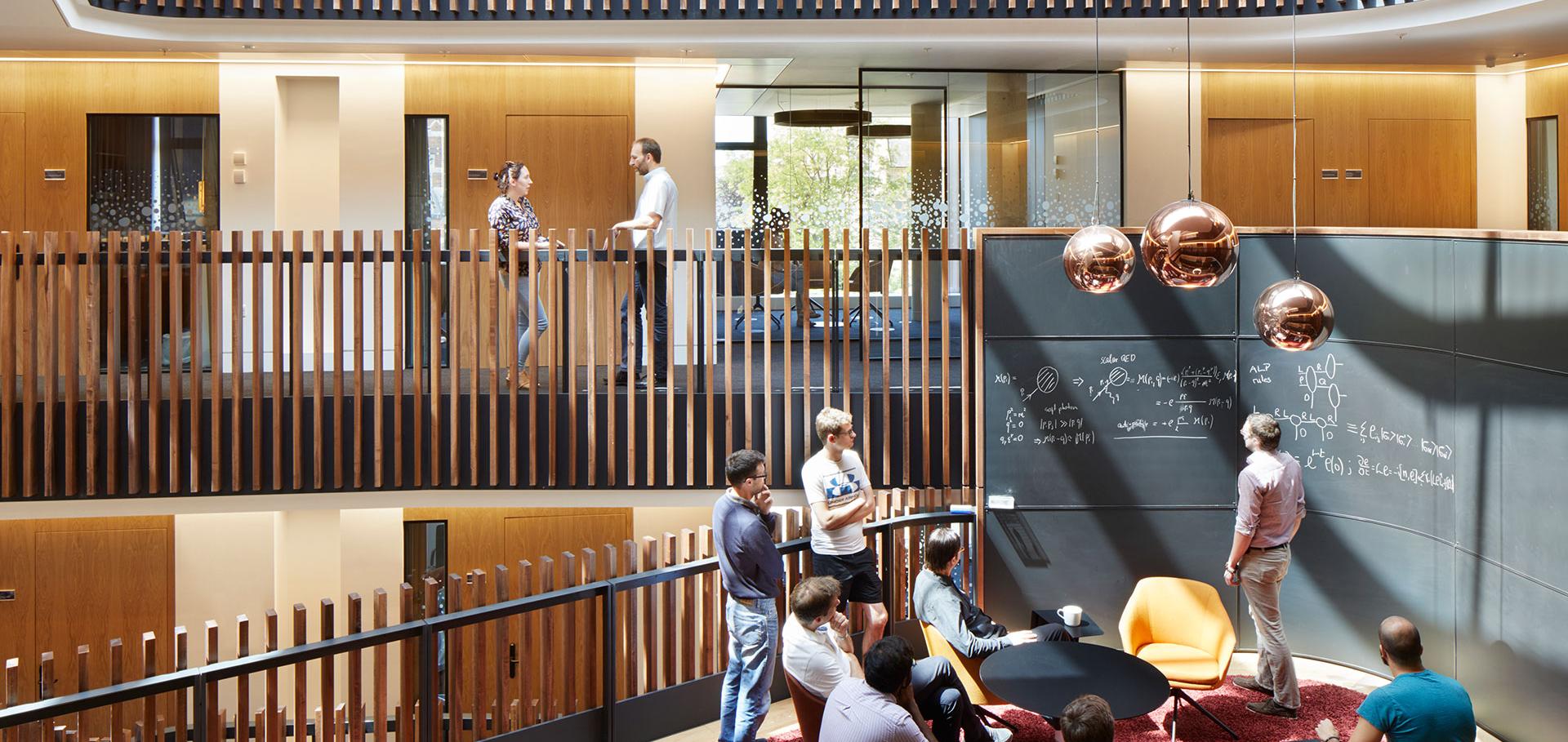
Theoretical physicists working at a blackboard collaboration pod in the Beecroft building.
Credit: Jack Hobhouse

Alexander Mietke

Associate Professor of Theoretical Soft Matter and Biophysics

Research theme

  • Biological physics

Sub department

  • Rudolf Peierls Centre for Theoretical Physics

Research groups

  • Condensed Matter Theory
Telephone: 01865 273956
Rudolf Peierls Centre for Theoretical Physics, room 70.26
Google Scholar
ORCID
  • About
  • Team
  • Publications

Orientational order on non-orientable domains

ArXiv 2609.11367 (2026)

Authors:

Gianmarco Spera, Axel Fotso Ndefo, Keaton J Burns, Alexander Mietke
Details from ArXiV

Resonances in Overdamped Odd Materials

ArXiv 2605.24276 (2026)

Authors:

Julius Kiln, Alexander Mietke
Details from ArXiV

Self-organized dynamics and emergent shape spaces of active isotropic fluid surfaces

Physical Review Research American Physical Society (APS) 8:2 (2026) 023046

Authors:

Da Gao, Huayang Sun, Rui Ma, Alexander Mietke

Abstract:

Theories of self-organized active fluid surfaces have emerged as an important class of minimal models for the shape dynamics of biological membranes, cells, and tissues. However, due to their inherent geometric nonlinearities and the absence of general minimization principles in active systems, it remains a major challenge to systematically study the emergent shape spaces that such theories give rise to. Here, we introduce a variational approach that allows for a direct computation of stationary surface geometries and flows, which enables the classification of nonequilibrium phase transitions in shape spaces described by active surface theories. To achieve this, we construct a dissipation functional systematically from the entropy production in active surfaces and show how generic symmetries imposed by Onsager relations can be exploited to also account for reactive nondissipative terms in constitutive laws. This functional is supplemented by Lagrange multipliers that relax nonlinear geometric constraints, which leads to a tractable variational problem suitable for implicit dynamic simulations and explicit calculations of nontrivial steady state geometries and flows. We apply this framework to study the dynamics of open fluid membranes and closed active fluid surfaces, and characterize the space of stationary solutions that corresponding surfaces and flows occupy. These analyses rationalize the interplay of first-order shape transitions of internally and externally forced fluid membranes, reveal degenerate regions in stationary shape spaces of mechanochemically active surfaces, and identify a mechanism by which hydrodynamic screening controls the geometry of active surfaces undergoing cell divisionlike shape transformations.
More details from the publisher
More details

Active Fluid Patterning in Inhomogeneous Environments

ArXiv 2603.07367 (2026)

Authors:

Douglas MacMyn Brown, Alexander Mietke
Details from ArXiV

Confinement-Induced Symmetry Breaking of Active Surfaces

ArXiv 2602.21519 (2026)

Authors:

Da Gao, Alexander Mietke, Rui Ma
Details from ArXiV

Pagination

  • Current page 1
  • Page 2
  • Page 3
  • Page 4
  • Page 5
  • Page 6
  • Page 7
  • Page 8
  • Next page Next
  • Last page Last

Footer Menu

  • Contact us
  • Giving to the Dept of Physics
  • Work with us
  • Media

User account menu

  • Log in

Follow us

FIND US

Clarendon Laboratory,

Parks Road,

Oxford,

OX1 3PU

CONTACT US

Tel: +44(0)1865272200

University of Oxfrod logo Department Of Physics text logo
IOP Juno Champion logo Athena Swan Silver Award logo

© University of Oxford - Department of Physics

Cookies | Privacy policy | Accessibility statement

Built by: Versantus

  • Home
  • Research
  • Study
  • Engage
  • Our people
  • News & Comment
  • Events
  • Our facilities & services
  • About us
  • Giving to Physics
  • Current students
  • Staff intranet