Home
Department Of Physics text logo
  • Research
    • Our research
    • Our research groups
    • Our research in action
    • Research funding support
    • Summer internships for undergraduates
  • Study
    • Undergraduates
    • Postgraduates
  • Engage
    • For young people
    • For teachers
    • For the public
    • For alumni
    • For business
  • Support
Menu
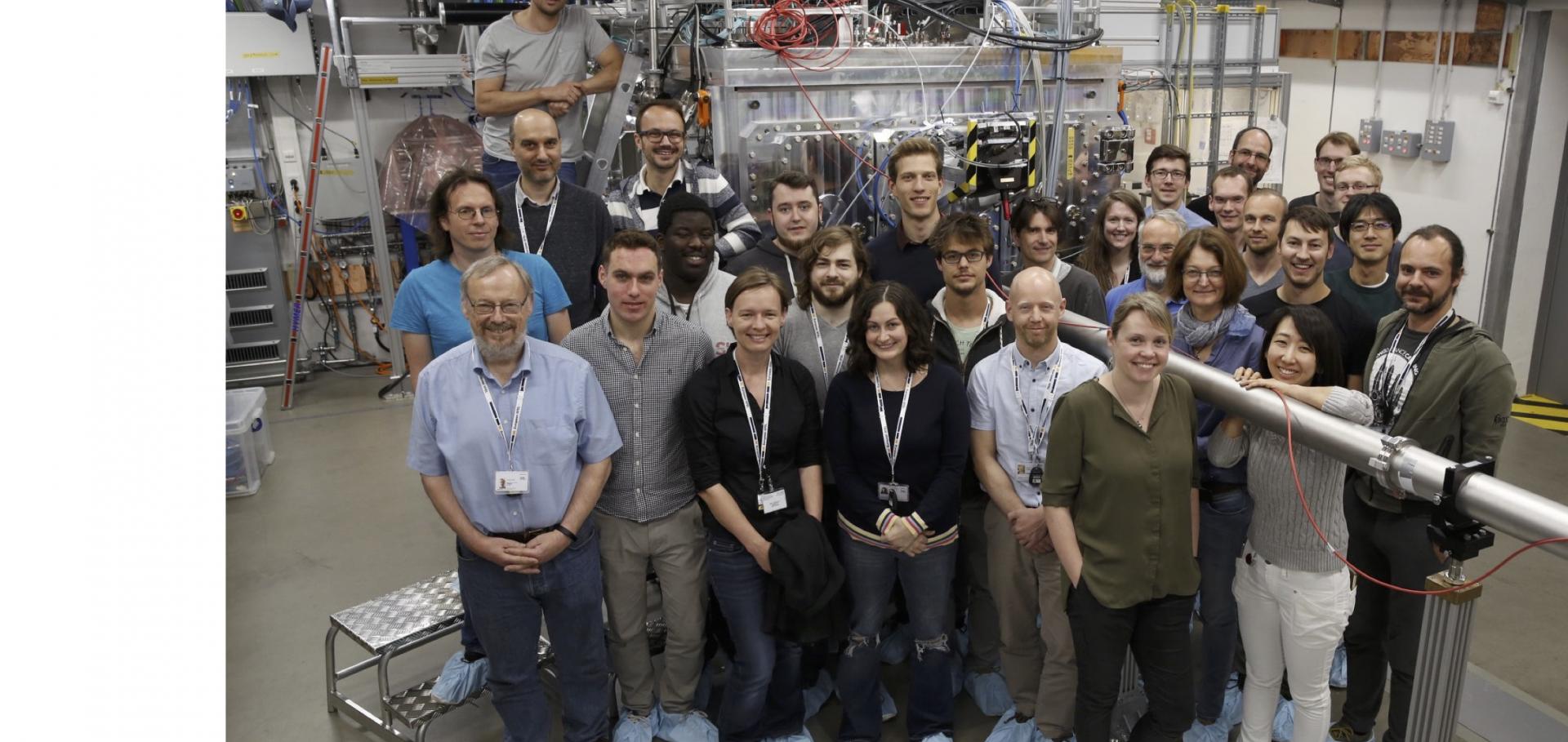
First HED experiment at XFEL

Professor Justin Wark

Professor of Physics

Sub department

  • Atomic and Laser Physics

Research groups

  • Oxford Centre for High Energy Density Science (OxCHEDS)
Justin.Wark@physics.ox.ac.uk
Telephone: 01865 (2)72251
Clarendon Laboratory, room 029.9
  • About
  • Publications

Investigation of disordering and reordering of laser-irradiated InSb by Time-resolved X-ray diffraction

Institute of Electrical and Electronics Engineers (IEEE) (2002) 168-168

Authors:

J Larsson, A Lindenberg, PA Heimann, PH Bucksbaum, RW Lee, JS Wark, RW Falcone
More details from the publisher

Laser Driven High Pressure, High Strain‐Rate Materials Experiments

AIP Conference Proceedings AIP Publishing 620:1 (2002) 615-618

Authors:

DH Kalantar, AM Allen, F Gregori, B Kad, M Kumar, KT Lorenz, A Loveridge, MA Meyers, S Pollaine, BA Remington, JS Wark
More details from the publisher

Plastic Deformation in Laser‐Induced Shock Compression of Monocrystalline Copper

AIP Conference Proceedings AIP Publishing 620:1 (2002) 619-622

Authors:

MA Meyers, F Gregori, BK Kad, MS Schneider, DH Kalantar, BA Remington, JS Wark, T Boehly, G Ravichandran
More details from the publisher

Picosecond x-ray diffraction studies of shocked crystals

Pacific Rim Conference on Lasers and Electro Optics CLEO Technical Digest (2002) 299-300

Authors:

JS Wark, A Allen, A Loveridge-Smith, J Belak, D Kalantar, RW Lee, S Pollaine, B Remington, S Weber, T Boehly, A Hauer, B Holian, G Kyrala, P Lomdahl, D Paisley, DC Swift, MA Meyers

Abstract:

Shocked crystals were investigated by picosecond X-ray diffraction. The response of single crystal silicon to nanosecond timescale uniaxial shock compression was purely elastic. Single crystal Cu shocked along the (200) axis exhibited compression of the unit cells along both (200) and (020), indicating a transition to plastic flow.
More details from the publisher

Picosecond x-ray diffraction studies of shocked crystals

Conference on Quantum Electronics and Laser Science QELS Technical Digest Series 74 (2002) 115

Authors:

JS Wark, A Allen, A Loveridge-Smith, J Belak, D Kalantar, RW Lee, S Pollaine, B Remington, S Weber, T Boehly, A Hauer, B Holian, G Kyrala, P Lomdahl, D Paisley, DC Swift, MA Meyers

Abstract:

Experimental time-resolved X-ray diffraction data that provide firm evidence that the response of single crystal silicon to nanosecond timescale uniaxial shock compression along the (400) axis is anomalous in that it is purely elastic is presented. In addition, the results of a molecular-dynamics simulations of the diffraction of X-rays from shocked samples, which indicate that it may be possible to directly measure dislocation densities by observing the angular shifts associated with sticking faults within face-centred-cubic metals are presented as well.
More details from the publisher

Pagination

  • First page First
  • Previous page Prev
  • …
  • Page 50
  • Page 51
  • Page 52
  • Page 53
  • Current page 54
  • Page 55
  • Page 56
  • Page 57
  • Page 58
  • …
  • Next page Next
  • Last page Last

Footer Menu

  • Contact us
  • Giving to the Dept of Physics
  • Work with us
  • Media

User account menu

  • Log in

Follow us

FIND US

Clarendon Laboratory,

Parks Road,

Oxford,

OX1 3PU

CONTACT US

Tel: +44(0)1865272200

University of Oxfrod logo Department Of Physics text logo
IOP Juno Champion logo Athena Swan Silver Award logo

© University of Oxford - Department of Physics

Cookies | Privacy policy | Accessibility statement

Built by: Versantus

  • Home
  • Research
  • Study
  • Engage
  • Our people
  • News & Comment
  • Events
  • Our facilities & services
  • About us
  • Giving to Physics
  • Current students
  • Staff intranet