Home
Department Of Physics text logo
  • Research
    • Our research
    • Our research groups
    • Our research in action
    • Research funding support
    • Summer internships for undergraduates
  • Study
    • Undergraduates
    • Postgraduates
  • Engage
    • For young people
    • For teachers
    • For the public
    • For alumni
    • For business
  • Support
Menu
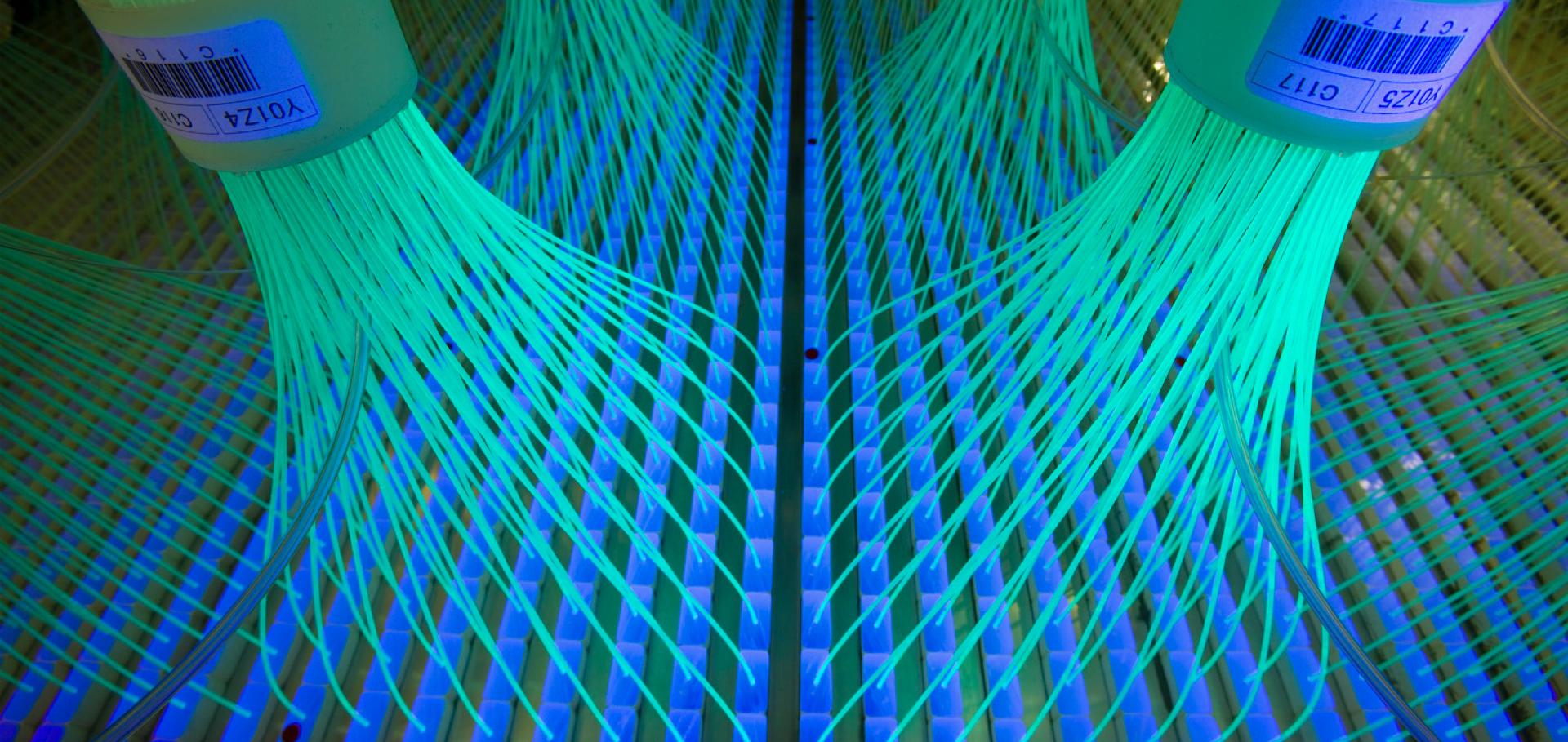
SciBar fibres

Wavelength shifting fibres from the SciBar detector used in the SciBooNE experiment at Fermilab.

Credit: Reidar Hahn, Fermilab.

Prof Morgan Wascko

Rokos-Clarendon Professor of Neutrino Physics

Research theme

  • Instrumentation
  • Fundamental particles and interactions

Sub department

  • Particle Physics

Research groups

  • Accelerator Neutrinos
morgan.wascko@physics.ox.ac.uk
My webpage at Pembroke College
My webpage at STFC RAL PPD
  • About
  • CV
  • Publications

Evidence for TeV emission from GRB 970417a

AIP Conference Proceedings AIP Publishing 526:1 (2000) 240-244

Authors:

JE McEnery, R Atkins, W Benbow, D Berley, ML Chen, DG Coyne, BL Dingus, DE Dorfan, RW Ellsworth, D Evans, A Falcone, L Fleysher, R Fleysher, G Gisler, JA Goodman, TJ Haines, CM Hoffman, S Hugenberger, LA Kelley, I Leonor, M McConnell, JF McCullough, RS Miller, AI Mincer, MF Morales, P Nemethy, JM Ryan, B Shen, A Shoup, C Sinnis, AJ Smith, GW Sullivan, T Tumer, K Wang, MO Wascko, S Westerhoff, DA Williams, T Yang, GB Yodh

Abstract:

Milagrito, a detector sensitive to γ-rays at TeV energies, monitored the northern sky during the period February 1997 through May 1998. With a large field of view and high duty cycle, this instrument was used to perform a search for TeV counterparts to γ-ray bursts. BATSE detected 54 GRBs within the field of view of Milagrito during this period. This paper describes the results of an analysis to search for TeV emission correlated with BATSE detected bursts. Milagrito detected an excess of events coincident both spatially and temporally with GRB 970417a, with chance probability 2.8×10⁻⁵ within the BATSE error radius. No other significant correlations were detected. Since 54 bursts were examined, the chance probability of observing an excess with at least this significance in any of these bursts is 1.5×10⁻³.
More details from the publisher

Milagro: A TeV observatory for gamma-ray bursts

AIP Conference Proceedings AIP Publishing 526:1 (2000) 751-755

Authors:

BL Dingus, R Atkins, W Benbow, D Berley, ML Chen, DG Coyne, RW Ellsworth, D Evans, A Falcone, L Fleysher, R Fleysher, G Gisler, JA Goodman, TJ Haines, CM Hoffman, S Hugenberger, LA Kelley, I Leonor, M McConnell, JF McCullough, JE McEnery, RS Miller, AI Mincer, MF Morales, P Nemethy, JM Ryan, B Shen, A Shoup, C Sinnis, AJ Smith, GW Sullivan, T Tumer, K Wang, MO Wascko, S Westerhoff, DA Williams, T Yang, GB Yodh

Abstract:

Observation of prompt TeV γ-rays from GRBs requires a new type of detector to overcome the low duty factor and small field of view of current TeV observatories. Milagro is such a new type of very high energy (> a few 100 GeV) gamma-ray observatory, which has a large field of view of >1 steradian and 24 hours/day operation. Milagrito, a prototype for Milagro, was operated from February 1997 to May 1998. During the summer of 1998, Milagrito was dismantled and Milagro was built. Both detectors use a 80 m×60 m×8 m pond of water in which a 3 m×3 m grid of photomultiplier tubes detects the Cherenkov light produced in the water by the relativistic particles in extensive air showers. Milagrito was smaller and had only one layer of photomultipliers, but allowed the technique to be tested. Milagrito observations of the Moon’s shadow and Mrk 501 are consistent with the Monte Carlo prediction of the telescope’s parameters, such as effective area and angular resolution. Milagro will have improved flux sensitivity over Milagrito due to larger effective area, better angular resolution and cosmic-ray background rejection.
More details from the publisher

Milagrito, a TeV air-shower array

Nuclear Instruments and Methods in Physics Research Section A Accelerators Spectrometers Detectors and Associated Equipment Elsevier 449:3 (2000) 478-499

Authors:

R Atkins, W Benbow, D Berley, M-L Chen, DG Coyne, RS Delay, BL Dingus, DE Dorfan, RW Ellsworth, C Espinoza, D Evans, A Falcone, L Fleysher, R Fleysher, G Gisler, JA Goodman, TJ Haines, CM Hoffman, S Hugenberger, LA Kelley, S Klein, I Leonor, J Macri, M McConnell, JF McCullough, JE McEnery, RS Miller, AI Mincer, MF Morales, MM Murray, P Nemethy, G Paliaga, JM Ryan, M Schneider, B Shen, A Shoup, G Sinnis, AJ Smith, GW Sullivan, TN Thompson, OT Tumer, K Wang, MO Wascko, S Westerhoff, DA Williams, T Yang, GB Yodh, The Milagro Collaboration
More details from the publisher
More details

First results of a study of TeV emission from GRBs in Milagrito

AIP Conference Proceedings AIP Publishing 515:1 (2000) 243-248

Authors:

JE McEnery, R Atkins, W Benbow, D Berley, ML Chen, DG Coyne, BL Dingus, DE Dorfan, RW Ellsworth, D Evans, A Falcone, L Fleysher, R Fleysher, G Gisler, JA Goodman, TJ Haines, CM Hoffman, S Hugenberger, LA Kelley, I Leonor, M McConnell, JF McCullough, RS Miller, AI Mincer, MF Morales, P Nemethy, JM Ryan, B Shen, A Shoup, C Sinnis, AJ Smith, GW Sullivan, T Tumer, K Wang, MO Wascko, S Westerhoff, DA Williams, T Yang, GB Yodh
More details from the publisher

Results from the Milagrito experiment

AIP Conference Proceedings AIP Publishing 515:1 (2000) 441-447

Authors:

AJ Smith, R Atkins, W Benbow, D Berley, ML Chen, DG Coyne, BL Dingus, DE Dorfan, RW Ellsworth, D Evans, A Falcone, L Fleysher, R Fleysher, G Gisler, JA Goodman, TJ Haines, CM Hoffman, S Hugenberger, LA Kelley, I Leonor, M McConnell, JF McCullough, JE McEnery, RS Miller, AI Mincer, MF Morales, P Nemethy, JM Ryan, B Shen, A Shoup, G Sinnis, GW Sullivan, T Tumer, K Wang, MO Wascko, S Westerhoff, DA Williams, T Yang, GB Yodh

Abstract:

The Milagro water Cherenkov detector near Los Alamos, New Mexico is the first air shower detector capable of continuously monitoring the sky at energies between 500 GeV and 20 TeV. Preliminary results of the Milagro experiment are presented. A predecessor of the Milagro detector, Milagrito, was operational from February 1997 to May 1998. Milagrito consisted of 228 8″ photomultiplier tubes (PMTs) arranged in a grid with a 2.8 meter spacing and submerged in 1–2 meters of water. During its operation, Milagrito collected in excess of 9 billion events with a median energy of about 3 TeV. The detector’s sensitivity extends below 1 TeV for showers from near zenith. The results of an all sky search for the Milagrito data for both transient and DC sources will be presented, including the Crab Nebula and active galaxies Markarian 501 and 421, which are known sources of TeV gamma-rays. Also presented will be a study of the TeV emission from gamma ray bursts (GRBs) in Milagrito’s field of view detected by the BATSE experiment on the Compton Gamma-Ray Observatory.
More details from the publisher

Pagination

  • First page First
  • Previous page Prev
  • …
  • Page 47
  • Page 48
  • Page 49
  • Page 50
  • Page 51
  • Page 52
  • Current page 53
  • Page 54
  • Page 55
  • Next page Next
  • Last page Last

Footer Menu

  • Contact us
  • Giving to the Dept of Physics
  • Work with us
  • Media

User account menu

  • Log in

Follow us

FIND US

Clarendon Laboratory,

Parks Road,

Oxford,

OX1 3PU

CONTACT US

Tel: +44(0)1865272200

University of Oxfrod logo Department Of Physics text logo
IOP Juno Champion logo Athena Swan Silver Award logo

© University of Oxford - Department of Physics

Cookies | Privacy policy | Accessibility statement

Built by: Versantus

  • Home
  • Research
  • Study
  • Engage
  • Our people
  • News & Comment
  • Events
  • Our facilities & services
  • About us
  • Giving to Physics
  • Current students
  • Staff intranet