

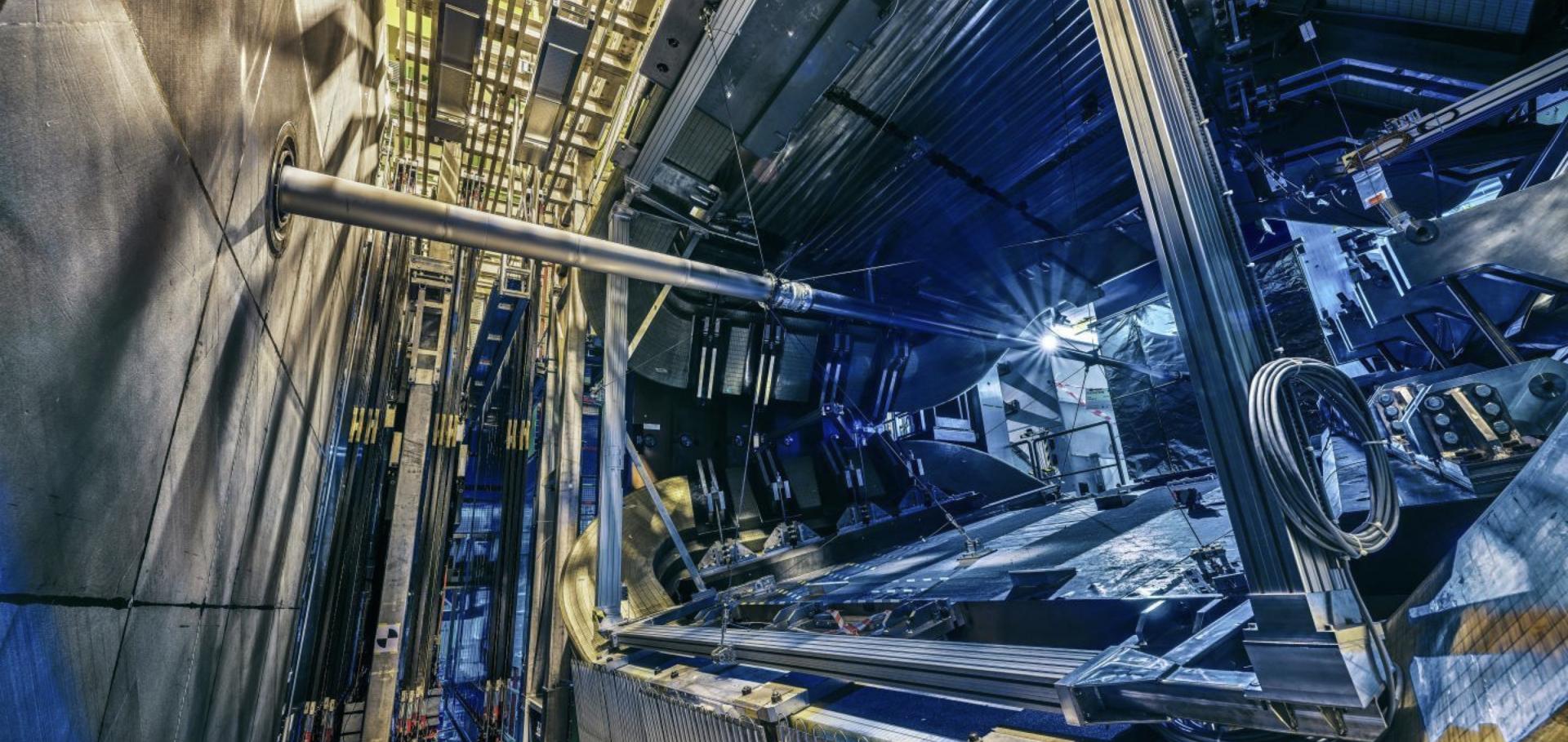
Implications of LHCb measurements and future prospects
(2012)
Authors:
LHCb collaboration, A Bharucha, II Bigi, C Bobeth, M Bobrowski, J Brod, AJ Buras, CTH Davies, A Datta, C Delaunay, S Descotes-Genon, J Ellis, T Feldmann, R Fleischer, O Gedalia, J Girrbach, D Guadagnoli, G Hiller, Y Hochberg, T Hurth, G Isidori, S Jaeger, M Jung, A Kagan, JF Kamenik, A Lenz, Z Ligeti, D London, F Mahmoudi, J Matias, S Nandi, Y Nir, P Paradisi, G Perez, AA Petrov, R Rattazzi, SR Sharpe, L Silvestrini, A Soni, DM Straub, D van Dyk, J Virto, Y-M Wang, A Weiler, J Zupan LHCb collaboration, :, R Aaij, C Abellan Beteta, A Adametz, B Adeva, M Adinolfi, C Adrover, A Affolder, Z Ajaltouni, J Albrecht, F Alessio, M Alexander, S Ali, G Alkhazov, P Alvarez Cartelle, AA Alves, S Amato, Y Amhis, L Anderlini, J Anderson, R Andreassen, M Anelli, RB Appleby, O Aquines Gutierrez, F Archilli, A Artamonov, M Artuso, E Aslanides, G Auriemma, S Bachmann, JJ Back, C Baesso, W Baldini, H Band, RJ Barlow, C Barschel, S Barsuk, W Barter, A Bates, Th Bauer, A Bay, J Beddow, I Bediaga, C Beigbeder-Beau, S Belogurov, K Belous, I Belyaev, E Ben-Haim, M Benayoun, G Bencivenni, S Benson, J Benton, A Berezhnoy, F Bernard, R Bernet, M-O Bettler, M van Beuzekom, V van Beveren, A Bien, S Bifani, T Bird, A Bizzeti, PM Bjørnstad, T Blake, F Blanc, C Blanks, J Blouw, S Blusk, A Bobrov, V Bocci, B Bochin, H Boer Rookhuizen, G Bogdanova, E Bonaccorsi, A Bondar, N Bondar, W Bonivento, S Borghi, A Borgia, TJV Bowcock, E Bowen, C Bozzi, T Brambach, J van den Brand, L Brarda, J Bressieux, D Brett, M Britsch, T Britton, NH Brook, H Brown, A Büchler-Germann, I Burducea, A Bursche, J Buytaert, T Cacérès, J-P Cachemiche, S Cadeddu, O Callot, M Calvi, M Calvo Gomez, A Camboni, P Campana, A Carbone, G Carboni, R Cardinale, A Cardini, H Carranza-Mejia, L Carson, K Carvalho Akiba, A Casajus Ramo, G Casse, M Cattaneo, Ch Cauet, L Ceelie, B Chadaj, H Chanal, M Charles, D Charlet, Ph Charpentier, M Chebbi, P Chen, N Chiapolini, M Chrzaszcz, P Ciambrone, K Ciba, X Cid Vidal, G Ciezarek, PEL Clarke, M Clemencic, HV Cliff, J Closier, C Coca, V Coco, J Cogan, E Cogneras, P Collins, A Comerma-Montells, A Contu, A Cook, M Coombes, B Corajod, G Corti, B Couturier, GA Cowan, D Craik, S Cunliffe, R Currie, C D'Ambrosio, I D'Antone, P David, PNY David, I De Bonis, K De Bruyn, S De Capua, M De Cian, P De Groen, JM De Miranda, L De Paula, P De Simone, D Decamp, M Deckenhoff, G Decreuse, H Degaudenzi, L Del Buono, C Deplano, D Derkach, O Deschamps, F Dettori, A Di Canto, J Dickens, H Dijkstra, P Diniz Batista, M Dogaru, F Domingo Bonal, M Domke, S Donleavy, F Dordei, A Dosil Suárez, D Dossett, A Dovbnya, C Drancourt, O Duarte, R Dumps, F Dupertuis, P-Y Duval, R Dzhelyadin, A Dziurda, A Dzyuba, S Easo, U Egede, V Egorychev, S Eidelman, D van Eijk, S Eisenhardt, R Ekelhof, L Eklund, I El Rifai, Ch Elsasser, D Elsby, F Evangelisti, A Falabella, C Färber, G Fardell, C Farinelli, S Farry, PJW Faulkner, V Fave, G Felici, V Fernandez Albor, F Ferreira Rodrigues, M Ferro-Luzzi, S Filippov, C Fitzpatrick, C Föhr, M Fontana, F Fontanelli, R Forty, C Fournier, O Francisco, M Frank, C Frei, R Frei, M Frosini, H Fuchs, S Furcas, A Gallas Torreira, D Galli, M Gandelman, P Gandini, Y Gao, J Garofoli, P Garosi, J Garra Tico, L Garrido, D Gascon, C Gaspar, R Gauld, E Gersabeck, M Gersabeck, T Gershon, S Gets, Ph Ghez, A Giachero, V Gibson, VV Gligorov, C Göbel, V Golovtsov, D Golubkov, A Golutvin, A Gomes, G Gong, H Gong, H Gordon, C Gotti, M Grabalosa Gándara, R Graciani Diaz, LA Granado Cardoso, E Graugés, G Graziani, A Grecu, E Greening, S Gregson, V Gromov, O Grünberg, B Gui, E Gushchin, Yu Guz, Z Guzik, T Gys, F Hachon, C Hadjivasiliou, G Haefeli, C Haen, SC Haines, S Hall, T Hampson, S Hansmann-Menzemer, N Harnew, ST Harnew, J Harrison, PF Harrison, T Hartmann, J He, B van der Heijden, V Heijne, K Hennessy, P Henrard, JA Hernando Morata, E van Herwijnen, E Hicks, D Hill, M Hoballah, W Hofmann, C Hombach, P Hopchev, W Hulsbergen, P Hunt, T Huse, N Hussain, D Hutchcroft, D Hynds, V Iakovenko, P Ilten, J Imong, R Jacobsson, A Jaeger, O Jamet, E Jans, F Jansen, L Jansen, P Jansweijer, P Jaton, F Jing, M John, D Johnson, CR Jones, B Jost, M Kaballo, S Kandybei, M Karacson, O Karavichev, TM Karbach, A Kashchuk, T Kechadi, IR Kenyon, U Kerzel, T Ketel, A Keune, B Khanji, T Kihm, R Kluit, O Kochebina, V Komarov, RF Koopman, P Koppenburg, M Korolev, J Kos, A Kozlinskiy, L Kravchuk, K Kreplin, M Kreps, R Kristic, G Krocker, P Krokovny, F Kruse, M Kucharczyk, Y Kudenko, V Kudryavtsev, T Kvaratskheliya, VN La Thi, D Lacarrere, G Lafferty, A Lai, D Lambert, RW Lambert, E Lanciotti, L Landi, G Lanfranchi, C Langenbruch, S Laptev, T Latham, I Lax, C Lazzeroni, R Le Gac, J van Leerdam, J-P Lees, R Lefèvre, A Leflat, J Lefrançois, O Leroy, T Lesiak, Y Li, L Li Gioi, A Likhoded, M Liles, R Lindner, C Linn, B Liu, G Liu, J von Loeben, JH Lopes, E Lopez Asamar, N Lopez-March, H Lu, J Luisier, H Luo, A Mac Raighne, F Machefert, IV Machikhiliyan, F Maciuc, O Maev, M Maino, S Malde, G Manca, G Mancinelli, N Mangiafave, U Marconi, R Märki, J Marks, G Martellotti, A Martens, A Martín Sánchez, M Martinelli, D Martinez Santos, D Martins Tostes, A Massafferri, R Matev, Z Mathe, C Matteuzzi, M Matveev, E Maurice, J Mauricio, A Mazurov, J McCarthy, R McNulty, B Meadows, M Meissner, H Mejia, V Mendez-Munoz, M Merk, DA Milanes, M-N Minard, J Molina Rodriguez, S Monteil, D Moran, P Morawski, R Mountain, I Mous, F Muheim, F Mul, K Müller, B Munneke, R Muresan, B Muryn, B Muster, P Naik, T Nakada, R Nandakumar, I Nasteva, A Nawrot, M Needham, N Neufeld, AD Nguyen, TD Nguyen, C Nguyen-Mau, M Nicol, V Niess, N Nikitin, T Nikodem, Y Nikolaiko, S Nisar, A Nomerotski, A Novoselov, A Oblakowska-Mucha, V Obraztsov, S Oggero, S Ogilvy, O Okhrimenko, R Oldeman, M Orlandea, A Ostankov, JM Otalora Goicochea, M van Overbeek, P Owen, BK Pal, A Palano, M Palutan, J Panman, A Papanestis, M Pappagallo, C Parkes, CJ Parkinson, G Passaleva, GD Patel, M Patel, GN Patrick, C Patrignani, C Pavel-Nicorescu, A Pazos Alvarez, A Pellegrino, G Penso, M Pepe Altarelli, S Perazzini, DL Perego, E Perez Trigo, A Pérez-Calero Yzquierdo, P Perret, M Perrin-Terrin, G Pessina, K Petridis, A Petrolini, O van Petten, A Phan, E Picatoste Olloqui, D Piedigrossi, B Pietrzyk, T Pilař, D Pinci, S Playfer, M Plo Casasus, F Polci, G Polok, A Poluektov, E Polycarpo, D Popov, B Popovici, C Potterat, A Powell, J Prisciandaro, M Pugatch, V Pugatch, A Puig Navarro, W Qian, JH Rademacker, B Rakotomiaramanana, MS Rangel, I Raniuk, N Rauschmayr, G Raven, S Redford, MM Reid, AC dos Reis, F Rethore, S Ricciardi, A Richards, K Rinnert, V Rives Molina, DA Roa Romero, P Robbe, E Rodrigues, P Rodriguez Perez, E Roeland, GJ Rogers, S Roiser, V Romanovsky, A Romero Vidal, K de Roo, J Rouvinet, L Roy, K Rudloff, T Ruf, H Ruiz, G Sabatino, JJ Saborido Silva, N Sagidova, P Sail, B Saitta, C Salzmann, B Sanmartin Sedes, R Santacesaria, C Santamarina Rios, E Santovetti, S Saornil Gamarra, M Sapunov, A Saputi, A Sarti, C Satriano, A Satta, T Savidge, M Savrie, P Schaack, M Schiller, A Schimmel, H Schindler, S Schleich, M Schlupp, M Schmelling, B Schmidt, O Schneider, T Schneider, A Schopper, H Schuijlenburg, M-H Schune, R Schwemmer, B Sciascia, A Sciubba, M Seco, A Semennikov, K Senderowska, I Sepp, N Serra, J Serrano, P Seyfert, B Shao, M Shapkin, I Shapoval, P Shatalov, Y Shcheglov, T Shears, L Shekhtman, O Shevchenko, V Shevchenko, A Shires, S Sigurdsson, R Silva Coutinho, T Skwarnicki, MW Slater, T Sluijk, NA Smith, E Smith, M Smith, K Sobczak, MD Sokoloff, FJP Soler, F Soomro, D Souza, B Souza De Paula, B Spaan, A Sparkes, P Spradlin, S Squerzanti, F Stagni, S Stahl, O Steinkamp, O Stenyakin, S Stoica, S Stone, B Storaci, M Straticiuc, U Straumann, VK Subbiah, S Swientek, M Szczekowski, P Szczypka, T Szumlak, S T'Jampens, M Teklishyn, E Teodorescu, F Teubert, C Thomas, E Thomas, A Tikhonov, J van Tilburg, V Tisserand, M Tobin, V Tocut, S Tolk, D Tonelli, S Topp-Joergensen, N Torr, E Tournefier, S Tourneur, MT Tran, M Tresch, A Tsaregorodtsev, P Tsopelas, N Tuning, M Ubeda Garcia, A Ukleja, O Ullaland, D Urner, U Uwer, V Vagnoni, G Valenti, R Vazquez Gomez, P Vazquez Regueiro, S Vecchi, JJ Velthuis, M Veltri, G Veneziano, M Vesterinen, B Viaud, D Vieira, X Vilasis-Cardona, W Vink, S Volkov, V Volkov, A Vollhardt, D Volyanskyy, D Voong, A Vorobyev, V Vorobyev, C Voß, H Voss, G Vouters, R Waldi, R Wallace, S Wandernoth, J Wang, DR Ward, K Warda, NK Watson, AD Webber, D Websdale, P Wenerke, M Whitehead, J Wicht, D Wiedner, L Wiggers, G Wilkinson, MP Williams, M Williams, FF Wilson, J Wishahi, M Witek, W Witzeling, SA Wotton, S Wright, S Wu, K Wyllie, Y Xie, Z Xing, T Xue, Z Yang, R Young, X Yuan, O Yushchenko, M Zangoli, F Zappon, M Zavertyaev, M Zeng, F Zhang, L Zhang, WC Zhang, Y Zhang, A Zhelezov, L Zhong, E Zverev, A Zvyagin, A ZwartImplications of LHCb measurements and future prospects
ArXiv 1208.3355 (2012)
Authors:
LHCb collaboration, A Bharucha, II Bigi, C Bobeth, M Bobrowski, J Brod, AJ Buras, CTH Davies, A Datta, C Delaunay, S Descotes-Genon, J Ellis, T Feldmann, R Fleischer, O Gedalia, J Girrbach, D Guadagnoli, G Hiller, Y Hochberg, T Hurth, G Isidori, S Jaeger, M Jung, A Kagan, JF Kamenik, A Lenz, Z Ligeti, D London, F Mahmoudi, J Matias, S Nandi, Y Nir, P Paradisi, G Perez, AA Petrov, R Rattazzi, SR Sharpe, L Silvestrini, A Soni, DM Straub, D van Dyk, J Virto, Y-M Wang, A Weiler, J Zupan LHCb collaboration, R Aaij, C Abellan Beteta, A Adametz, B Adeva, M Adinolfi, C Adrover, A Affolder, Z Ajaltouni, J Albrecht, F Alessio, M Alexander, S Ali, G Alkhazov, P Alvarez Cartelle, AA Alves Jr, S Amato, Y Amhis, L Anderlini, J Anderson, R Andreassen, M Anelli, RB Appleby, O Aquines Gutierrez, F Archilli, A Artamonov, M Artuso, E Aslanides, G Auriemma, S Bachmann, JJ Back, C Baesso, W Baldini, H Band, RJ Barlow, C Barschel, S Barsuk, W Barter, A Bates, Th Bauer, A Bay, J Beddow, I Bediaga, C Beigbeder-Beau, S Belogurov, K Belous, I Belyaev, E Ben-Haim, M Benayoun, G Bencivenni, S Benson, J Benton, A Berezhnoy, F Bernard, R Bernet, M-O Bettler, M van Beuzekom, V van Beveren, A Bien, S Bifani, T Bird, A Bizzeti, PM Bjørnstad, T Blake, F Blanc, C Blanks, J Blouw, S Blusk, A Bobrov, V Bocci, B Bochin, H Boer Rookhuizen, G Bogdanova, E Bonaccorsi, A Bondar, N Bondar, W Bonivento, S Borghi, A Borgia, TJV Bowcock, E Bowen, C Bozzi, T Brambach, J van den Brand, L Brarda, J Bressieux, D Brett, M Britsch, T Britton, NH Brook, H Brown, A Büchler-Germann, I Burducea, A Bursche, J Buytaert, T Cacérès, J-P Cachemiche, S Cadeddu, O Callot, M Calvi, M Calvo Gomez, A Camboni, P Campana, A Carbone, G Carboni, R Cardinale, A Cardini, H Carranza-Mejia, L Carson, K Carvalho Akiba, A Casajus Ramo, G Casse, M Cattaneo, Ch Cauet, L Ceelie, B Chadaj, H Chanal, M Charles, D Charlet, Ph Charpentier, M Chebbi, P Chen, N Chiapolini, M Chrzaszcz, P Ciambrone, K Ciba, X Cid Vidal, G Ciezarek, PEL Clarke, M Clemencic, HV Cliff, J Closier, C Coca, V Coco, J Cogan, E Cogneras, P Collins, A Comerma-Montells, A Contu, A Cook, M Coombes, B Corajod, G Corti, B Couturier, GA Cowan, D Craik, S Cunliffe, R Currie, C D'Ambrosio, I D'Antone, P David, PNY David, I De Bonis, K De Bruyn, S De Capua, M De Cian, P De Groen, JM De Miranda, L De Paula, P De Simone, D Decamp, M Deckenhoff, G Decreuse, H Degaudenzi, L Del Buono, C Deplano, D Derkach, O Deschamps, F Dettori, A Di Canto, J Dickens, H Dijkstra, P Diniz Batista, M Dogaru, F Domingo Bonal, M Domke, S Donleavy, F Dordei, A Dosil Suárez, D Dossett, A Dovbnya, C Drancourt, O Duarte, R Dumps, F Dupertuis, P-Y Duval, R Dzhelyadin, A Dziurda, A Dzyuba, S Easo, U Egede, V Egorychev, S Eidelman, D van Eijk, S Eisenhardt, R Ekelhof, L Eklund, I El Rifai, Ch Elsasser, D Elsby, F Evangelisti, A Falabella, C Färber, G Fardell, C Farinelli, S Farry, PJW Faulkner, V Fave, G Felici, V Fernandez Albor, F Ferreira Rodrigues, M Ferro-Luzzi, S Filippov, C Fitzpatrick, C Föhr, M Fontana, F Fontanelli, R Forty, C Fournier, O Francisco, M Frank, C Frei, R Frei, M Frosini, H Fuchs, S Furcas, A Gallas Torreira, D Galli, M Gandelman, P Gandini, Y Gao, J Garofoli, P Garosi, J Garra Tico, L Garrido, D Gascon, C Gaspar, R Gauld, E Gersabeck, M Gersabeck, T Gershon, S Gets, Ph Ghez, A Giachero, V Gibson, VV Gligorov, C Göbel, V Golovtsov, D Golubkov, A Golutvin, A Gomes, G Gong, H Gong, H Gordon, C Gotti, M Grabalosa Gándara, R Graciani Diaz, LA Granado Cardoso, E Graugés, G Graziani, A Grecu, E Greening, S Gregson, V Gromov, O Grünberg, B Gui, E Gushchin, Yu Guz, Z Guzik, T Gys, F Hachon, C Hadjivasiliou, G Haefeli, C Haen, SC Haines, S Hall, T Hampson, S Hansmann-Menzemer, N Harnew, ST Harnew, J Harrison, PF Harrison, T Hartmann, J He, B van der Heijden, V Heijne, K Hennessy, P Henrard, JA Hernando Morata, E van Herwijnen, E Hicks, D Hill, M Hoballah, W Hofmann, C Hombach, P Hopchev, W Hulsbergen, P Hunt, T Huse, N Hussain, D Hutchcroft, D Hynds, V Iakovenko, P Ilten, J Imong, R Jacobsson, A Jaeger, O Jamet, E Jans, F Jansen, L Jansen, P Jansweijer, P Jaton, F Jing, M John, D Johnson, CR Jones, B Jost, M Kaballo, S Kandybei, M Karacson, O Karavichev, TM Karbach, A Kashchuk, T Kechadi, IR Kenyon, U Kerzel, T Ketel, A Keune, B Khanji, T Kihm, R Kluit, O Kochebina, V Komarov, RF Koopman, P Koppenburg, M Korolev, J Kos, A Kozlinskiy, L Kravchuk, K Kreplin, M Kreps, R Kristic, G Krocker, P Krokovny, F Kruse, M Kucharczyk, Y Kudenko, V Kudryavtsev, T Kvaratskheliya, VN La Thi, D Lacarrere, G Lafferty, A Lai, D Lambert, RW Lambert, E Lanciotti, L Landi, G Lanfranchi, C Langenbruch, S Laptev, T Latham, I Lax, C Lazzeroni, R Le Gac, J van Leerdam, J-P Lees, R Lefèvre, A Leflat, J Lefrançois, O Leroy, T Lesiak, Y Li, L Li Gioi, A Likhoded, M Liles, R Lindner, C Linn, B Liu, G Liu, J von Loeben, JH Lopes, E Lopez Asamar, N Lopez-March, H Lu, J Luisier, H Luo, A Mac Raighne, F Machefert, IV Machikhiliyan, F Maciuc, O Maev, M Maino, S Malde, G Manca, G Mancinelli, N Mangiafave, U Marconi, R Märki, J Marks, G Martellotti, A Martens, A Martín Sánchez, M Martinelli, D Martinez Santos, D Martins Tostes, A Massafferri, R Matev, Z Mathe, C Matteuzzi, M Matveev, E Maurice, J Mauricio, A Mazurov, J McCarthy, R McNulty, B Meadows, M Meissner, H Mejia, V Mendez-Munoz, M Merk, DA Milanes, M-N Minard, J Molina Rodriguez, S Monteil, D Moran, P Morawski, R Mountain, I Mous, F Muheim, F Mul, K Müller, B Munneke, R Muresan, B Muryn, B Muster, P Naik, T Nakada, R Nandakumar, I Nasteva, A Nawrot, M Needham, N Neufeld, AD Nguyen, TD Nguyen, C Nguyen-Mau, M Nicol, V Niess, N Nikitin, T Nikodem, Y Nikolaiko, S Nisar, A Nomerotski, A Novoselov, A Oblakowska-Mucha, V Obraztsov, S Oggero, S Ogilvy, O Okhrimenko, R Oldeman, M Orlandea, A Ostankov, JM Otalora Goicochea, M van Overbeek, P Owen, BK Pal, A Palano, M Palutan, J Panman, A Papanestis, M Pappagallo, C Parkes, CJ Parkinson, G Passaleva, GD Patel, M Patel, GN Patrick, C Patrignani, C Pavel-Nicorescu, A Pazos Alvarez, A Pellegrino, G Penso, M Pepe Altarelli, S Perazzini, DL Perego, E Perez Trigo, A Pérez-Calero Yzquierdo, P Perret, M Perrin-Terrin, G Pessina, K Petridis, A Petrolini, O van Petten, A Phan, E Picatoste Olloqui, D Piedigrossi, B Pietrzyk, T Pilař, D Pinci, S Playfer, M Plo Casasus, F Polci, G Polok, A Poluektov, E Polycarpo, D Popov, B Popovici, C Potterat, A Powell, J Prisciandaro, M Pugatch, V Pugatch, A Puig Navarro, W Qian, JH Rademacker, B Rakotomiaramanana, MS Rangel, I Raniuk, N Rauschmayr, G Raven, S Redford, MM Reid, AC dos Reis, F Rethore, S Ricciardi, A Richards, K Rinnert, V Rives Molina, DA Roa Romero, P Robbe, E Rodrigues, P Rodriguez Perez, E Roeland, GJ Rogers, S Roiser, V Romanovsky, A Romero Vidal, K de Roo, J Rouvinet, L Roy, K Rudloff, T Ruf, H Ruiz, G Sabatino, JJ Saborido Silva, N Sagidova, P Sail, B Saitta, C Salzmann, B Sanmartin Sedes, R Santacesaria, C Santamarina Rios, E Santovetti, S Saornil Gamarra, M Sapunov, A Saputi, A Sarti, C Satriano, A Satta, T Savidge, M Savrie, P Schaack, M Schiller, A Schimmel, H Schindler, S Schleich, M Schlupp, M Schmelling, B Schmidt, O Schneider, T Schneider, A Schopper, H Schuijlenburg, M-H Schune, R Schwemmer, B Sciascia, A Sciubba, M Seco, A Semennikov, K Senderowska, I Sepp, N Serra, J Serrano, P Seyfert, B Shao, M Shapkin, I Shapoval, P Shatalov, Y Shcheglov, T Shears, L Shekhtman, O Shevchenko, V Shevchenko, A Shires, S Sigurdsson, R Silva Coutinho, T Skwarnicki, MW Slater, T Sluijk, NA Smith, E Smith, M Smith, K Sobczak, MD Sokoloff, FJP Soler, F Soomro, D Souza, B Souza De Paula, B Spaan, A Sparkes, P Spradlin, S Squerzanti, F Stagni, S Stahl, O Steinkamp, O Stenyakin, S Stoica, S Stone, B Storaci, M Straticiuc, U Straumann, VK Subbiah, S Swientek, M Szczekowski, P Szczypka, T Szumlak, S T'Jampens, M Teklishyn, E Teodorescu, F Teubert, C Thomas, E Thomas, A Tikhonov, J van Tilburg, V Tisserand, M Tobin, V Tocut, S Tolk, D Tonelli, S Topp-Joergensen, N Torr, E Tournefier, S Tourneur, MT Tran, M Tresch, A Tsaregorodtsev, P Tsopelas, N Tuning, M Ubeda Garcia, A Ukleja, O Ullaland, D Urner, U Uwer, V Vagnoni, G Valenti, R Vazquez Gomez, P Vazquez Regueiro, S Vecchi, JJ Velthuis, M Veltri, G Veneziano, M Vesterinen, B Viaud, D Vieira, X Vilasis-Cardona, W Vink, S Volkov, V Volkov, A Vollhardt, D Volyanskyy, D Voong, A Vorobyev, V Vorobyev, C Voß, H Voss, G Vouters, R Waldi, R Wallace, S Wandernoth, J Wang, DR Ward, K Warda, NK Watson, AD Webber, D Websdale, P Wenerke, M Whitehead, J Wicht, D Wiedner, L Wiggers, G Wilkinson, MP Williams, M Williams, FF Wilson, J Wishahi, M Witek, W Witzeling, SA Wotton, S Wright, S Wu, K Wyllie, Y Xie, Z Xing, T Xue, Z Yang, R Young, X Yuan, O Yushchenko, M Zangoli, F Zappon, M Zavertyaev, M Zeng, F Zhang, L Zhang, WC Zhang, Y Zhang, A Zhelezov, L Zhong, E Zverev, A Zvyagin, A ZwartAbstract:
During 2011 the LHCb experiment at CERN collected 1.0 fb-1 of sqrt{s} = 7 TeV pp collisions. Due to the large heavy quark production cross-sections, these data provide unprecedented samples of heavy flavoured hadrons. The first results from LHCb have made a significant impact on the flavour physics landscape and have definitively proved the concept of a dedicated experiment in the forward region at a hadron collider. This document discusses the implications of these first measurements on classes of extensions to the Standard Model, bearing in mind the interplay with the results of searches for on-shell production of new particles at ATLAS and CMS. The physics potential of an upgrade to the LHCb detector, which would allow an order of magnitude more data to be collected, is emphasised.Measurement of the cross-section ratio σ(χ c2)/σ(χ c1) for prompt χ c production at s=7 TeV
Physics Letters, Section B: Nuclear, Elementary Particle and High-Energy Physics 714:2-5 (2012) 215-223
Authors:
R Aaij, C Abellan Beteta, C Abellan Beteta, B Adeva, M Adinolfi, C Adrover, A Affolder, Z Ajaltouni, J Albrecht, F Alessio, M Alexander, G Alkhazov, P Alvarez Cartelle, AA Alves, S Amato, Y Amhis, J Anderson, RB Appleby, O Aquines Gutierrez, F Archilli, F Archilli, L Arrabito, A Artamonov, M Artuso, M Artuso, E Aslanides, G Auriemma, G Auriemma, S Bachmann, JJ Back, DS Bailey, V Balagura, V Balagura, W Baldini, RJ Barlow, C Barschel, S Barsuk, W Barter, A Bates, C Bauer, T Bauer, A Bay, I Bediaga, S Belogurov, K Belous, I Belyaev, I Belyaev, E Ben-Haim, M Benayoun, G Bencivenni, S Benson, J Benton, R Bernet, MO Bettler, M van Beuzekom, A Bien, S Bifani, T Bird, A Bizzeti, A Bizzeti, PM Bjørnstad, T Blake, F Blanc, C Blanks, J Blouw, S Blusk, A Bobrov, V Bocci, A Bondar, N Bondar, W Bonivento, S Borghi, S Borghi, A Borgia, TJV Bowcock, C Bozzi, T Brambach, J van den Brand, J Bressieux, D Brett, M Britsch, T Britton, NH Brook, H Brown, A Büchler-Germann, I Burducea, A Bursche, J Buytaert, S Cadeddu, O Callot, M Calvi, M Calvi, M Calvo Gomez, M Calvo Gomez, A Camboni, P Campana, P Campana, A Carbone, G Carboni, G CarboniAbstract:
The prompt production of the charmonium χ c1 and χ c2 mesons has been studied in proton-proton collisions at the Large Hadron Collider at a centre-of-mass energy of s=7 TeV. The χ c mesons are identified through their decays χ c→J/ψγ with J/ψ→μ +μ - using 36 pb -1 of data collected by the LHCb detector in 2010. The ratio of the prompt production cross-sections for the two χ c spin states, σ(χ c2)/σ(χ c1), has been determined as a function of the J/ψ transverse momentum, pTJ/ψ, in the range from 2 to 15 GeV/c. The results are in agreement with the next-to-leading order non-relativistic QCD model at high pTJ/ψ and lie consistently above the pure leading-order colour-singlet prediction. © 2012 CERN.Measurement of ψ (2S) meson production in pp collisions at √s =7 TeV
European Physical Journal C 72:8 (2012)
Authors:
R Aaij, CA Beteta, B Adeva, M Adinolfi, C Adrover, A Affolder, Z Ajaltouni, J Albrecht, F Alessio, M Alexander, G Alkhazov, PA Cartelle, AA Alves, S Amato, Y Amhis, J Anderson, RB Appleby, OA Gutierrez, F Archilli, L Arrabito, A Artamonov, M Artuso, E Aslanides, G Auriemma, S Bachmann, JJ Back, DS Bailey, V Balagura, W Baldini, RJ Barlow, C Barschel, S Barsuk, W Barter, A Bates, C Bauer, T Bauer, A Bay, I Bediaga, S Belogurov, K Belous, I Belyaev, E Ben-Haim, M Benayoun, G Bencivenni, S Benson, J Benton, R Bernet, MO Bettler, M Van Beuzekom, A Bien, S Bifani, T Bird, A Bizzeti, PM Bjørnstad, T Blake, F Blanc, C Blanks, J Blouw, S Blusk, A Bobrov, V Bocci, A Bondar, N Bondar, W Bonivento, S Borghi, A Borgia, TJV Bowcock, C Bozzi, T Brambach, J Van Den Brand, J Bressieux, D Brett, M Britsch, T Britton, NH Brook, H Brown, K De Bruyn, A Büchler-Germann, I Burducea, A Bursche, J Buytaert, S Cadeddu, O Callot, M Calvi, MC Gomez, A Camboni, P Campana, A Carbone, G Carboni, R Cardinale, A Cardini, L Carson, KC Akiba, G Casse, M Cattaneo, C Cauet, M Charles, P Charpentier, N Chiapolini, K CibaAbstract:
The differential cross-section for the inclusive production of ψ(2S) mesons in pp collisions at √s = 7 TeV has been measured with the LHCb detector. The data sample corresponds to an integrated luminosity of 36 pb−1. The ψ(2S) mesons are reconstructed in the decay channels ψ(2S)→μ + μ − and ψ(2S)→J/ψπ + π −, with the J/ψ meson decaying into two muons. Results are presented both for promptly produced ψ(2S) mesons and for those originating from b-hadron decays. In the kinematic range pMeasurement of the $B^0_s\rightarrow J/\psi K^{*0}$ branching fraction and angular amplitudes
(2012)