

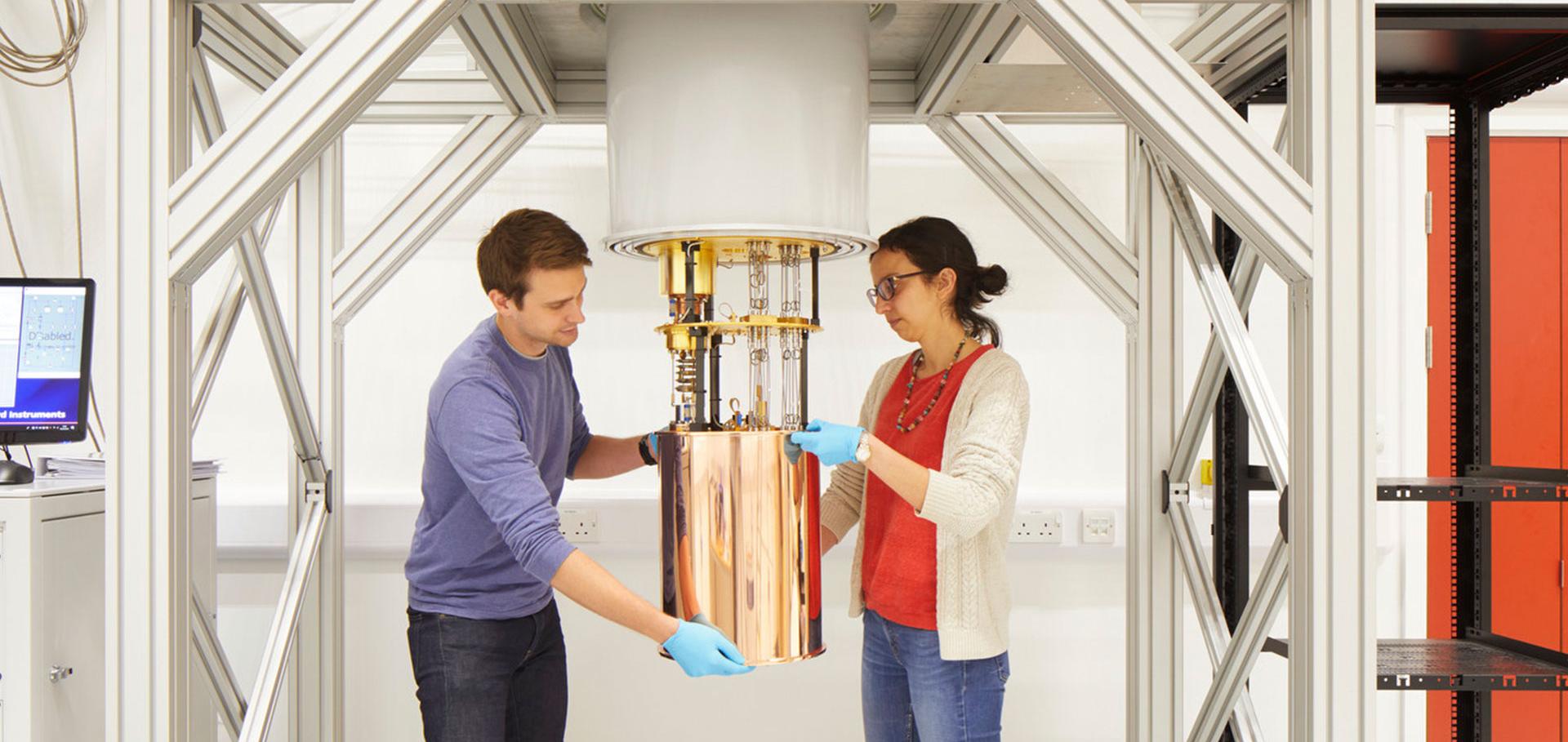

High Coherence in a Tileable 3D Integrated Superconducting Circuit Architecture
(2021)
Improving dispersive readout of a superconducting qubit by machine learning on path signature
Abstract:
One major challenge that arises from quantum computing is to implement fast, high-accuracy quantum state readout. For superconducting circuits, this problem reduces to a time series classification problem on readout signals. We propose that using path signature methods to extract features can enhance existing techniques for quantum state discrimination. We demonstrate the superior performance of our proposed approach over conventional methods in distinguishing three different quantum states on real experimental data from a superconducting transmon qubit.Full vectorial maxwell equations with continuous angular indices—part II: numerical solvers and convergence analysis
Proceedings of the Royal Society A The Royal Society 482:2348 (2026) 20250786
Abstract:
Abstract In part I of this work, we established an analytic framework for solving Maxwell's equations in spherical geometry with continuous angular indices (ℓ,m)∈R2, proving finite-energy conditions for singular solutions and formulating continuous spectral integrals in weighted Sobolev spaces. In this companion article (part II), we develop and validate numerical methods that operationalize this framework. We introduce a Galerkin discretization of the coupled angular operator on divergence-free continuous-index vector bases. To reconstruct physical fields, we complement this with an Eisenstein-type spectral integral, evaluated by mapped Gauss–Legendre quadrature. These methods explicitly account for non-orthogonality of the basis and the singular behaviour near the origin. The block formulation acts on the full matrix-valued angular Maxwell operator and is not restricted to the wedge and cone geometries used below as analytically tractable benchmarks. We analyse and numerically demonstrate convergence. The hybrid pipeline is validated by reproducing eigenmode frequencies of spherical cavities with wedge and cone modifications to within 1−2% of full-wave high-frequency structure simulator (HFSS) simulations. Together with part I, this paper completes a unified analytic–computational framework for singular electromagnetic fields with continuous angular indices.Crosstalk dispersion and spatial scaling in superconducting qubit arrays
Physical Review Research American Physical Society (APS) 8:3 (2026) 033193
Abstract:
Crosstalk between qubits fundamentally limits the scalability of quantum processors, necessitating physics-based models that can handle the complexity of large qubit arrays. Here, we develop a comprehensive theoretical and experimental framework that captures residual interactions between both adjacent and nonadjacent qubits in fixed-frequency transmon lattices. The model integrates the combined effects of exponential localization in banded capacitance matrices, suppression of virtual couplings through detuning products across intermediate modes, and evanescent decay of below-cutoff electromagnetic fields, yielding predictive scaling relations for coupling strength as a function of spatial separation and spectral detuning. Experimental characterization of a superconducting qubit lattice with inductive shunt pillars reveals exponential spatial decay and frequency-dependent suppression consistent with theoretical predictions, achieving quantitative agreement for all nearest-neighbor couplings across the operating range. Our results show that standard dispersive Hamiltonian approximations systematically overestimate long-range coupling when spatial and spectral dependencies are neglected; these errors propagate into circuit simulation and design strategies. Our framework provides design guidance for crosstalk mitigation in larger-scale quantum processors under realistic fabrication constraints, addressing a bottleneck in scalability.Electromagnetic modes in spherical cavities: Angular spectra, dispersion relations, and self-adjoint extensions
Physical Review Applied American Physical Society (APS) 26:2 (2026) 024050