Latest news and comment Audience - Any Audience - Alumni Industry Schools, prospective students and community Research Undergraduates Graduates International Year of Quantum Department of Physics (requires login) Research theme - Any Research theme - Accelerator physics Astronomy and astrophysics Biological physics Climate physics Exoplanets and planetary physics Fields, strings, and quantum dynamics Fundamental particles and interactions Instrumentation Lasers and high energy density science Particle astrophysics & cosmology Photovoltaics and nanoscience Plasma physics Quantum information and computation Quantum materials Quantum optics & ultra-cold matter Sub-department - Any Sub-department - Astrophysics Atmospheric, Oceanic and Planetary Physics Atomic and Laser Physics Condensed Matter Physics Particle Physics Professional and support services Rudolf Peierls Centre for Theoretical Physics Coldest recorded cloud temperature measured by satellite A new paper led by Dr Simon Proud at the Department of Physics, describes a unprecedentedly cold temperature measured atop a severe thunderstorm cloud in the Pacific by an Earth-orbiting satellite. 27 March 2021 Growing hints of lepton-universality violation The LHCb collaboration reveals strengthening evidence of a particle decay that deviates from the Standard Model. 23 March 2021 Obituary: David Brink FRS The Department of Physics is sorry to announce the death of Professor David Brink FRS on 8 March 2021. 17 March 2021 A tale of two detectors As the Deep Underground Neutrino Experiment (DUNE) reveals more details about its so-called ‘near detector’ at Fermilab, we take a look at what it is and what it might mean for physics. 15 March 2021 An insight into astrophysical magnetic fields An international collaboration has conducted experiments that captured for the first time a physical mechanism thought to be responsible for generating and sustaining astrophysical magnetic fields. 11 March 2021 IceCube detection of ‘Glashow resonance’ proves 60-year-old theory 'Glashow resonance' event observed in IceCube Neutrino Observatory. 10 March 2021 Tutoring and mentoring for local Y12 students Oxford’s Department of Physics is partnering with the Institute of Physics to offer a brand new programme of tutoring and mentoring to local school students who want to study physics at university - Levelling up: physics. 8 March 2021 Dame Jocelyn Bell Burnell recognised on IWD Jocelyn Bell Burnell has been recognised along with seven other women in the Vanity Fair International Women's Day Challenger Awards 2021. 8 March 2021 The promise of perovskites The latest findings of a team of researchers at Oxford's Department of Physics add further weight to perovskites earning their status as wonder-materials in the world of semiconductors. 3 March 2021 Scientists uncover cosmic particle accelerator Professor Rob Fender from Oxford’s Department of Physics gathered and interpreted radio observations that helped an international collaboration of scientists discover a gigantic cosmic particle accelerator. 22 February 2021 ExoMars discovers hydrogen chloride on Mars Sea salt embedded in the dusty surface of Mars and lofted into the planet’s atmosphere has led to the discovery of hydrogen chloride – the first time the ESA-Roscosmos ExoMars Trace Gas Orbiter has detected a new gas. 10 February 2021 Stargazing Oxford@Home Our annual Stargazing event is an afternoon and evening of fascinating talks, hands-on activities and, not surprisingly, telescopes; this year, we stage a pandemic-proof online edition. 1 February 2021 Load More
Coldest recorded cloud temperature measured by satellite A new paper led by Dr Simon Proud at the Department of Physics, describes a unprecedentedly cold temperature measured atop a severe thunderstorm cloud in the Pacific by an Earth-orbiting satellite. 27 March 2021
Growing hints of lepton-universality violation The LHCb collaboration reveals strengthening evidence of a particle decay that deviates from the Standard Model. 23 March 2021
Obituary: David Brink FRS The Department of Physics is sorry to announce the death of Professor David Brink FRS on 8 March 2021. 17 March 2021
A tale of two detectors As the Deep Underground Neutrino Experiment (DUNE) reveals more details about its so-called ‘near detector’ at Fermilab, we take a look at what it is and what it might mean for physics. 15 March 2021
An insight into astrophysical magnetic fields An international collaboration has conducted experiments that captured for the first time a physical mechanism thought to be responsible for generating and sustaining astrophysical magnetic fields. 11 March 2021
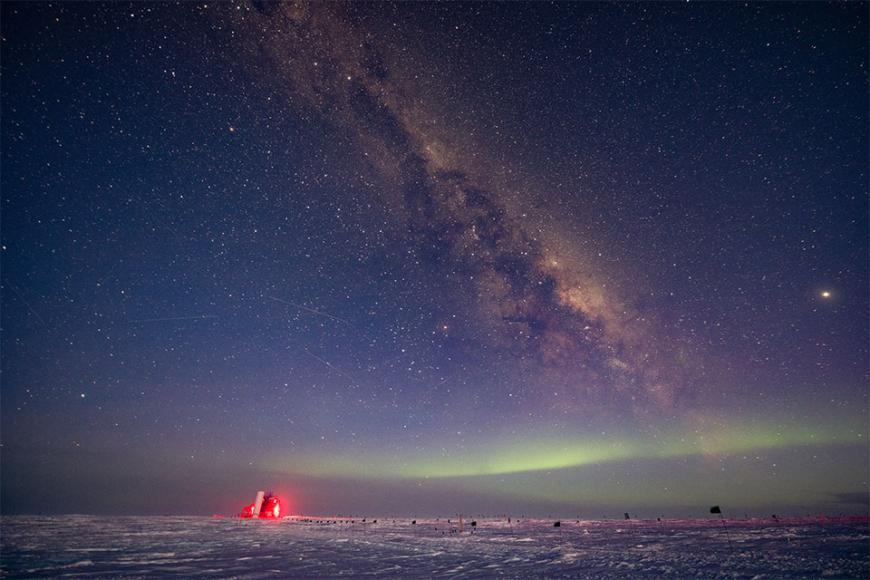
IceCube detection of ‘Glashow resonance’ proves 60-year-old theory 'Glashow resonance' event observed in IceCube Neutrino Observatory. 10 March 2021
Tutoring and mentoring for local Y12 students Oxford’s Department of Physics is partnering with the Institute of Physics to offer a brand new programme of tutoring and mentoring to local school students who want to study physics at university - Levelling up: physics. 8 March 2021
Dame Jocelyn Bell Burnell recognised on IWD Jocelyn Bell Burnell has been recognised along with seven other women in the Vanity Fair International Women's Day Challenger Awards 2021. 8 March 2021
The promise of perovskites The latest findings of a team of researchers at Oxford's Department of Physics add further weight to perovskites earning their status as wonder-materials in the world of semiconductors. 3 March 2021
Scientists uncover cosmic particle accelerator Professor Rob Fender from Oxford’s Department of Physics gathered and interpreted radio observations that helped an international collaboration of scientists discover a gigantic cosmic particle accelerator. 22 February 2021
ExoMars discovers hydrogen chloride on Mars Sea salt embedded in the dusty surface of Mars and lofted into the planet’s atmosphere has led to the discovery of hydrogen chloride – the first time the ESA-Roscosmos ExoMars Trace Gas Orbiter has detected a new gas. 10 February 2021
Stargazing Oxford@Home Our annual Stargazing event is an afternoon and evening of fascinating talks, hands-on activities and, not surprisingly, telescopes; this year, we stage a pandemic-proof online edition. 1 February 2021