

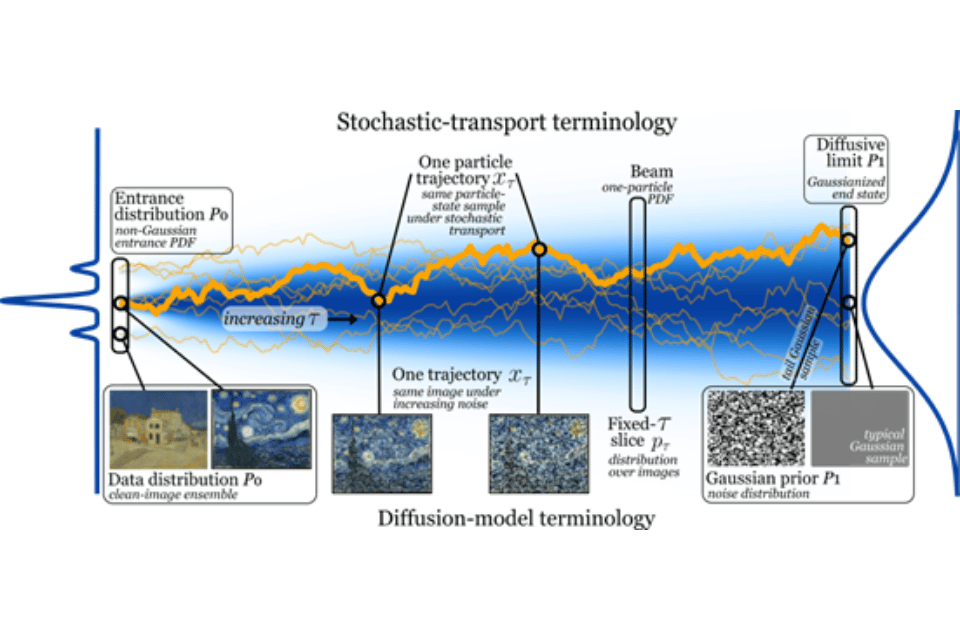
Researchers at the University of Oxford have developed a new way to use generative artificial intelligence (AI) that circumvents the need for machine-learning models to rediscover relationships that physicists already know how to describe. This novel approach is aimed at a familiar gap in physics where we happen to know the law that governs how a population spreads, but are unable to follow each microscopic trajectory – because when many particles move through a turbulent environment their collective evolution becomes too expensive to calculate, too difficult to observe directly, or too sparsely sampled to be reconstructed in detail.
The underlying technology is a class of diffusion models best known from AI image generators; these can recover structure after information has been gradually washed away by noise. They learn the statistical landscape well enough to generate many plausible outcomes. Yet the journey from noise to structure is usually contrived – designed to make the algorithm work well, rather than to represent what actually happens in nature.
Lead author Dr Patrick Reichherzer was a DFG Walter Benjamin Fellow in Oxford plasma physics when this work was done. He says: ‘In many physical systems, randomness is the process itself, not something we need to add artificially. For example, we can describe how populations of charged particles propagate through magnetised turbulence, using statistical laws. We wanted to build this understanding of physics directly into the generative AI, instead of having the neural network rediscover it from data via a numerically expensive training process.’
Co-author Dr David Hosking was a DPhil student in astrophysics at Oxford and awarded several prizes for his thesis.
The authors simulated the behaviour of a physical system – charged particles in a turbulent magnetic field – with the transition from ballistic to diffusive transport modelled by the ‘telegraph equation’. They set up a new ‘physically anchored diffusion model’ framework in which the transport laws are embedded directly into the model, so the neural network did not need to learn the system’s timescale empirically; moreover higher-order statistics could be accurately captured rather than just the variance. This represents a substantial speedup over conventional approaches, while reducing computational demands, by focussing on machine learning only rare events, after the evolution of the variance has been analytically described. The framework is applicable wherever the macroscopic transport laws are known — whether in biology or in finance. This novel approach should stimulate further investigation into generative models in physics-informed simulation and inference.
‘This work shows not only how generative AI can be used to interpret physical systems, but also how physics can help construct more efficient AI algorithms – especially for image generation as demonstrated in our paper,’ adds co-author Professor Gianluca Gregori.
Co-author Professor Subir Sarkar concludes: ‘AI is a useful tool and machine learning techniques have been used by physicists for decades. As our work shows, they are far more effective when informed by physical understanding – rather than performing just brute force computation which neither provides the fundamental insights we seek, nor is environmentally sustainable in its energy usage.’
Generative diffusion surrogates with analytical variance schedule, P Reichherzer et al, Nature Communications, 8 October 2026