Home
Department Of Physics text logo
  • Research
    • Our research
    • Our research groups
    • Our research in action
    • Research funding support
    • Summer internships for undergraduates
  • Study
    • Undergraduates
    • Postgraduates
  • Engage
    • For alumni
    • For business
    • For schools
    • For the public
  • Support
Menu
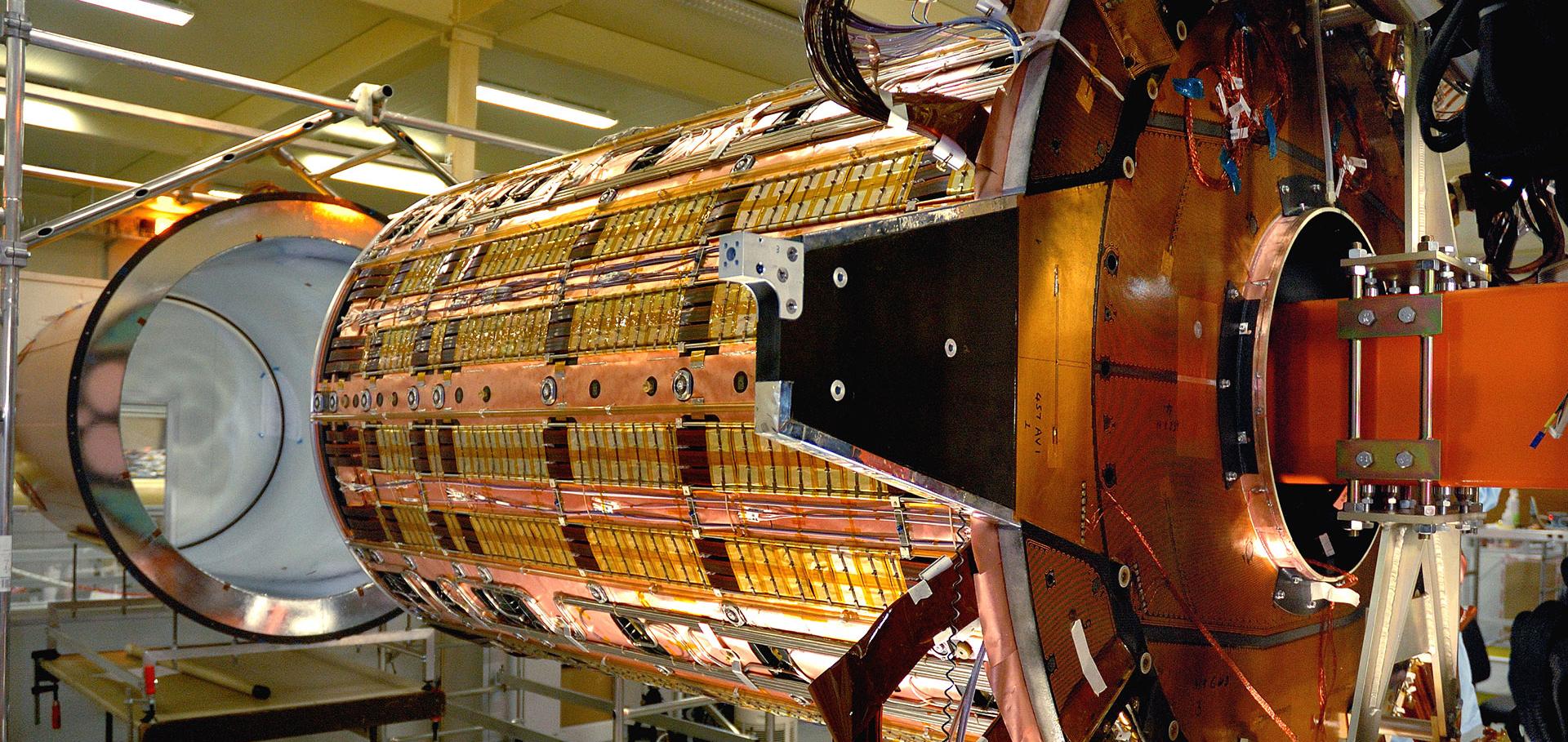
Insertion of STC into TRT at the Department of Physics, Oxford
Credit: CERN

David Bacher

Graduate Student

Sub department

  • Particle Physics

Research groups

  • LHCb
david.bacher@physics.ox.ac.uk
Telephone: (2)73382
Denys Wilkinson Building, room 653
  • About
  • Publications

Search for the lepton-flavour-violating decays B 0 → K *0 τ ± e ∓

Journal of High Energy Physics Springer 2025:11 (2025) 172

Authors:

R Aaij, ASW Abdelmotteleb, C Abellan Beteta, F Abudinén, T Ackernley, AA Adefisoye, B Adeva, M Adinolfi, P Adlarson, C Agapopoulou, CA Aidala, Z Ajaltouni, S Akar, K Akiba, P Albicocco, J Albrecht, F Alessio, Z Aliouche, P Alvarez Cartelle, R Amalric, S Amato, JL Amey, Y Amhis, L An, D Bacher

Abstract:

A first search at LHCb for the lepton-flavour-violating decays B0 → K*0τ±e∓ is presented. The analysis is performed using a sample of proton-proton collision data, collected with the LHCb detector at a centre-of-mass energy of 13 TeV between 2016 and 2018, corresponding to an integrated luminosity of 5.4 fb−1. No significant signal is observed, and upper limits on the branching fractions are determined to be BB0→K∗0τ−e+<5.97.1×10−6 and BB0→K∗0τ+e−<4.95.9×10−6 at the 90% (95%) confidence level. These results correspond to the current most stringent upper limits for b → sτl transitions.
More details from the publisher
Details from ORA
More details

Coherent photoproduction of ρ 0, ω and excited vector mesons in ultraperipheral PbPb collisions

Journal of High Energy Physics Springer 2025:11 (2025) 103

Authors:

R Aaij, ASW Abdelmotteleb, C Abellan Beteta, F Abudinén, T Ackernley, AA Adefisoye, B Adeva, M Adinolfi, P Adlarson, C Agapopoulou, CA Aidala, Z Ajaltouni, S Akar, K Akiba, P Albicocco, J Albrecht, F Alessio, Z Aliouche, P Alvarez Cartelle, R Amalric, S Amato, JL Amey, Y Amhis, L An, D Bacher

Abstract:

The invariant-mass distribution for the coherent photoproduction of dipions in ultraperipheral PbPb collisions is measured using data, corresponding to an integrated luminosity of 224.6 ± 9.6μb−1, collected by the LHCb experiment in 2018 at a nucleon-nucleon centre-of-mass energy sNN=5.02 TeV. In the mass range from 400 to 1200 MeV, the results are consistent with previous experiments, with the spectrum dominated by the ρ0 meson, which interferes with a nonresonant component, together with a smaller ω meson contribution. In an extended mass range up to 2300 MeV, models previously used do not fit the data and a consistent description requires the introduction of two resonances at masses of 1350 ± 20 MeV and 1790 ± 20 MeV with widths of about 300 MeV. The cross-section for each meson is measured differentially in twelve bins of rapidity from 2.05 to 4.90. The ρ0 cross-section increases with rapidity from about 400 to 600 mb and is measured with a typical precision of 8%, while the cross-section times branching fraction for the ω, ρ′ and ρ′′, with the statistical precision of the data, do not have a pronounced rapidity dependence and are between 0.5 and 1.5mb, with uncertainties up to 30%. A large nuclear suppression is observed for the ρ0 meson compared to expectations based on photoproduction on the proton that use the impulse approximation. Significant suppression is also observed compared to that predicted by elastic scattering described in the Glauber approach, or with the addition of inelastic scattering in a Gribov-Glauber model.
More details from the publisher
Details from ORA
More details

Inclusive B -meson flavour-tagging algorithm at LHCb

Journal of High Energy Physics Springer 2025:11 (2025) 41

Authors:

R Aaij, ASW Abdelmotteleb, C Abellan Beteta, F Abudinén, T Ackernley, AA Adefisoye, B Adeva, M Adinolfi, P Adlarson, C Agapopoulou, CA Aidala, Z Ajaltouni, S Akar, K Akiba, P Albicocco, J Albrecht, R Aleksiejunas, F Alessio, P Alvarez Cartelle, R Amalric, S Amato, JL Amey, Y Amhis, L An, D Bacher

Abstract:

A new algorithm is developed to identify the flavour of neutral B mesons at production in pp collisions by utilising all tracks from the hadronisation process. The algorithm is calibrated separately for B0 and Bs0 mesons using B0 → J/ψK+π− and Bs0→Ds−π+ decays from pp collision data collected by the LHCb experiment at a centre-of-mass energy of 13 TeV. This new algorithm improves the tagging power by 35% for B0 mesons and 20% for Bs0 mesons when compared to the combined performance of the existing LHCb flavour-tagging algorithms.
More details from the publisher
Details from ORA
More details

Measurement of branching fractions and CP asymmetries in Λ b 0 Ξ b 0 → p K S 0 h − decays

Journal of High Energy Physics Springer 2025:10 (2025) 169

Authors:

R Aaij, ASW Abdelmotteleb, C Abellan Beteta, F Abudinén, T Ackernley, AA Adefisoye, B Adeva, M Adinolfi, P Adlarson, C Agapopoulou, CA Aidala, Z Ajaltouni, S Akar, K Akiba, P Albicocco, J Albrecht, F Alessio, Z Aliouche, P Alvarez Cartelle, R Amalric, S Amato, JL Amey, Y Amhis, L An, D Bacher

Abstract:

A study of Λb0 and Ξb0 baryon decays to the final states pKS0π− and pKS0K− is performed using pp collision data collected by the LHCb experiment, corresponding to an integrated luminosity of 9 fb−1. The decays Λb0→pKS0K− and Ξb0→pKS0K− are observed for the first time, with significances reaching eight standard deviations. The branching fractions and integrated CP asymmetries are measured for the Λb0→pKS0π−, Λb0→pKS0K−, and Ξb0→pKS0K− decays. For the decay Λb0→pKS0π−, the CP asymmetries are measured in different regions of the Dalitz plot. No evidence of CP violation is observed.
More details from the publisher
Details from ORA
More details

Updated measurement of CP violation and polarisation in B s 0 → J / ψ K ¯ ∗ 892 0 decays

Journal of High Energy Physics Springer 2025:10 (2025) 173

Authors:

R Aaij, ASW Abdelmotteleb, C Abellan Beteta, F Abudinén, T Ackernley, AA Adefisoye, B Adeva, M Adinolfi, P Adlarson, C Agapopoulou, CA Aidala, Z Ajaltouni, S Akar, K Akiba, P Albicocco, J Albrecht, R Aleksiejunas, F Alessio, Z Aliouche, P Alvarez Cartelle, R Amalric, S Amato, JL Amey, Y Amhis, D Bacher

Abstract:

A time-integrated angular analysis of the decay Bs0→J/ψK¯∗8920, with J/ψ → μ+μ− and K¯∗8920→K−π+, is presented. The analysis employs a sample of proton-proton collision data collected by the LHCb experiment during 2015–2018 at a centre-of-mass energy of 13 TeV, corresponding to an integrated luminosity of 6 fb−1. A simultaneous maximum-likelihood fit is performed to the angular distributions in bins of the K−π+ mass. This fit yields measurements of the CP-averaged polarisation fractions and CP asymmetries for the P-wave component of the K−π+ system. The longitudinal and parallel polarisation fractions are determined to be f0 = 0.534 ± 0.012 ± 0.009 and f|| = 0.211 ± 0.014 ± 0.005, respectively, where the first uncertainty is statistical and the second is systematic. The CP asymmetries are measured with 3–7% precision and are found to be consistent with zero. These measurements, along with an updated determination of the branching fraction relative to the B0 → J/ψK*0 decay, are combined with previous LHCb results, providing the most precise values for these observables to date.
More details from the publisher
Details from ORA
More details

Pagination

  • First page First
  • Previous page Prev
  • …
  • Page 4
  • Page 5
  • Page 6
  • Page 7
  • Current page 8
  • Page 9
  • Page 10
  • Page 11
  • Page 12
  • …
  • Next page Next
  • Last page Last

Footer Menu

  • Contact us
  • Giving to the Dept of Physics
  • Work with us
  • Media

User account menu

  • Log in

Follow us

FIND US

Clarendon Laboratory,

Parks Road,

Oxford,

OX1 3PU

CONTACT US

Tel: +44(0)1865272200

University of Oxfrod logo Department Of Physics text logo
IOP Juno Champion logo Athena Swan Silver Award logo

© University of Oxford - Department of Physics

Cookies | Privacy policy | Accessibility statement

Built by: Versantus

  • Home
  • Research
  • Study
  • Engage
  • Our people
  • News & Comment
  • Events
  • Our facilities & services
  • About us
  • Giving to Physics
  • Current students
  • Staff intranet