


Forward production of charged pions with incident π± on nuclear targets measured at the CERN PS
Nuclear Physics A 821:1-4 (2009) 118-192
Abstract:
Measurements of the double-differential π± production cross-section in the range of momentum 0.5 GeV / c ≤ p ≤ 8.0 GeV / c and angle 0.025 rad ≤ θ ≤ 0.25 rad in interactions of charged pions on beryllium, carbon, aluminium, copper, tin, tantalum and lead are presented. These data represent the first experimental campaign to systematically measure forward pion hadroproduction. The data were taken with the large acceptance HARP detector in the T9 beam line of the CERN PS. Incident particles, impinging on a 5% nuclear interaction length target, were identified by an elaborate system of beam detectors. The tracking and identification of the produced particles was performed using the forward spectrometer of the HARP detector. Results are obtained for the double-differential cross-sections d2 σ / d p d Ω mainly at four incident pion beam momenta (3 GeV/c, 5 GeV/c, 8 GeV/c and 12 GeV/c). The measurements are compared with the GEANT4 and MARS Monte Carlo simulation. © 2009 Elsevier B.V.Sudden stratospheric warmings seen in MINOS deep underground muon data
Geophysical Research Letters 36:5 (2009)
Abstract:
The rate of high energy cosmic ray muons as measured underground is shown to be strongly correlated with upper-air temperatures during short-term atmospheric (10-day) events. The effects are seen by correlating data from the MINOS underground detector and temperatures from the European Centre for Medium Range Weather Forecasts during the winter periods from 2003-2007. This effect provides an independent technique for the measurement of meteorological conditions and presents a unique opportunity to measure both short and long-term changes in this important part of the atmosphere. Copyright 2009 by the American Geophysical Union.Search for muon-Neutrino to electron-Neutrino transitions in MINOS
Physical Review Letters 103:26 (2009)
Abstract:
This Letter reports on a search for νμ→νe transitions by the MINOS experiment based on a 3.14×10²⁰ protons-on-target exposure in the Fermilab NuMI beam. We observe 35 events in the Far Detector with a background of 27±5(stat)±2(syst) events predicted by the measurements in the Near Detector. If interpreted in terms of νμ→νe oscillations, this 1.5σ excess of events is consistent with sin 2(2θ13) comparable to the CHOOZ limit when |Δm2|=2.43×10⁻³eV2 and sin 2(2θ23)=1.0 are assumed. © 2009 The American Physical Society.Absolute momentum calibration of the HARP TPC
Journal of Instrumentation 3:4 (2008)
Abstract:
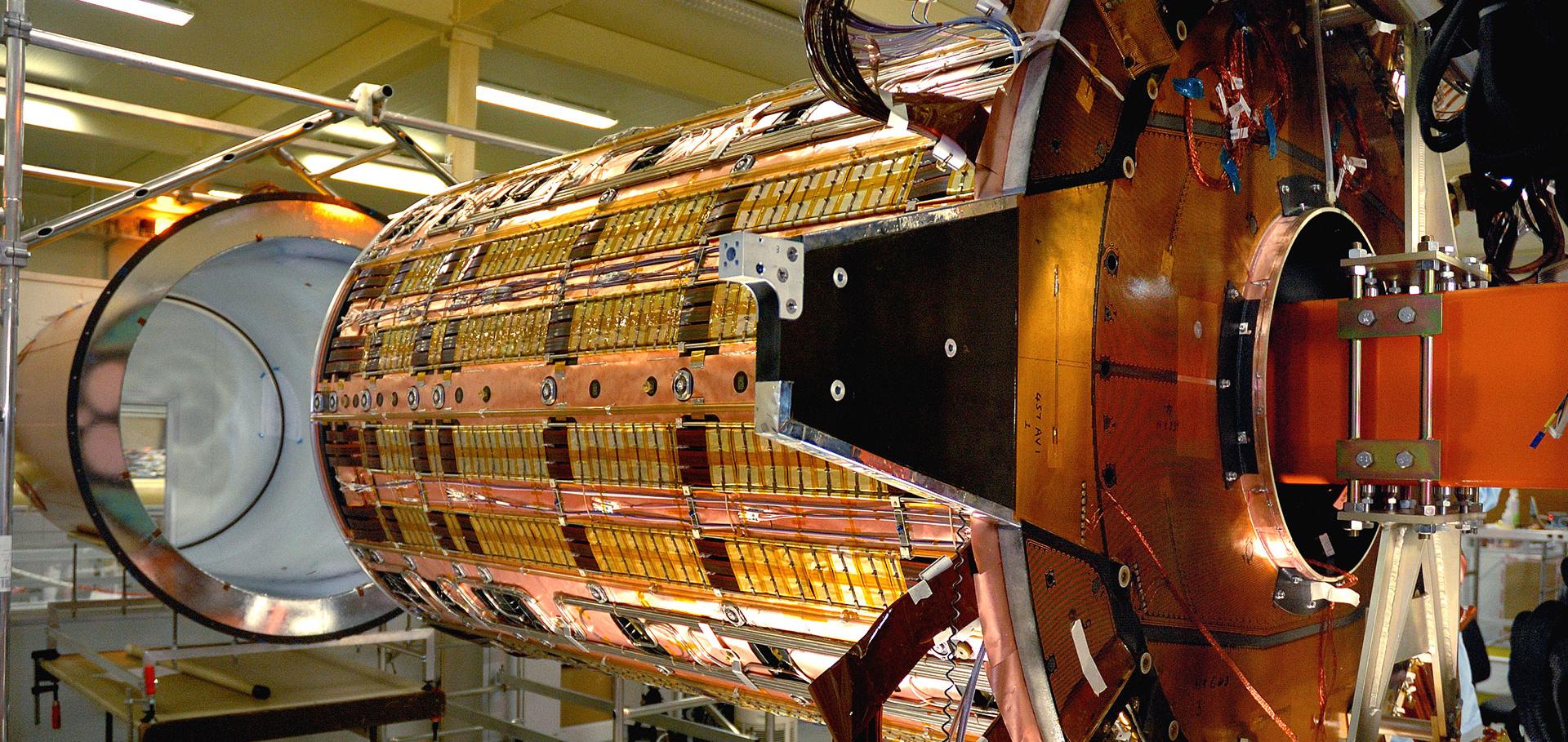
In the HARP experiment the large-angle spectrometer is using a cylindrical TPC as main tracking and particle identification detector. The momentum scale of reconstructed tracks in the TPC is the most important systematic error for the majority of kinematic bins used for the HARP measurements of the double-differential production cross-section of charged pions in proton interactions on nuclear targets at large angle. The HARP TPC operated with a number of hardware shortfalls and operational mistakes. Thus it was important to control and characterize its momentum calibration. While it was not possible to enter a direct particle beam into the sensitive volume of the TPC to calibrate the detector, a set of physical processes and detector properties were exploited to achieve a precise calibration of the apparatus. In the following we recall the main issues concerning the momentum measurement in the HARP TPC, and describe the cross-checks made to validate the momentum scale. As a conclusion, this analysis demonstrates that the measurement of momentum is correct within the published precision of 3%. © 2008 IOP Publishing Ltd and SISSA.Search for active neutrino disappearance using neutral-current interactions in the MINOS long-baseline experiment
Physical Review Letters 101:22 (2008)