Home
Department Of Physics text logo
  • Research
    • Our research
    • Our research groups
    • Our research in action
    • Research funding support
    • Summer internships for undergraduates
  • Study
    • Undergraduates
    • Postgraduates
  • Engage
    • For alumni
    • For business
    • For schools
    • For the public
  • Support
Menu
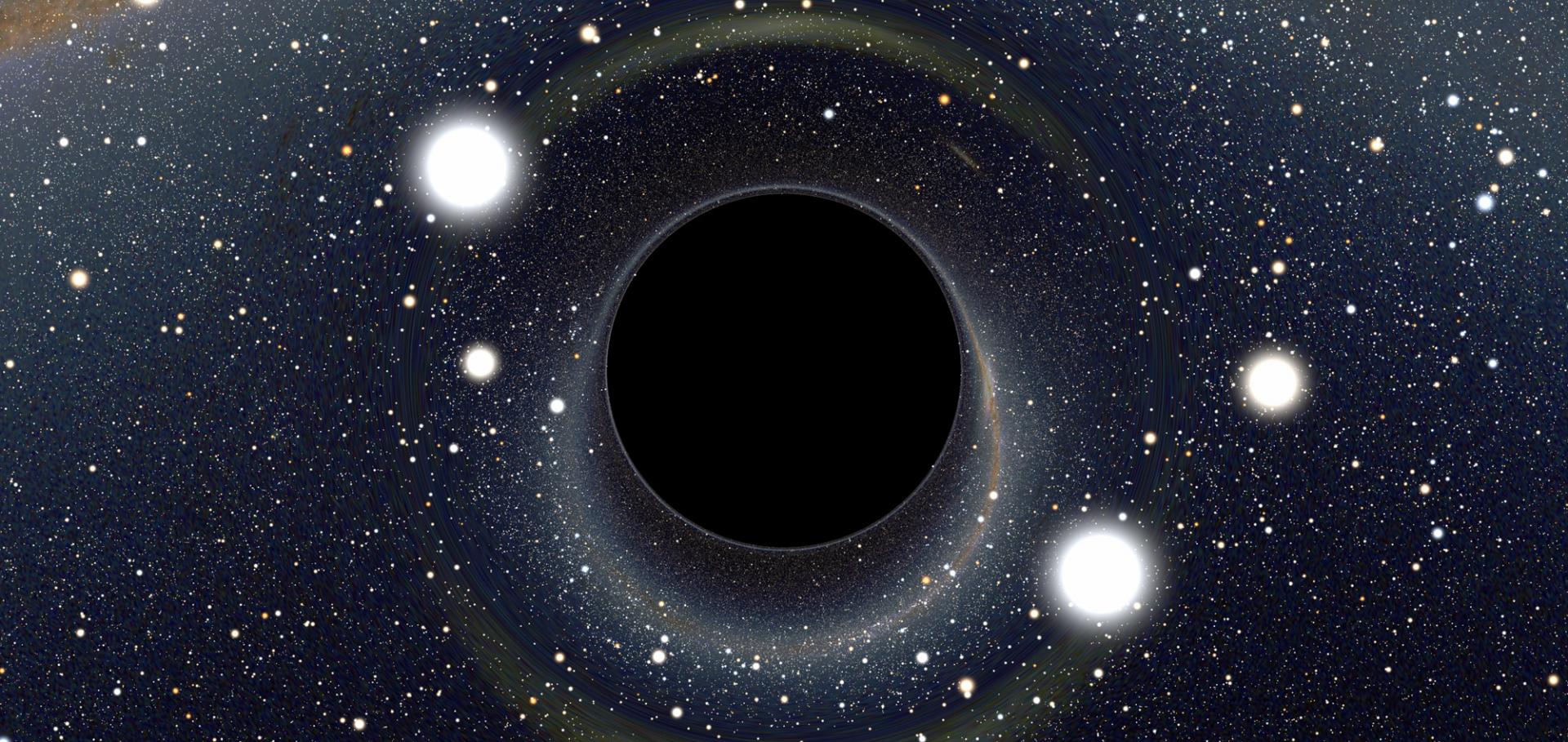
Black Hole

Lensing of space time around a black hole. At Oxford we study black holes observationally and theoretically on all size and time scales - it is some of our core work.

Credit: ALAIN RIAZUELO, IAP/UPMC/CNRS. CLICK HERE TO VIEW MORE IMAGES.

Professor Andrew Bunker

Professor of Astrophysics

Research theme

  • Astronomy and astrophysics

Sub department

  • Astrophysics

Research groups

  • Galaxy formation and evolution
Andy.Bunker@physics.ox.ac.uk
Telephone: 01865 (2)83126
Denys Wilkinson Building, room 702
  • About
  • Publications

Polycyclic Aromatic Hydrocarbon Emission in the Central Regions of Three Seyferts and the Implication for Underlying Feedback Mechanisms

The Astrophysical Journal Letters American Astronomical Society 975:1 (2024) L2

Authors:

Lulu Zhang, Ismael García-Bernete, Chris Packham, Fergus R Donnan, Dimitra Rigopoulou, Erin KS Hicks, Ric I Davies, Taro T Shimizu, Almudena Alonso-Herrero, Cristina Ramos Almeida, Miguel Pereira-Santaella, Claudio Ricci, Andrew J Bunker, Mason T Leist, David J Rosario, Santiago García-Burillo, Laura Hermosa Muñoz, Francoise Combes, Masatoshi Imanishi, Alvaro Labiano, Donaji Esparza-Arredondo, Enrica Bellocchi, Anelise Audibert, Lindsay Fuller

Abstract:

We analyze JWST Mid-Infrared Instrument/Medium Resolution Spectrograph integral field unit observations of three Seyferts from the Galactic Activity, Torus, and Outflow Survey (GATOS) and showcase the intriguing polycyclic aromatic hydrocarbon (PAH) and emission-line characteristics in regions of ∼500 pc scales over or around their active galactic nuclei (AGN). Combing the measurements and model predictions, we find that the central regions containing a high fraction of neutral PAHs with small sizes, e.g., those in ESO137-G034, are in highly heated environments, due to collisional shock heating, with hard and moderately intense radiation fields. Such environments are proposed to result in inhibited growth or preferential erosion of PAHs, decreasing their average size and overall abundance. We additionally find that the central regions containing a high fraction of ionized PAHs with large sizes, e.g., those in MCG-05-23-016, are likely experiencing severe photoionization because of the radiative effects from the radiative shock precursor besides the AGN. The severe photoionization can contribute to the ionization and further destruction of PAHs. Overall, different Seyferts, even different regions in the same galaxy, e.g., those in NGC 3081, can contain PAH populations of different properties. Specifically, Seyferts that exhibit similar PAH characteristics to ESO137-G034 and MCG-05-23-016 also tend to have similar emission-line properties to them, suggesting that the explanations for PAH characteristics of ESO137-G034 and MCG-05-23-016 may also apply generally. These results have promising application in the era of JWST, especially in diagnosing different (i.e., radiative and kinetic) AGN feedback modes.
More details from the publisher
Details from ORA
More details

SMILES: Discovery of Higher Ionizing Photon Production Efficiency in Overdense Regions

(2024)

Authors:

Yongda Zhu, Stacey Alberts, Jianwei Lyu, Jane Morrison, George H Rieke, Yang Sun, Jakob M Helton, Zhiyuan Ji, Rachana Bhatawdekar, Nina Bonaventura, Andrew J Bunker, Xiaojing Lin, Marcia J Rieke, Pierluigi Rinaldi, Irene Shivaei, Christopher NA Willmer, Junyu Zhang
More details from the publisher

The abundance and nature of high-redshift quiescent galaxies from JADES spectroscopy and the FLAMINGO simulations

(2024)

Authors:

William M Baker, Seunghwan Lim, Francesco D'Eugenio, Roberto Maiolino, Zhiyuan Ji, Santiago Arribas, Andrew J Bunker, Stefano Carniani, Stephane Charlot, Anna de Graaff, Kevin Hainline, Tobias J Looser, Jianwei Lyu, Pierluigi Rinaldi, Brant Robertson, Matthieu Schaller, Joop Schaye, Jan Scholtz, Hannah Ubler, Christina C Williams, Christopher NA Willmer, Chris Willott, Yongda Zhu
More details from the publisher

Using JADES NIRCam photometry to investigate the dependence of stellar mass inferences on the IMF in the early universe

Proceedings of the National Academy of Sciences of the United States of America Proceedings of the National Academy of Sciences 121:42 (2024) e2317375121

Authors:

Charity Woodrum, Marcia Rieke, Zhiyuan Ji, William M Baker, Rachana Bhatawdekar, Andrew J Bunker, Stéphane Charlot, Emma Curtis-Lake, Daniel J Eisenstein, Kevin Hainline, Ryan Hausen, Jakob M Helton, Raphael E Hviding, Benjamin D Johnson, Brant Robertson, Fengwu Sun, Sandro Tacchella, Lily Whitler, Christina C Williams, Christopher NA Willmer
More details from the publisher
More details

GA-NIFS & EIGER: A merging quasar host at z=7 with an overmassive black hole

(2024)

Authors:

Madeline A Marshall, Minghao Yue, Anna-Christina Eilers, Jan Scholtz, Michele Perna, Chris J Willott, Roberto Maiolino, Hannah Übler, Santiago Arribas, Andrew J Bunker, Stephane Charlot, Bruno Rodríguez Del Pino, Torsten Böker, Stefano Carniani, Giovanni Cresci, Francesco D'Eugenio, Gareth C Jones, Giacomo Venturi, Rongmon Bordoloi, Daichi Kashino, Ruari Mackenzie, Jorryt Matthee, Rohan Naidu, Robert A Simcoe
More details from the publisher

Pagination

  • First page First
  • Previous page Prev
  • …
  • Page 30
  • Page 31
  • Page 32
  • Page 33
  • Current page 34
  • Page 35
  • Page 36
  • Page 37
  • Page 38
  • …
  • Next page Next
  • Last page Last

Footer Menu

  • Contact us
  • Giving to the Dept of Physics
  • Work with us
  • Media

User account menu

  • Log in

Follow us

FIND US

Clarendon Laboratory,

Parks Road,

Oxford,

OX1 3PU

CONTACT US

Tel: +44(0)1865272200

University of Oxfrod logo Department Of Physics text logo
IOP Juno Champion logo Athena Swan Silver Award logo

© University of Oxford - Department of Physics

Cookies | Privacy policy | Accessibility statement

Built by: Versantus

  • Home
  • Research
  • Study
  • Engage
  • Our people
  • News & Comment
  • Events
  • Our facilities & services
  • About us
  • Giving to Physics
  • Current students
  • Staff intranet