


The 2dF Galaxy Redshift Survey: luminosity functions by density environment and galaxy type
MONTHLY NOTICES OF THE ROYAL ASTRONOMICAL SOCIETY 356:3 (2005) 1155-1167
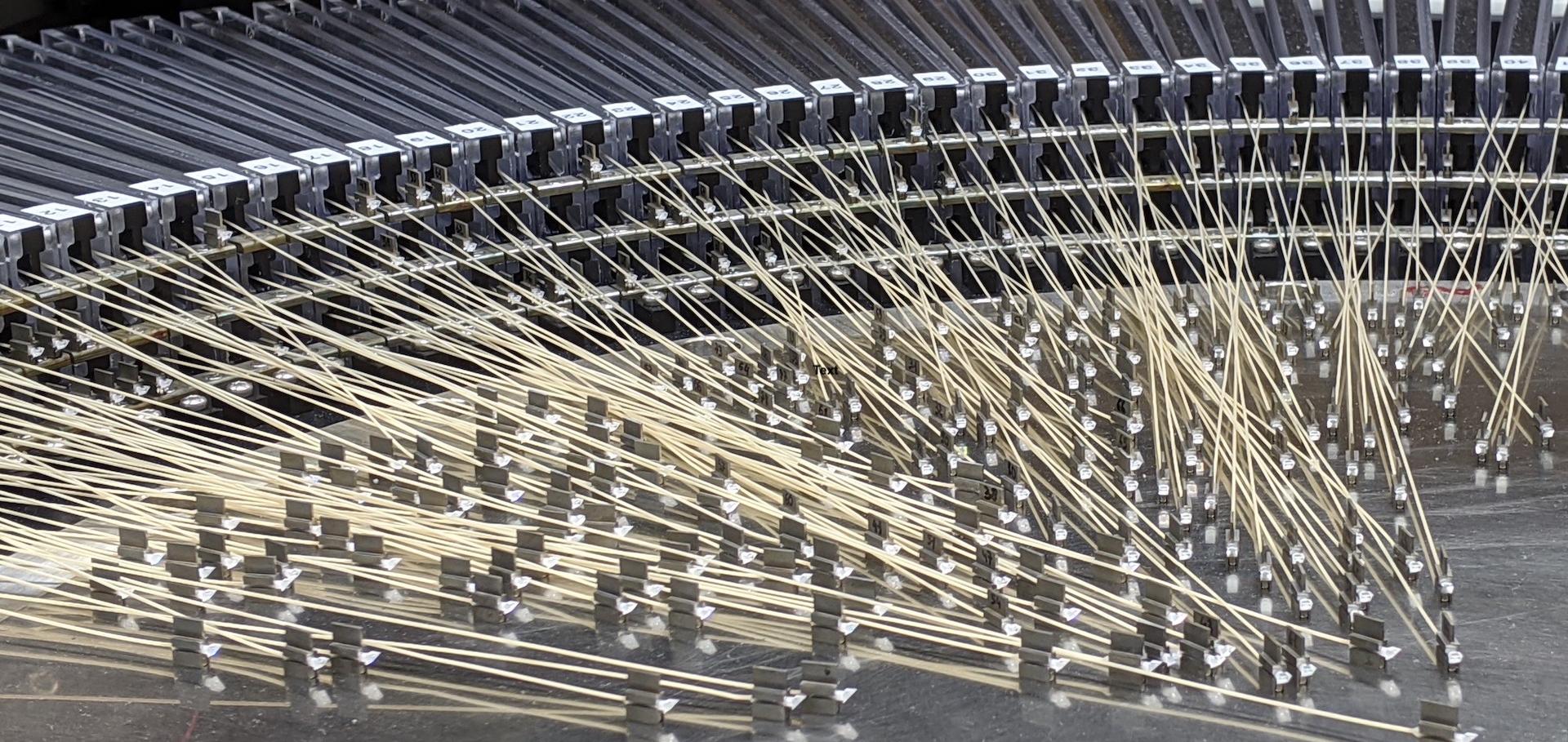
Novel coating and photo-fabrication techniques for astronomy
Proceedings of SPIE the International Society for Optical Engineering 5494 (2004) 562-565
Abstract:
In this paper we describe two coating and fabrication techniques we have developed applicable to astronomical instrumentation with particular emphasis on the FMOS instrument for the Subaru telescope.The VISTA IR camera
Proceedings of SPIE the International Society for Optical Engineering 5492:PART 2 (2004) 988-997
Abstract:
The VISTA IR Camera has now completed its detailed design phase and is on schedule for delivery to ESO's Cerro Paranal Observatory in 2006. The camera consists of 16 Raytheon VIRGO 2048×2048 HgCdTe arrays in a sparse focal plane sampling a 1.65 degree field of view. A 1.4m diameter filter wheel provides slots for 7 distinct science filters, each comprising 16 individual filter panes. The camera also provides autoguiding and curvature sensing information for the VISTA telescope, and relies on tight tolerancing to meet the demanding requirements of the f/1 telescope design. The VISTA IR camera is unusual in that it contains no cold pupil-stop, but rather relies on a series of nested cold baffles to constrain the light reaching the focal plane to the science beam. In this paper we present a complete overview of the status of the final IR Camera design, its interaction with the VISTA telescope, and a summary of the predicted performance of the system.The current status of the UK-FMOS spectrograph
Proceedings of SPIE the International Society for Optical Engineering 5492:PART 3 (2004) 1362-1370
Abstract:
FMOS is a near-IR OH-suppressed multi-fibre fed spectrograph for the Subaru telescope. The spectrograph will accept 200 optical fibres from the ECHIDNA positioner system at the 30arcmin Prime focus of the telescope. We will describe the recent activities here in the UK in progressing the instrument from its conceptual phase through detailed design and into manufacture. A variety of technical areas will be described including: the opto-mechanical system design and construction, development of the HAWAH-II detector control system, the thermal system design & control and OH suppression techniques.Galaxy groups in the two-degree field galaxy redshift survey: The luminous content of the groups
Monthly Notices of the Royal Astronomical Society 355:3 (2004) 769-784