Home
Department Of Physics text logo
  • Research
    • Our research
    • Our research groups
    • Our research in action
    • Research funding support
    • Summer internships for undergraduates
  • Study
    • Undergraduates
    • Postgraduates
  • Engage
    • For young people
    • For teachers
    • For the public
    • For alumni
    • For business
  • Support
Menu
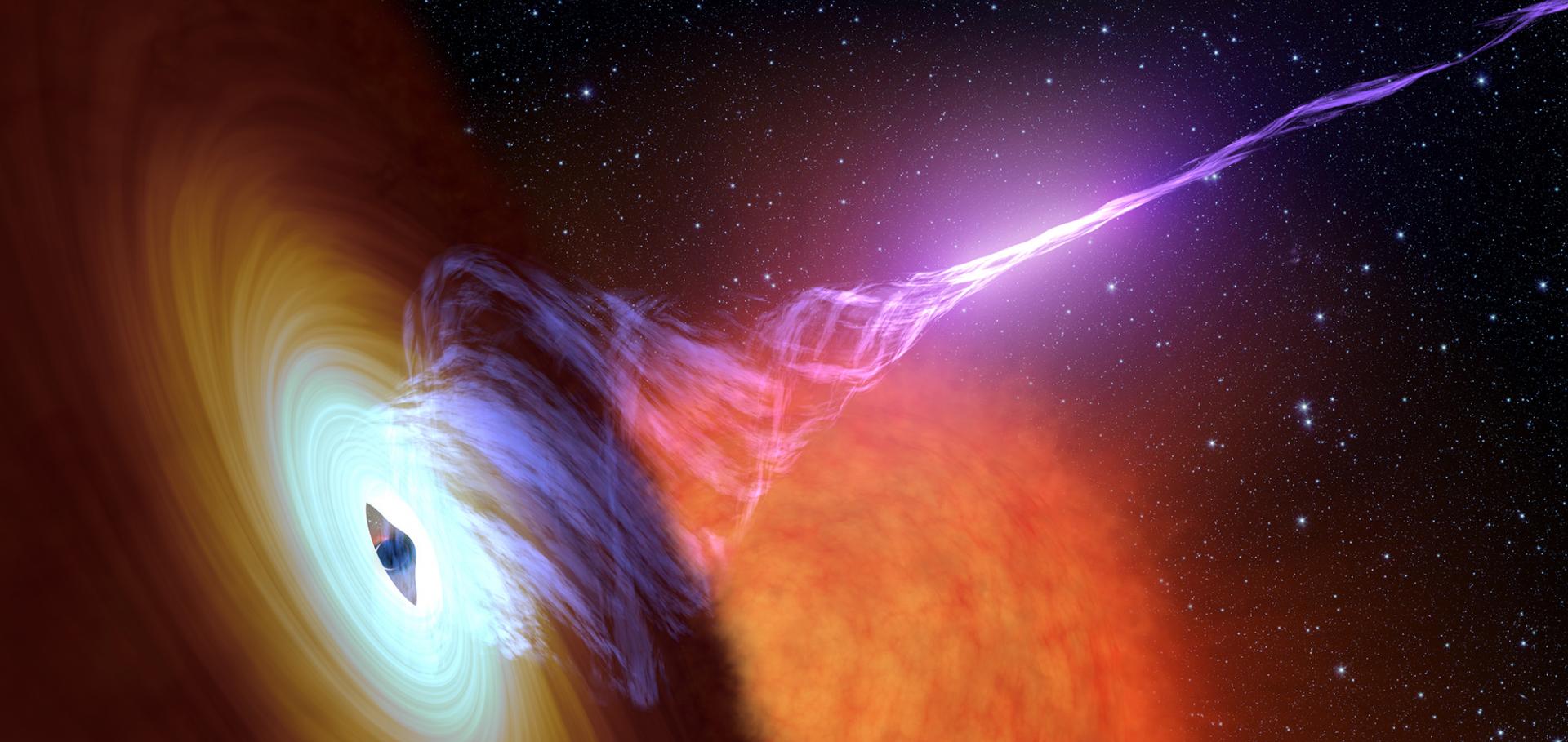
Relativistic Jet from Black Hole

An artist's impression of a relativistic jet propagating away from a black hole at close to the speed of light. Such jets are formed by the inner regions of the accretion flow: matter flowing inwards towards the black hole, via processes which are not yet fully understood. The accretion flow emits primarily in X-rays, the relativistic jet in the radio band: by combing observations in each band we can try and understand how such jets form and how much energy they carry away from the black hole.

Professor Rob Fender

Professor of Astrophysics

Research theme

  • Astronomy and astrophysics

Sub department

  • Astrophysics

Research groups

  • Hintze Centre for Astrophysical Surveys
  • MeerKAT
  • Pulsars, transients and relativistic astrophysics
  • Rubin-LSST
  • The Square Kilometre Array (SKA)
  • Gamma-ray astronomy
Rob.Fender@physics.ox.ac.uk
Telephone: 01865 (2)73435
Denys Wilkinson Building, room 712
  • About
  • Publications

Multiwavelength Observations of the Black Hole Candidate Swift J1753.5‐0127

AIP Conference Proceedings AIP Publishing 1010:1 (2008) 103-106

Authors:

P Soleri, D Altamirano, R Fender, P Casella, V Tudose, D Maitra, R Wijnands, T Belloni, J Miller-Jones, M Klein-Wolt, M van der Klis, Reba M Bandyopadhyay, Stefanie Wachter, Dawn Gelino, Christopher R Gelino
More details from the publisher
More details
Details from ArXiV

Searching for the signatures of jet-ISM interactions in X-ray binaries

(2008)

Authors:

J Miller-Jones, C Kaiser, T Maccarone, R Fender, A Kapińska, K Gunn, D Russell, C Brocksopp, J Sokoloski, B Stappers, T Muxlow

Abstract:

Jets from X-ray binaries are continuously injecting matter and energy into the surrounding interstellar medium (ISM). However, there exist to date relatively few cases where jet-ISM interactions have been directly observed. We review the current examples, and go on to present new data on the proposed hotspots of GRS1915+105, finding no concrete evidence for any association between the hotspots and the central source, in agreement with previous findings in the literature. We also present preliminary results on radio and H-alpha searches for jet-ISM interactions around known X-ray binaries, and discuss strategies for future searches.
More details from the publisher
Details from ArXiV

Polarimetric Signatures of Infrared Jets in X-ray Binaries

A Population Explosion: The Nature & Evolution of X-ray Binaries in Diverse Environments 1010 (2008) 100-102-100-102

Authors:

T Shahbaz, RP Fender, CA Watson, K O Brien
More details from the publisher
More details

Coupled radio and X-ray emission and evidence for discrete ejecta in the jets of SS 433

(2008)

Authors:

JCA Miller-Jones, S Migliari, RP Fender, TWJ Thompson, M van der Klis, M Mendez
More details from the publisher

Studying the X-ray hysteresis in GX 339-4: the disc and iron line over one decade

(2008)

Authors:

RJH Dunn, RP Fender, EG Koerding, C Cabanac, T Belloni
More details from the publisher

Pagination

  • First page First
  • Previous page Prev
  • …
  • Page 152
  • Page 153
  • Page 154
  • Page 155
  • Current page 156
  • Page 157
  • Page 158
  • Page 159
  • Page 160
  • …
  • Next page Next
  • Last page Last

Footer Menu

  • Contact us
  • Giving to the Dept of Physics
  • Work with us
  • Media

User account menu

  • Log in

Follow us

FIND US

Clarendon Laboratory,

Parks Road,

Oxford,

OX1 3PU

CONTACT US

Tel: +44(0)1865272200

University of Oxfrod logo Department Of Physics text logo
IOP Juno Champion logo Athena Swan Silver Award logo

© University of Oxford - Department of Physics

Cookies | Privacy policy | Accessibility statement

Built by: Versantus

  • Home
  • Research
  • Study
  • Engage
  • Our people
  • News & Comment
  • Events
  • Our facilities & services
  • About us
  • Giving to Physics
  • Current students
  • Staff intranet