Home
Department Of Physics text logo
  • Research
    • Our research
    • Our research groups
    • Our research in action
    • Research funding support
    • Summer internships for undergraduates
  • Study
    • Undergraduates
    • Postgraduates
  • Engage
    • For young people
    • For teachers
    • For the public
    • For alumni
    • For business
  • Support
Menu
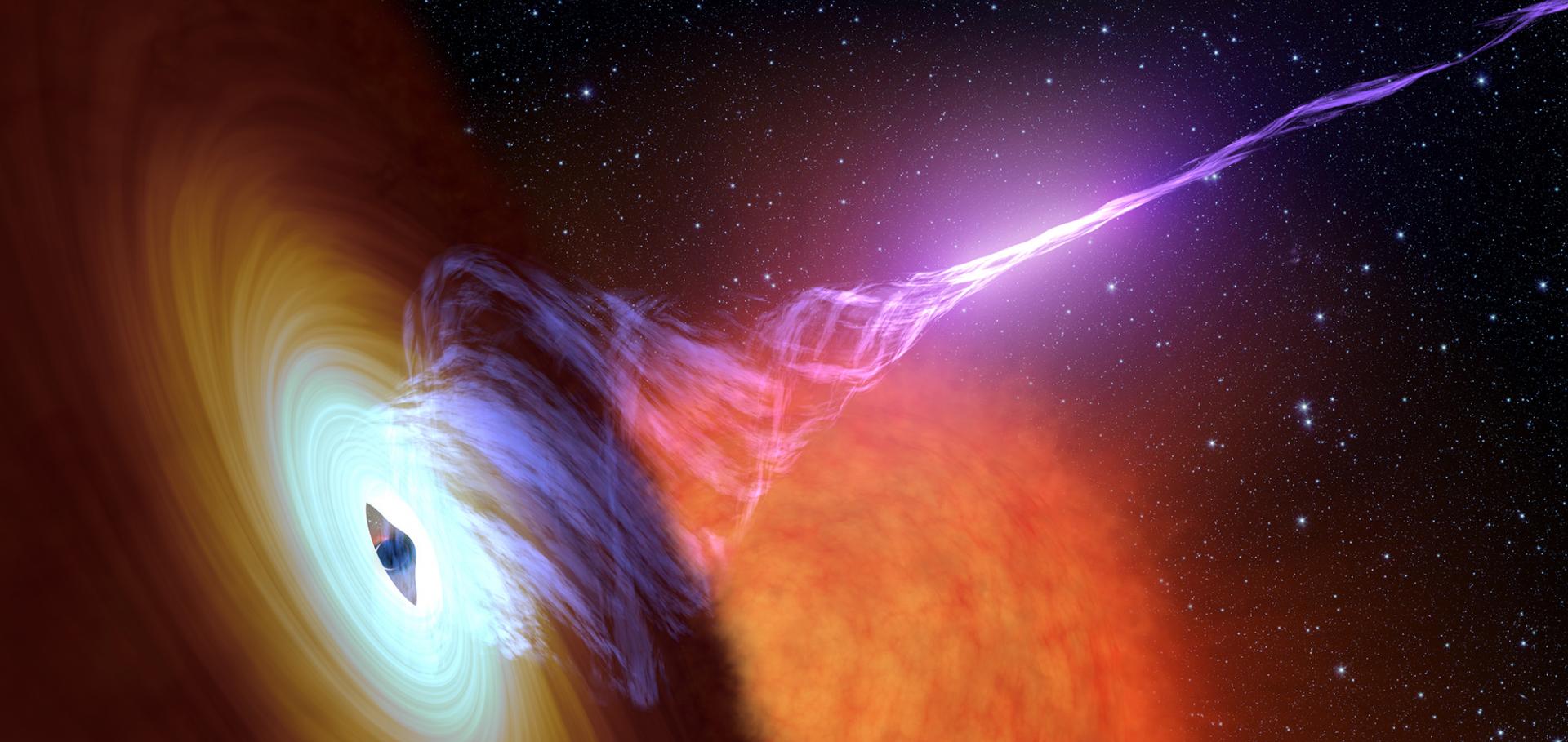
Relativistic Jet from Black Hole

An artist's impression of a relativistic jet propagating away from a black hole at close to the speed of light. Such jets are formed by the inner regions of the accretion flow: matter flowing inwards towards the black hole, via processes which are not yet fully understood. The accretion flow emits primarily in X-rays, the relativistic jet in the radio band: by combing observations in each band we can try and understand how such jets form and how much energy they carry away from the black hole.

Professor Rob Fender

Professor of Astrophysics

Research theme

  • Astronomy and astrophysics

Sub department

  • Astrophysics

Research groups

  • Hintze Centre for Astrophysical Surveys
  • MeerKAT
  • Pulsars, transients and relativistic astrophysics
  • Rubin-LSST
  • The Square Kilometre Array (SKA)
  • Gamma-ray astronomy
Rob.Fender@physics.ox.ac.uk
Telephone: 01865 (2)73435
Denys Wilkinson Building, room 712
  • About
  • Publications

A Highly Polarised Jet in XTE J1748-288

Sissa Medialab Srl (2007) 018

Authors:

Catherine Brocksopp, Rob Fender, James CA Miller-Jones, Ben Stappers
More details from the publisher

A link between radio loudness and X-ray/optical properties of AGN

PoSMQW 6 (2007) 026-026

Authors:

Sebastian Jester, Elmar Koerding, Rob Fender

Abstract:

We have found empirically that the radio loudness of AGN can be understood as function of both the X-ray and optical luminosity. This way of considering the radio loudness was inspired by the hardness-intensity diagrams for X-ray binaries, in which objects follow a definite track with changes to their radio properties occurring in certain regions. We generalize the hardness-intensity diagram to a "disk-fraction luminosity diagram", which can be used to classify the accretion states both of X-ray binaries and of AGN. Using a sample of nearly 5000 SDSS quasars with ROSAT matches, we show that an AGN is more likely to have a high radio:optical flux ratio when it has a high total luminosity or a large contribution from X-rays. Thus, it is necessary to take into account both the optical and the X-ray properties of quasars in order to understand their radio loudness. The success of categorizing quasars in the same way as X-ray binaries is further evidence for the unification of accretion onto stellar-mass and supermassive compact objects.
More details from the publisher
More details
Details from ArXiV

Deceleration in the radio jets of GRS 1915+105

Sissa Medialab Srl (2007) 060

Authors:

James CA Miller-Jones, Michael Rupen, Rob Fender, Anthony Rushton, Guy G Pooley, Ralph E Spencer
More details from the publisher

Eight powers of ten: similarities in black hole accretion on all mass scales

Sissa Medialab Srl (2007) 011

Authors:

Rob Fender, Elmar Körding, Tomaso Belloni, Phil Uttley, Ian McHardy, Tasso Tzioumis
More details from the publisher

First observations of GRS 1915+105 with e-VLBI

Sissa Medialab Srl (2007) 092

Authors:

Anthony Rushton, Ralph E Spencer, Matthew Strong, Robert M Campbell, Simon Casey, Rob Fender, Michael Garrett, James CA Miller-Jones, Guy G Pooley, C Reynolds, Arpad Szomoru, Valeriu M Tudose, Zsolt Paragi
More details from the publisher

Pagination

  • First page First
  • Previous page Prev
  • …
  • Page 160
  • Page 161
  • Page 162
  • Page 163
  • Current page 164
  • Page 165
  • Page 166
  • Page 167
  • Page 168
  • …
  • Next page Next
  • Last page Last

Footer Menu

  • Contact us
  • Giving to the Dept of Physics
  • Work with us
  • Media

User account menu

  • Log in

Follow us

FIND US

Clarendon Laboratory,

Parks Road,

Oxford,

OX1 3PU

CONTACT US

Tel: +44(0)1865272200

University of Oxfrod logo Department Of Physics text logo
IOP Juno Champion logo Athena Swan Silver Award logo

© University of Oxford - Department of Physics

Cookies | Privacy policy | Accessibility statement

Built by: Versantus

  • Home
  • Research
  • Study
  • Engage
  • Our people
  • News & Comment
  • Events
  • Our facilities & services
  • About us
  • Giving to Physics
  • Current students
  • Staff intranet