Home
Department Of Physics text logo
  • Research
    • Our research
    • Our research groups
    • Our research in action
    • Research funding support
    • Summer internships for undergraduates
  • Study
    • Undergraduates
    • Postgraduates
  • Engage
    • For young people
    • For teachers
    • For the public
    • For alumni
    • For business
  • Support
Menu
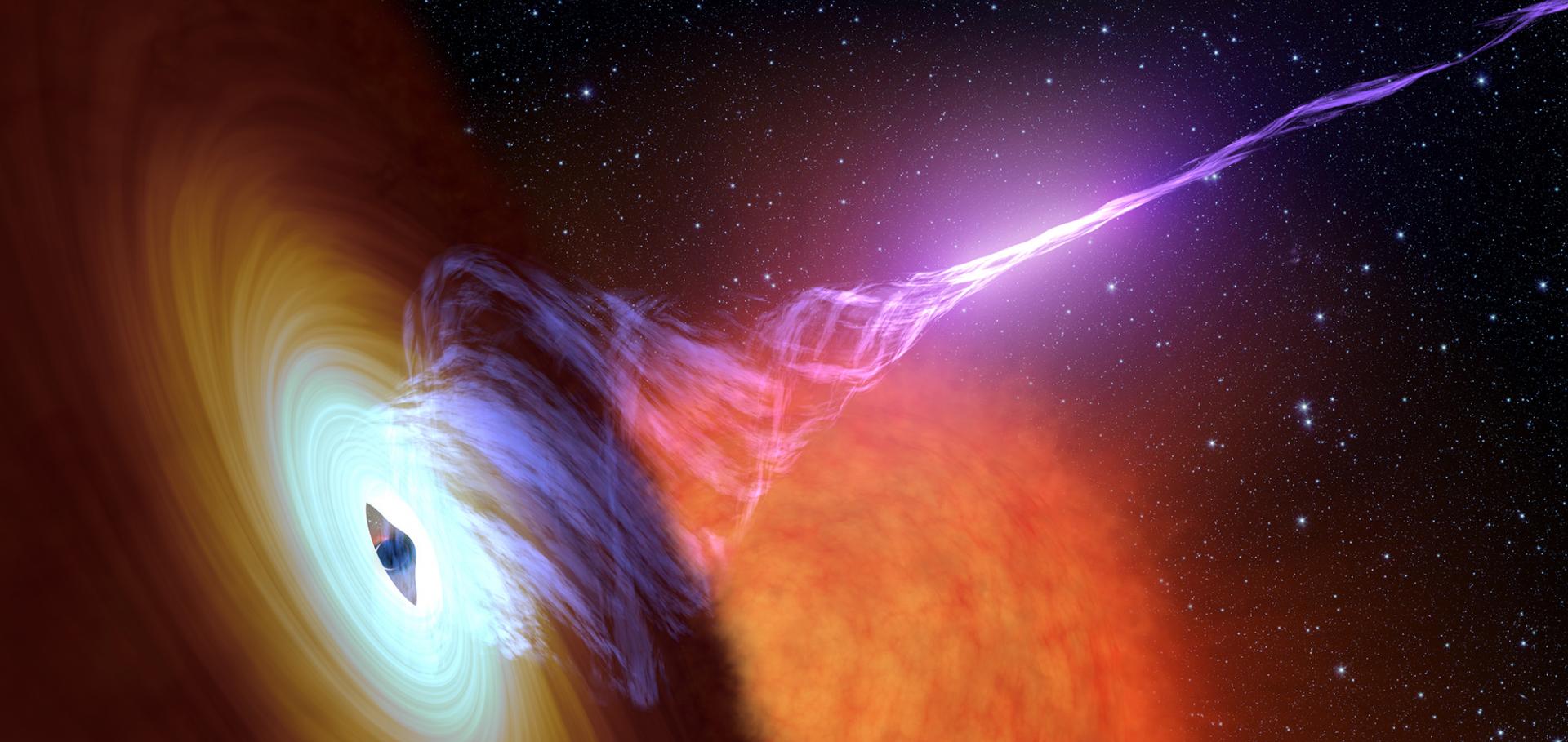
Relativistic Jet from Black Hole

An artist's impression of a relativistic jet propagating away from a black hole at close to the speed of light. Such jets are formed by the inner regions of the accretion flow: matter flowing inwards towards the black hole, via processes which are not yet fully understood. The accretion flow emits primarily in X-rays, the relativistic jet in the radio band: by combing observations in each band we can try and understand how such jets form and how much energy they carry away from the black hole.

Professor Rob Fender

Professor of Astrophysics

Research theme

  • Astronomy and astrophysics

Sub department

  • Astrophysics

Research groups

  • Hintze Centre for Astrophysical Surveys
  • MeerKAT
  • Pulsars, transients and relativistic astrophysics
  • Rubin-LSST
  • The Square Kilometre Array (SKA)
  • Gamma-ray astronomy
Rob.Fender@physics.ox.ac.uk
Telephone: 01865 (2)73435
Denys Wilkinson Building, room 712
  • About
  • Publications

First e-VLBI observations of GRS 1915+105

Monthly Notices of the Royal Astronomical Society: Letters Oxford University Press (OUP) 374:1 (2007) l47-l50

Authors:

A Rushton, RE Spencer, M Strong, RM Campbell, S Casey, RP Fender, MA Garrett, JCA Miller-Jones, GG Pooley, C Reynolds, A Szomoru, V Tudose, Z Paragi
More details from the publisher

Long-term radio behaviour of the X-ray binary circinus X-1

Proceedings of Science 56 (2007)

Authors:

V Tudose, R Fender, T Tzioumis, R Spencer

Abstract:

Circinus X-1 is a neutron star X-ray binary system with an interesting and at times puzzling behaviour over a broad range of frequencies, specifically in the X-ray and radio bands. The system seems to harbour the most relativistic outflow (likely oriented close to the line of sight) observed so far within the Milky Way. It lies within a radio synchrotron nebula and has variable radio flux densities at cm wavelengths. The radio flares associated to the orbital phase zero reached up to 1 Jy in the late '70s, then have been observed at the tens of mJy level until recently; in 2007 January, Circinus X-1 seemed to have entered a very active radio flaring state. Here we present a sample of the 4.8 and 8.6 GHz radio observations made with the Australia Telescope Compact Array, covering 10 years time period. The entire data set comprised 41 epochs, unequally spread in time between 1996 and 2006. We investigate the long-term changes in the brightness, morphology and spectrum of the radio structures. We have detected linear polarisation in a third of the epochs and a good case for Faraday rotation in one epoch. The analysis reveals structural changes in the radio emission at time scales as short as days. Clear evidence for a counter-jet was found in a few epochs.

The spectral energy distribution of quiescent black hole X-ray binaries:: New constraints from spitzer

ASTROPHYSICAL JOURNAL 670:1 (2007) 600-609

Authors:

Elena Gallo, Simone Migliari, Sera Markoff, John A Tomsick, Charles D Bailyn, Stefano Berta, Rob Fender, James CA Miller-Jones
More details from the publisher

Discovery of twin kHz QPOs in the peculiar X-ray binary Circinus X-1

Astrophys.J. 653 (2006) 1435-1444

Authors:

S Boutloukos, MVD Klis, D Altamirano, M Klein-Wolt, R Wijnands, PG Jonker, RP Fender

Abstract:

We report the discovery with the RXTE/PCA of twin kHz QPOs in Cir X-1. Eleven cases of simultaneous double QPOs occurred, with significances of up to 6.3 and 5.5 sigma and centroid frequencies ranging between approximately 56-225 and 230-500 Hz for the two QPO peaks, respectively, i.e., for the most part at frequencies well below those of other sources. The QPO properties clearly indicate that these double peaks are the kHz QPOs known from low magnetic field neutron stars, and not black-hole high-frequency QPOs, confirming that Cir X-1 is a neutron star. The kHz QPO peak separation varies over a wide range, \~175-340 Hz, and increases with QPO frequency. This is contrary to what is seen in other sources but agrees with predictions of the relativistic precession model and Alfven wave models; beat-frequency models require modification to accommodate this. In other observations single kHz QPOs can be seen down to frequencies as low as ~12 Hz, as well as a strong low-frequency (LF) QPO between 1 and 30 Hz. The relations between the frequencies of the kHz QPOs and the LF QPO are in good agreement with those found previously in Z sources, confirming that Cir X-1 may be a peculiar Z source. We suggest that the low frequencies of the kHz QPOs in Cir X-1 and to a lesser extent in (other) Z sources might be due to a relatively stronger radial inflow to the neutron star than in other kHz QPO sources.
More details from the publisher
Details from ArXiV

Active Galactic Nuclei as scaled-up Galactic black holes

(2006)

Authors:

IM McHardy, E Koerding, C Knigge, P Uttley, RP Fender
More details from the publisher

Pagination

  • First page First
  • Previous page Prev
  • …
  • Page 166
  • Page 167
  • Page 168
  • Page 169
  • Current page 170
  • Page 171
  • Page 172
  • Page 173
  • Page 174
  • …
  • Next page Next
  • Last page Last

Footer Menu

  • Contact us
  • Giving to the Dept of Physics
  • Work with us
  • Media

User account menu

  • Log in

Follow us

FIND US

Clarendon Laboratory,

Parks Road,

Oxford,

OX1 3PU

CONTACT US

Tel: +44(0)1865272200

University of Oxfrod logo Department Of Physics text logo
IOP Juno Champion logo Athena Swan Silver Award logo

© University of Oxford - Department of Physics

Cookies | Privacy policy | Accessibility statement

Built by: Versantus

  • Home
  • Research
  • Study
  • Engage
  • Our people
  • News & Comment
  • Events
  • Our facilities & services
  • About us
  • Giving to Physics
  • Current students
  • Staff intranet