Home
Department Of Physics text logo
  • Research
    • Our research
    • Our research groups
    • Our research in action
    • Research funding support
    • Summer internships for undergraduates
  • Study
    • Undergraduates
    • Postgraduates
  • Engage
    • For young people
    • For teachers
    • For the public
    • For alumni
    • For business
  • Support
Menu
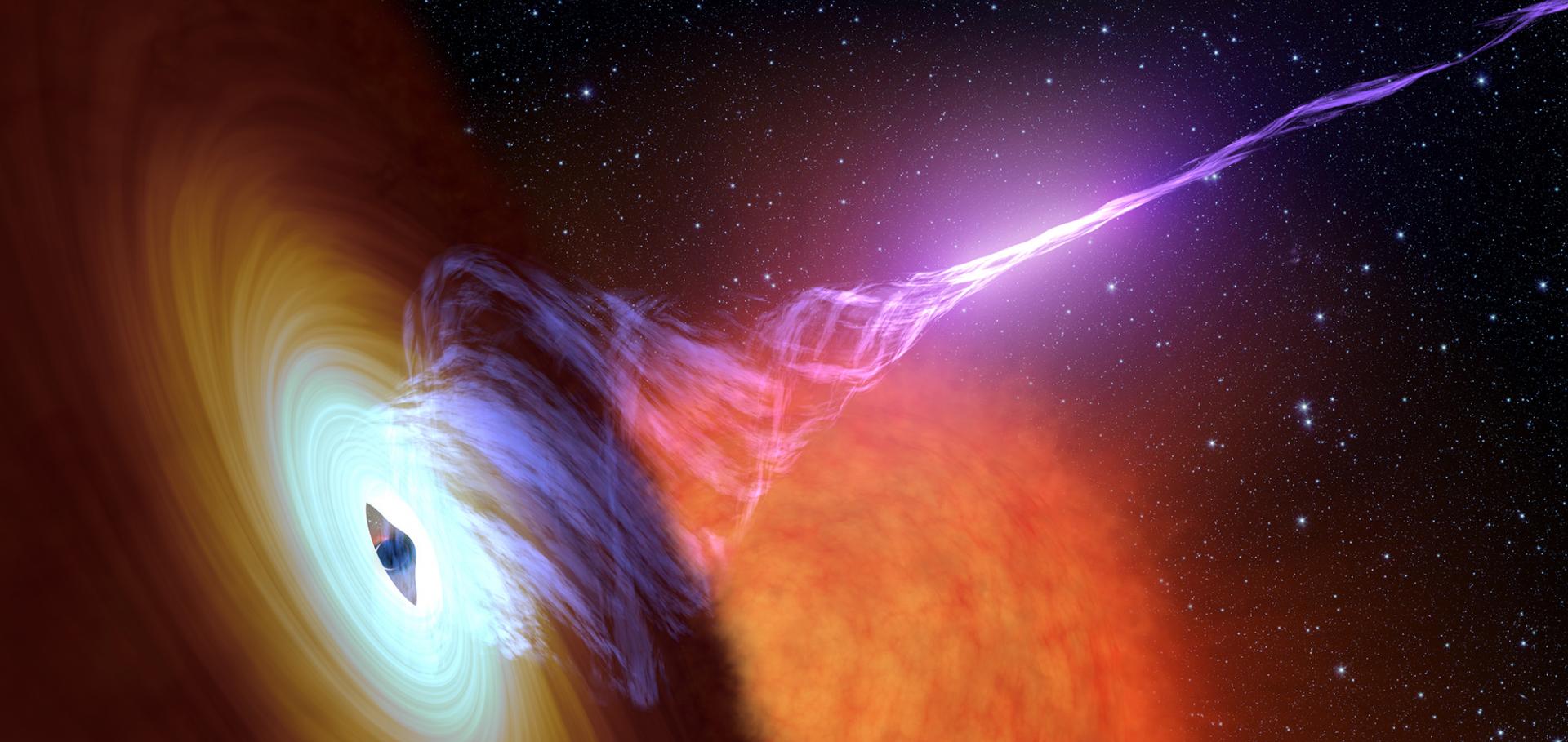
Relativistic Jet from Black Hole

An artist's impression of a relativistic jet propagating away from a black hole at close to the speed of light. Such jets are formed by the inner regions of the accretion flow: matter flowing inwards towards the black hole, via processes which are not yet fully understood. The accretion flow emits primarily in X-rays, the relativistic jet in the radio band: by combing observations in each band we can try and understand how such jets form and how much energy they carry away from the black hole.

Professor Rob Fender

Professor of Astrophysics

Research theme

  • Astronomy and astrophysics

Sub department

  • Astrophysics

Research groups

  • Hintze Centre for Astrophysical Surveys
  • MeerKAT
  • Pulsars, transients and relativistic astrophysics
  • Rubin-LSST
  • The Square Kilometre Array (SKA)
  • Gamma-ray astronomy
Rob.Fender@physics.ox.ac.uk
Telephone: 01865 (2)73435
Denys Wilkinson Building, room 712
  • About
  • Publications

High resolution optical and infrared spectroscopic observations of Cir X-1

(1999)

Authors:

Helen Johnston, Rob Fender, Kinwah Wu
More details from the publisher

Low Luminosity States of the Black Hole Candidate GX 339-4. I. ASCA and Simultaneous Radio/RXTE Observations

(1999)

Authors:

Joern Wilms, Michael Nowak, James B Dove, Robert P Fender, Tiziana Di Matteo
More details from the publisher

Infrared spectroscopic variability of Cygnus X-3 in outburst and quiescence

(1999)

Authors:

RP Fender, MM Hanson, GG Pooley
More details from the publisher

Multiple ejections during the 1975 outburst of A0620-00

ArXiv astro-ph/9902360 (1999)

Authors:

Erik Kuulkers, RP Fender, Ralph E Spencer, Richard J Davis, Ian Morison

Abstract:

The well-known black-hole X-ray transient A0620-00 was a bright radio source during the first part of its outburst in 1975. We have revisited the available data and find for the first time evidence that the source exhibited multiple jet ejections. Rapid radio spectral changes indicate the addition of at least three new components which are initially optically thick. From single baseline interferometry taken about three weeks after the start of the X-ray outburst we find that the source is extended on arcsec scales and infer a relativistic expansion velocity. Some of the other (soft) X-ray transients, such as GS 1124-68 and GS 2000+25, show very similar X-ray outburst light curve shapes to that of A0620-00, while their radio outburst light curve shapes are different. We suggest that this is due to the radio emission being strongly beamed in outburst, whereas the X-ray emission remains isotropic. Since this effect is stronger at higher jet velocities, this strengthens our conclusion that the jets in A0620-00 and other soft X-ray transients move with relativistic speeds.
More details from the publisher
Details from ArXiV

Multiple ejections during the 1975 outburst of A0620-00

(1999)

Authors:

Erik Kuulkers, RP Fender, Ralph E Spencer, Richard J Davis, Ian Morison
More details from the publisher

Pagination

  • First page First
  • Previous page Prev
  • …
  • Page 226
  • Page 227
  • Page 228
  • Page 229
  • Current page 230
  • Page 231
  • Page 232
  • Page 233
  • Page 234
  • …
  • Next page Next
  • Last page Last

Footer Menu

  • Contact us
  • Giving to the Dept of Physics
  • Work with us
  • Media

User account menu

  • Log in

Follow us

FIND US

Clarendon Laboratory,

Parks Road,

Oxford,

OX1 3PU

CONTACT US

Tel: +44(0)1865272200

University of Oxfrod logo Department Of Physics text logo
IOP Juno Champion logo Athena Swan Silver Award logo

© University of Oxford - Department of Physics

Cookies | Privacy policy | Accessibility statement

Built by: Versantus

  • Home
  • Research
  • Study
  • Engage
  • Our people
  • News & Comment
  • Events
  • Our facilities & services
  • About us
  • Giving to Physics
  • Current students
  • Staff intranet