Home
Department Of Physics text logo
  • Research
    • Our research
    • Our research groups
    • Our research in action
    • Research funding support
    • Summer internships for undergraduates
  • Study
    • Undergraduates
    • Postgraduates
  • Engage
    • For young people
    • For teachers
    • For the public
    • For alumni
    • For business
  • Support
Menu
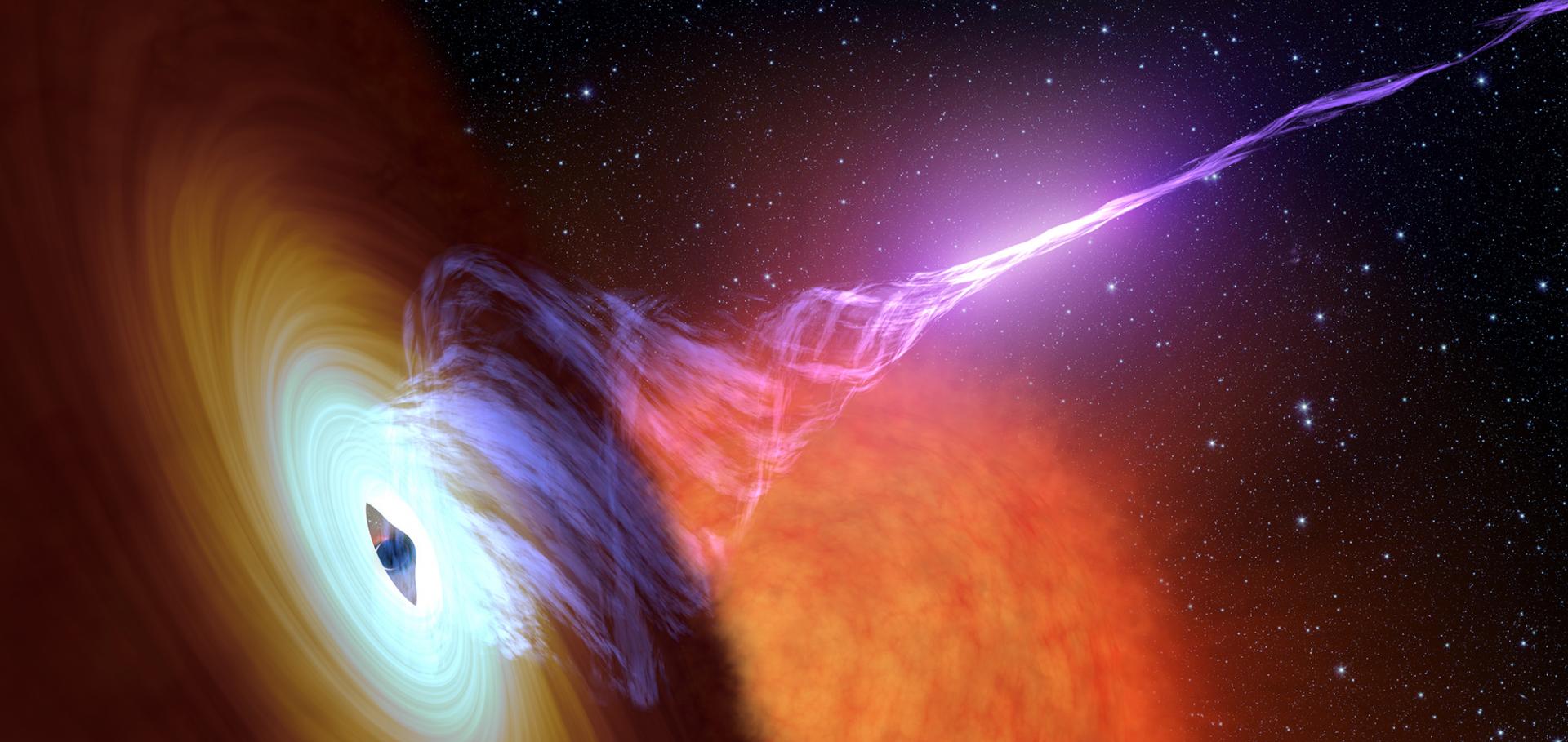
Relativistic Jet from Black Hole

An artist's impression of a relativistic jet propagating away from a black hole at close to the speed of light. Such jets are formed by the inner regions of the accretion flow: matter flowing inwards towards the black hole, via processes which are not yet fully understood. The accretion flow emits primarily in X-rays, the relativistic jet in the radio band: by combing observations in each band we can try and understand how such jets form and how much energy they carry away from the black hole.

Professor Rob Fender

Professor of Astrophysics

Research theme

  • Astronomy and astrophysics

Sub department

  • Astrophysics

Research groups

  • Hintze Centre for Astrophysical Surveys
  • MeerKAT
  • Pulsars, transients and relativistic astrophysics
  • Rubin-LSST
  • The Square Kilometre Array (SKA)
  • Gamma-ray astronomy
Rob.Fender@physics.ox.ac.uk
Telephone: 01865 (2)73435
Denys Wilkinson Building, room 712
  • About
  • Publications

VLBI observations of GRB 201015A, a relatively faint GRB with a hint of very high-energy gamma-ray emission

ASTRONOMY & ASTROPHYSICS 664 (2022) ARTN A36

Authors:

S Giarratana, L Rhodes, B Marcote, R Fender, G Ghirlanda, M Giroletti, L Nava, JM Paredes, ME Ravasio, M Ribo, M Patel, J Rastinejad, G Schroeder, W Fong, BP Gompertz, AJ Levan, P O'Brien
More details from the publisher
Details from ORA
More details
More details

MeerKAT radio observations of the neutron star low-mass X-ray binary Cen X-4 at low accretion rates

(2022)

Authors:

J van den Eijnden, R Fender, JCA Miller-Jones, TD Russell, P Saikia, GR Sivakoff, F Carotenuto
More details from the publisher
Details from ArXiV

A Late-time Radio Flare Following a Possible Transition in Accretion State in the Tidal Disruption Event AT 2019azh

ASTROPHYSICAL JOURNAL 933:2 (2022) ARTN 176

Authors:

Itai Sfaradi, Assaf Horesh, Rob Fender, David A Green, David RA Williams, Joe Bright, Steve Schulze
More details from the publisher
More details

Discovery of a radio emitting neutron star with an ultra-long spin period of 76 seconds.

Nature astronomy 6:7 (2022) 828-836

Authors:

Manisha Caleb, Ian Heywood, Kaustubh Rajwade, Mateusz Malenta, Benjamin Stappers, Ewan Barr, Weiwei Chen, Vincent Morello, Sotiris Sanidas, Jakob van den Eijnden, Michael Kramer, David Buckley, Jaco Brink, Sara Elisa Motta, Patrick Woudt, Patrick Weltevrede, Fabian Jankowski, Mayuresh Surnis, Sarah Buchner, Mechiel Christiaan Bezuidenhout, Laura Nicole Driessen, Rob Fender

Abstract:

The radio-emitting neutron star population encompasses objects with spin periods ranging from milliseconds to tens of seconds. As they age and spin more slowly, their radio emission is expected to cease. We present the discovery of an ultra-long period radio-emitting neutron star, PSR J0901-4046, with spin properties distinct from the known spin and magnetic-decay powered neutron stars. With a spin-period of 75.88 s, a characteristic age of 5.3 Myr, and a narrow pulse duty-cycle, it is uncertain how radio emission is generated and challenges our current understanding of how these systems evolve. The radio emission has unique spectro-temporal properties such as quasi-periodicity and partial nulling that provide important clues to the emission mechanism. Detecting similar sources is observationally challenging, which implies a larger undetected population. Our discovery establishes the existence of ultra-long period neutron stars, suggesting a possible connection to the evolution of highly magnetized neutron stars, ultra-long period magnetars, and fast radio bursts.
More details from the publisher
Details from ORA
More details
More details

The science case and challenges of space-borne sub-millimeter interferometry

Acta Astronautica Elsevier 196 (2022) 314-333

Authors:

Leonid I Gurvits, Zsolt Paragi, Ricardo I Amils, Ilse van Bemmel, Paul Boven, Viviana Casasola, John Conway, Jordy Davelaar, M Carmen Díez-González, Heino Falcke, Rob Fender, Sándor Frey, Christian M Fromm, Juan D Gallego-Puyol, Cristina García-Miró, Michael A Garrett, Marcello Giroletti, Ciriaco Goddi, José L Gómez, Jeffrey van der Gucht, José Carlos Guirado, Zoltán Haiman, Frank Helmich, Ben Hudson, Elizabeth Humphreys, Violette Impellizzeri, Michael Janssen, Michael D Johnson, Yuri Y Kovalev, Michael Kramer, Michael Lindqvist, Hendrik Linz, Elisabetta Liuzzo, Andrei P Lobanov, Isaac López-Fernández, Inmaculada Malo-Gómez, Kunal Masania, Yosuke Mizuno, Alexander V Plavin, Raj T Rajan, Luciano Rezzolla, Freek Roelofs, Eduardo Ros, Kazi LJ Rygl, Tuomas Savolainen, Karl Schuster, Tiziana Venturi, Marjolein Verkouter, Pablo de Vicente, Pieter NAM Visser, Martina C Wiedner, Maciek Wielgus, Kaj Wiik, J Anton Zensus
More details from the publisher

Pagination

  • First page First
  • Previous page Prev
  • …
  • Page 34
  • Page 35
  • Page 36
  • Page 37
  • Current page 38
  • Page 39
  • Page 40
  • Page 41
  • Page 42
  • …
  • Next page Next
  • Last page Last

Footer Menu

  • Contact us
  • Giving to the Dept of Physics
  • Work with us
  • Media

User account menu

  • Log in

Follow us

FIND US

Clarendon Laboratory,

Parks Road,

Oxford,

OX1 3PU

CONTACT US

Tel: +44(0)1865272200

University of Oxfrod logo Department Of Physics text logo
IOP Juno Champion logo Athena Swan Silver Award logo

© University of Oxford - Department of Physics

Cookies | Privacy policy | Accessibility statement

Built by: Versantus

  • Home
  • Research
  • Study
  • Engage
  • Our people
  • News & Comment
  • Events
  • Our facilities & services
  • About us
  • Giving to Physics
  • Current students
  • Staff intranet