Home
Department Of Physics text logo
  • Research
    • Our research
    • Our research groups
    • Our research in action
    • Research funding support
    • Summer internships for undergraduates
  • Study
    • Undergraduates
    • Postgraduates
  • Engage
    • For young people
    • For teachers
    • For the public
    • For alumni
    • For business
  • Support
Menu
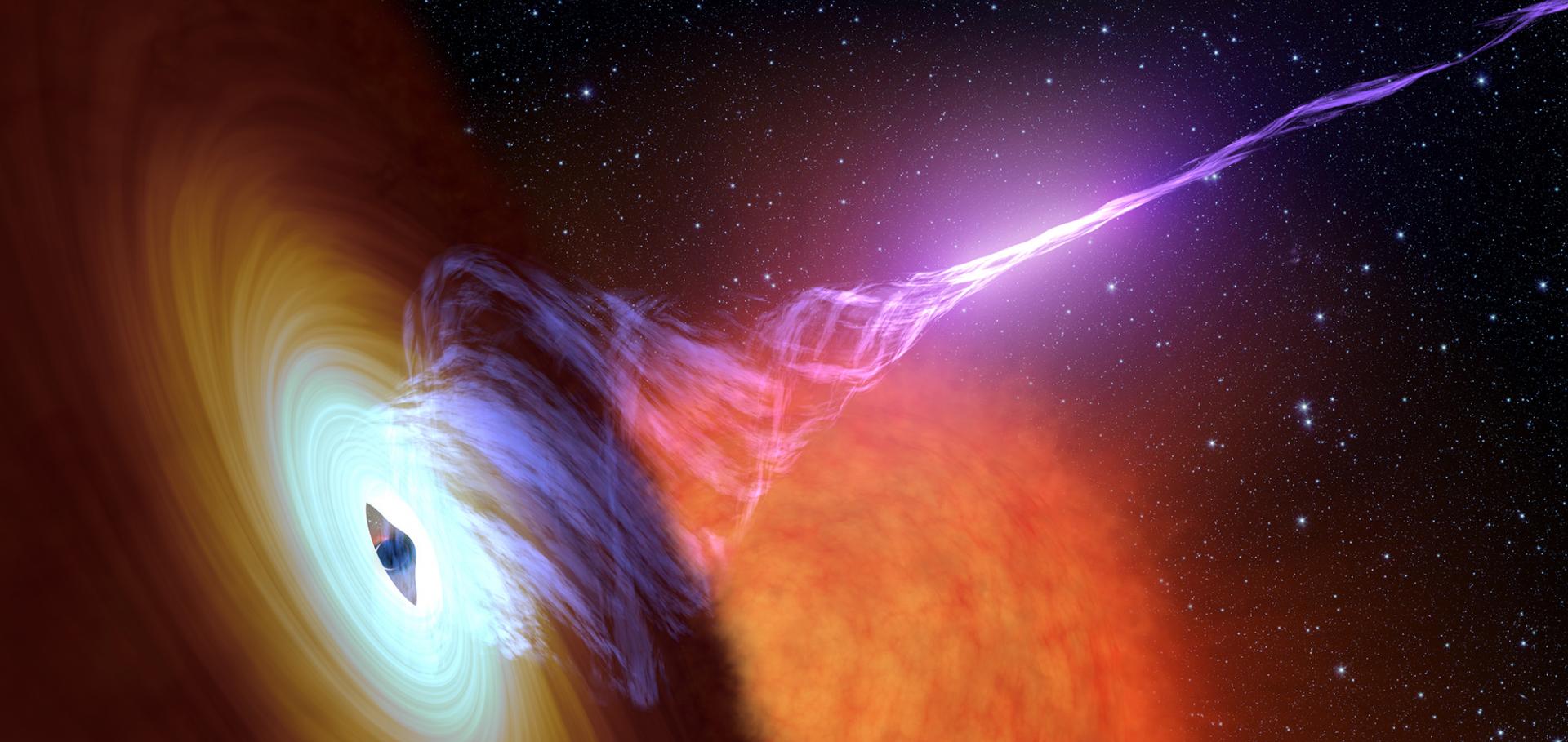
Relativistic Jet from Black Hole

An artist's impression of a relativistic jet propagating away from a black hole at close to the speed of light. Such jets are formed by the inner regions of the accretion flow: matter flowing inwards towards the black hole, via processes which are not yet fully understood. The accretion flow emits primarily in X-rays, the relativistic jet in the radio band: by combing observations in each band we can try and understand how such jets form and how much energy they carry away from the black hole.

Professor Rob Fender

Professor of Astrophysics

Research theme

  • Astronomy and astrophysics

Sub department

  • Astrophysics

Research groups

  • Hintze Centre for Astrophysical Surveys
  • MeerKAT
  • Pulsars, transients and relativistic astrophysics
  • Rubin-LSST
  • The Square Kilometre Array (SKA)
  • Gamma-ray astronomy
Rob.Fender@physics.ox.ac.uk
Telephone: 01865 (2)73435
Denys Wilkinson Building, room 712
  • About
  • Publications

A connection between accretion states and the formation of ultra-relativistic outflows in a neutron star X-ray binary

Monthly Notices of the Royal Astronomical Society Oxford University Press (OUP) (2018)

Authors:

SE Motta, RP Fender

Abstract:

The nearby accreting neutron star binary Sco X-1 is the closest example of ongoing relativistic jet production at high Eddington ratios. Previous radio studies have revealed that alongside mildly relativistic, radio-emitting ejecta, there is at times a much faster transfer of energy from the region of the accretion flow along the jet. The nature of this ultrarelativistic flow remains unclear and while there is some evidence for a similar phenomenon in other systems which might contain neutron stars, it has never been observed in a confirmed black hole system. We have compared these previous radio observations with a new analysis of simultaneous X-ray observations which were performed with the RXTE mission. We find that the ejection of the ultra-relativistic flow seems to be associated with the simultaneous appearance of two particular types of quasi-periodic oscillations in the X-ray power spectrum. In contrast, the mildly relativistic, radio-emitting outflows may be associated with flat-topped broad band noise in the X-ray power spectrum. This is the first time a link, albeit tentative, has been found between these mysterious unseen flows and the accretion flow from which they are launched.
More details from the publisher
Details from ORA
More details
Details from ArXiV

Don't Blink: Constraining the Circumstellar Environment of the Interacting Type Ia Supernova 2015cp

(2018)

Authors:

CE Harris, PE Nugent, A Horesh, JS Bright, RP Fender, ML Graham, K Maguire, M Smith, N Butler, S Valenti, AV Filippenko, O Fox, A Goobar, PL Kelly, KJ Shen
More details from the publisher

A Strong Jet Signature in the Late-time Light Curve of GW170817

ASTROPHYSICAL JOURNAL LETTERS 868:1 (2018) ARTN L11

Authors:

KP Mooley, DA Frail, D Dobie, E Lenc, A Corsi, K De, AJ Nayana, S Makhathini, I Heywood, T Murphy, DL Kaplan, P Chandra, O Smirnov, E Nakar, G Hallinan, F Camilo, R Fender, S Goedhart, P Groot, MM Kasliwal, SR Kulkarni, PA Woudt
More details from the publisher
Details from ORA
More details
Details from ArXiV
More details

Classification of Multiwavelength Transients with Machine Learning

(2018)

Authors:

K Sooknunan, M Lochner, Bruce A Bassett, HV Peiris, R Fender, AJ Stewart, M Pietka, PA Woudt, JD McEwen, O Lahav
More details from the publisher

Don’t blink: constraining the circumstellar environment of the interacting type Ia supernova 2015cp

Astrophysical Journal American Astronomical Society 868:21 (2018)

Authors:

CE Harris, PE Nugent, A Horesh, Joe Bright, Robert Fender, ML Graham, K Maguire, M Smith, N Butler, S Valenti, AV Filippenko, O Fox, A Goobar, PL Kelly, KJ Shen

Abstract:

Despite their cosmological utility, the progenitors of Type Ia supernovae (SNe Ia) are still unknown, with many efforts focused on whether accretion from a nondegenerate companion can grow a carbon–oxygen white dwarf to near the Chandrasekhar mass. The association of SNe Ia resembling SN 1991T ("91T-like") with circumstellar interaction may be evidence for this "single-degenerate" channel. However, the observed circumstellar medium (CSM) in these interacting systems is unlike a stellar wind—of particular interest, it is sometimes detached from the stellar surface, residing at ~1016 cm. A Hubble Space Telescope (HST) program to discover detached CSM around 91T-like SNe Ia successfully discovered interaction nearly two years after explosion in SN 2015cp (Graham et al. 2018). In this work, we present radio and X-ray follow-up observations of SN 2015cp and analyze them in the framework of Harris et al. (2016) to limit the properties of a constant-density CSM shell in this system. Assuming the HST detection took place shortly after the shock crossed the CSM, we constrain the total CSM mass in this system to be <0.5 ${M}_{\odot }$. This limit is comparable to the CSM mass of supernova PTF11kx, but does not rule out lower masses predicted for recurrent novae. From lessons learned modeling PTF11kx and SN 2015cp, we suggest a strategy for future observations of these events to increase the sample of known interacting SNe Ia.
More details from the publisher
Details from ORA
More details

Pagination

  • First page First
  • Previous page Prev
  • …
  • Page 62
  • Page 63
  • Page 64
  • Page 65
  • Current page 66
  • Page 67
  • Page 68
  • Page 69
  • Page 70
  • …
  • Next page Next
  • Last page Last

Footer Menu

  • Contact us
  • Giving to the Dept of Physics
  • Work with us
  • Media

User account menu

  • Log in

Follow us

FIND US

Clarendon Laboratory,

Parks Road,

Oxford,

OX1 3PU

CONTACT US

Tel: +44(0)1865272200

University of Oxfrod logo Department Of Physics text logo
IOP Juno Champion logo Athena Swan Silver Award logo

© University of Oxford - Department of Physics

Cookies | Privacy policy | Accessibility statement

Built by: Versantus

  • Home
  • Research
  • Study
  • Engage
  • Our people
  • News & Comment
  • Events
  • Our facilities & services
  • About us
  • Giving to Physics
  • Current students
  • Staff intranet