


Results of the CRESST commissioning run 2007
Proceedings of the 4th Patras Workshop on Axions, WIMPs and WISPs, PATRAS 2008 (2008) 95-98
Abstract:
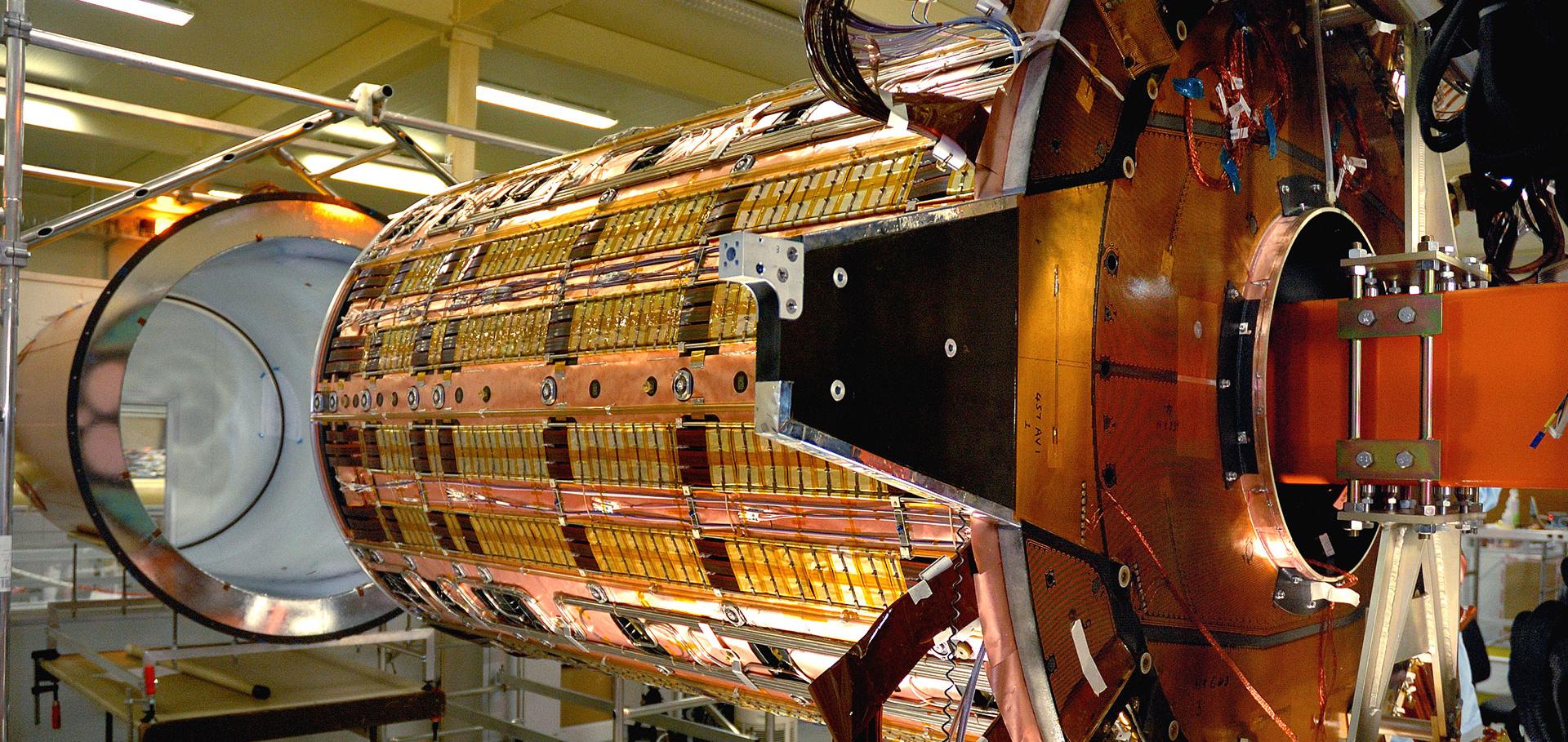
CRESST (Cryogenic Rare Event Search with Superconducting Thermometers) is a low temperature experiment dedicated to the direct dark matter detection via nuclear recoil. It is located in Hall A of the Laboratori Nazionali del Gran Sasso, Italy. Scintillating CaWO4 crystals operated at a few mK are utilized as target forWIMPs (Weakly Interacting Massive Particles), which are expected to scatter predominantly on the heavy tungsten nuclei. As for background rejection, CRESST uses the phonon-light technique, where two different quantities of an interaction are recorded: the heat production in the CaWO4crystal and the simultaneous emission of scintillation light, which is monitored by a second low-temperature detector, the light detector. The information provided by both detectors allows a powerful background discrimination on an event by event basis. After a major upgrade phase, CRESST-II has now successfully completed a commissioning run during 2007, the results of which are presented in this article.Scintillation properties of pure and ca-doped ZnWO4 crystals
Physica Status Solidi A Applications and Materials Science 205:2 (2008) 335-339
Abstract:
Following the investigations of the structure and scintillation properties of Ca-doped zinc tungstate powder [phys. stat. sol. (a) 204. 730 (2007)] a single-crystal of ZnWOEURECA - The future of cryogenic dark matter detection in Europe
Proceedings of Science (2008)
Abstract:
European Underground Rare Event Calorimeter Array (EURECA) will be an astro-particle physics facility in the Laboratoire Souterrain de Modane, aiming to directly detect galactic dark matter. The EURECA collaboration unites CRESST, EDELWEISS and the Spanish-French experiment ROSEBUD, thus concentrating and focussing effort on cryogenic detector research in Europe into a single facility. The aim is to explore WIMP - nucleon scalar cross sections in the 10 - 10 picobarn region with a target mass of up to one ton. A major advantage of EURECA is the planned use of more than just one target material (multi target experiment for WIMP identification).The cresst dark matter search
Proceedings of the 6th International Workshop on the Identification of Dark Matter, IDM 2006 (2007) 192-197
Abstract:
CRESST I1 is a WIMP search experiment using cryogenic detectors to detect heat and scintillation signals in Caw04 crystals simultaneously. Competitive limits on the coherent WIMP-nucleon scattering cross section and other results from runs from the upgrade to CRESST I1 are shown. New features and upgrades installed on the CRESST I1 setup are described and the status of the experiment is presented.CRESST - status and future
NUCL PHYS B-PROC SUP 173 (2007) 104-107