

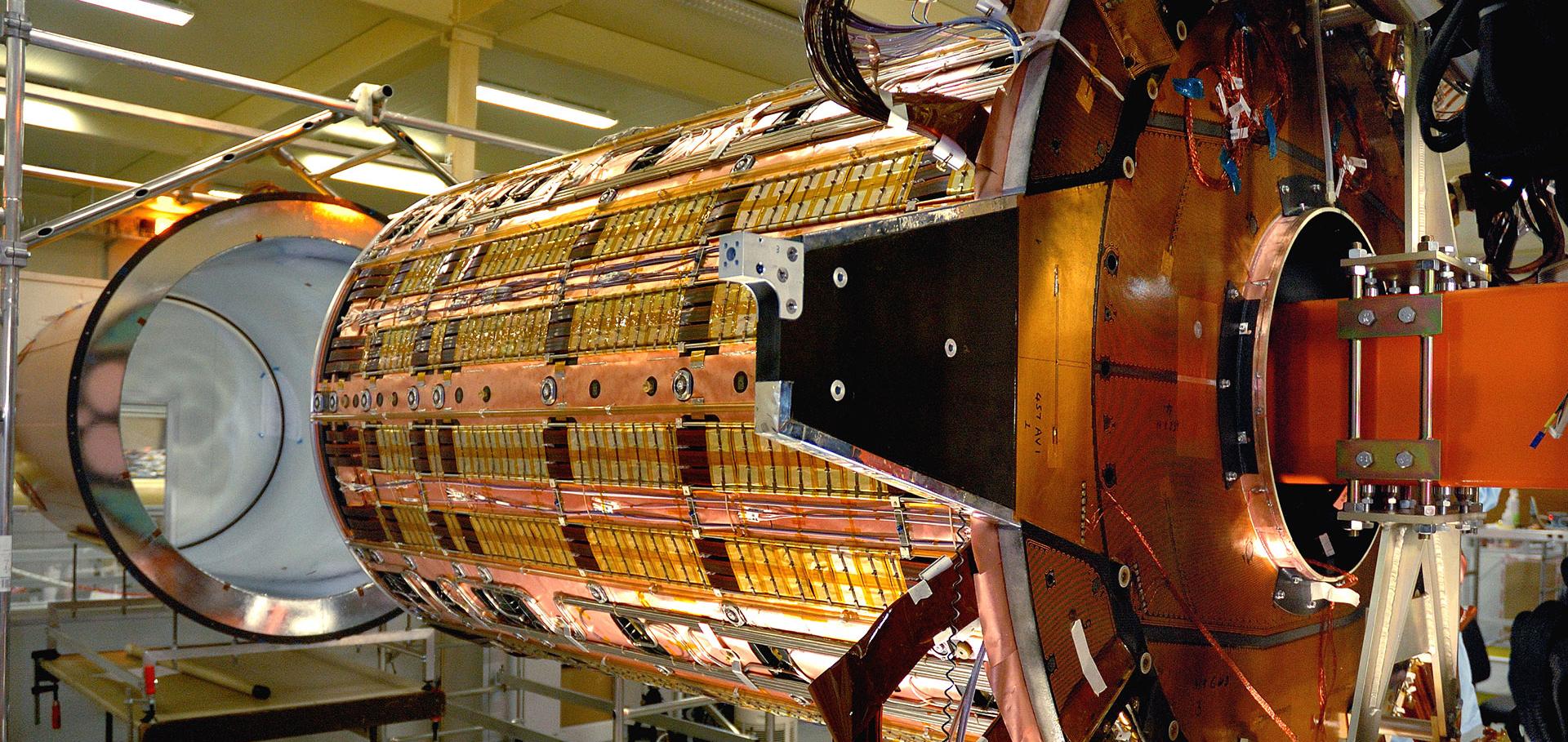

LHCb detector commissioning: Results with cosmics and first beam
Proceedings of Science (2009)
Abstract:
With high-energy collisions at the LHC imminent, this contribution describes the final commissioning of LHCb detector with comics and non-circulating beam. The status of each major sub-detector is reported, with particular attention paid to recent highlights. © Copyright owned by the author(s) under the terms of the Creative Commons Attribution-Non Commercial-ShareAlike Licence.P20-19 LB. Extensive HLA-driven viral diversity following a single-source HIV-1 outbreak in rural China
Retrovirology Springer Science and Business Media LLC 6:S3 (2009) P423
First LHC beam induced tracks reconstructed in the LHCb VELO
Nuclear Instruments and Methods in Physics Research Section A Accelerators Spectrometers Detectors and Associated Equipment 604:1-2 (2009) 1-4
Abstract:
The Vertex Locator of the LHCb experiment has been used to fully reconstruct beam induced tracks at the LHC. A beam of protons was collided with a beam absorber during the LHC synchronisation test of the anti-clockwise beam on the weekend 22nd-24th August 2008. The resulting particles have been observed by the Vertex Locator. The LHCb Vertex Locator is a silicon micro-strip detector containing 21 planes of modules. Tracks were observed passing through up to 19 modules (38 silicon sensors). A total of over 700 tracks were reconstructed, and are being used to study the calibration and alignment of the detector. © 2009 Elsevier B.V. All rights reserved.Preliminary results using Timepix as a particle tracking detector
Proceedings of Science 95 (2009)
Abstract:
A series of tests in CERN’s North Area beam facility have been used to demonstrate the suitability of the Timepix chip, combined with a silicon sensor, as a particle tracking device. Specifically of interest is the potential of a successor to the current chip to be used in the context of an LHCb VELO upgrade. The 55µm square pixels, large active fraction and analogue information make the chip very attractive for forward, high precision tracking systems such as the VELO. In this contribution preliminary results are presented showing the resolution achieved by a Timepix assembly in a 120GeV π beam, over a wide range of incident angles. At the optimum angle the detector was able to provide an unbiased track residual of 5.5µm. The telescope constructed for these measurements contributed a track extrapolation error of 2.5µm. The plans for a future development of this telescope, also based on Timepix assemblies are discussed, with proposals for upgrading its spatial and timing resolution.Synchrotron tests of 3D Medipix2 and TimePix X-Ray Detectors
IEEE Nuclear Science Symposium Conference Record (2009) 2145-2150