Home
Department Of Physics text logo
  • Research
    • Our research
    • Our research groups
    • Our research in action
    • Research funding support
    • Summer internships for undergraduates
  • Study
    • Undergraduates
    • Postgraduates
  • Engage
    • For young people
    • For teachers
    • For the public
    • For alumni
    • For business
  • Support
Menu
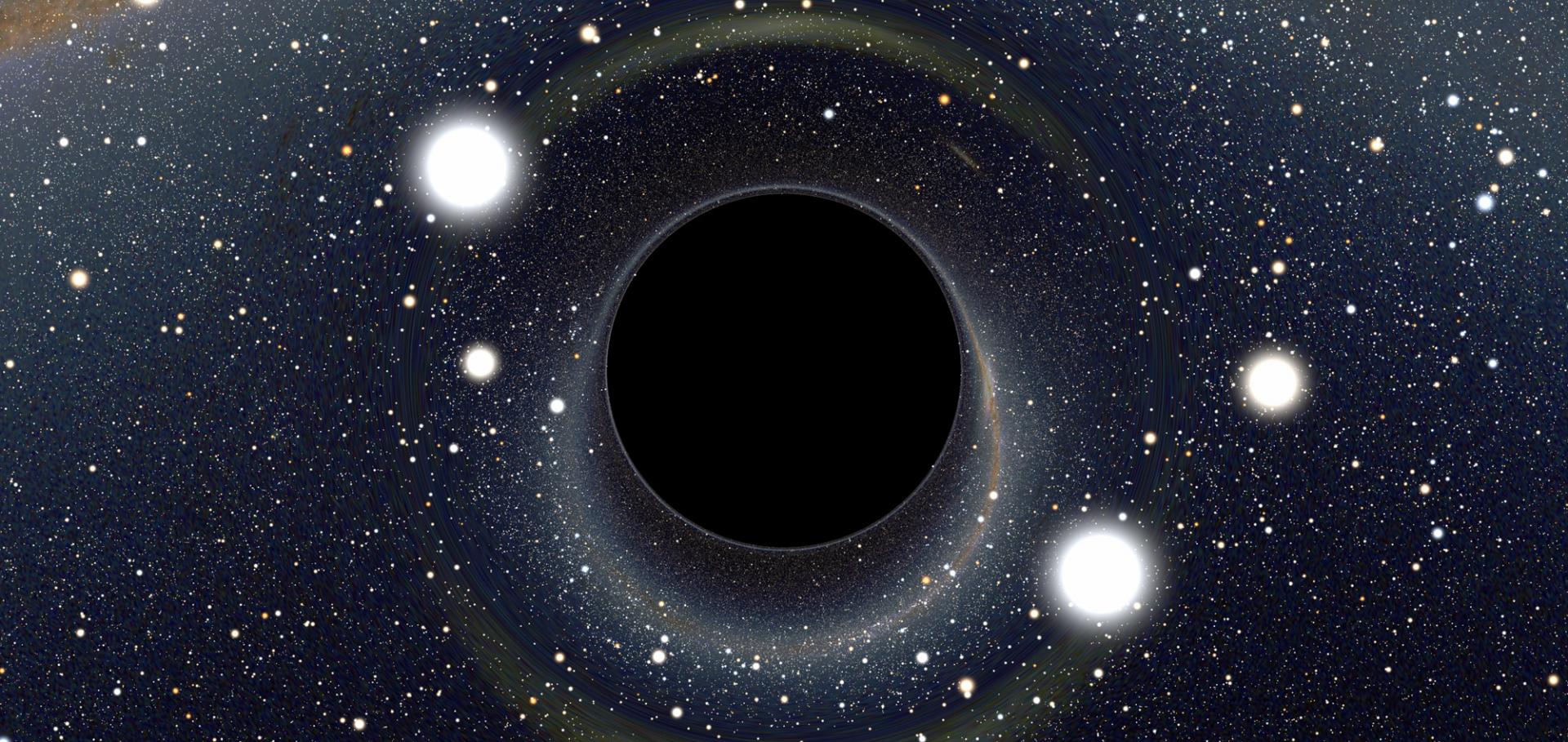
Black Hole

Lensing of space time around a black hole. At Oxford we study black holes observationally and theoretically on all size and time scales - it is some of our core work.

Credit: ALAIN RIAZUELO, IAP/UPMC/CNRS. CLICK HERE TO VIEW MORE IMAGES.

Dr Lauren Rhodes

TSI Postdoctoral Research Fellow

Research theme

  • Astronomy and astrophysics

Sub department

  • Astrophysics

Research groups

  • MeerKAT
  • Pulsars, transients and relativistic astrophysics
  • The Square Kilometre Array (SKA)
  • Gamma-ray astronomy
lauren.rhodes@physics.ox.ac.uk
laurenrhodes.github.io
  • About
  • Publications

The Long-lived Broadband Afterglow of Short Gamma-Ray Burst 231117A and the Growing Radio-Detected Short GRB Population

ArXiv 2407.13822 (2024)

Authors:

Genevieve Schroeder, Wen-fai Fong, Charles D Kilpatrick, Alicia Rouco Escorial, Tanmoy Laskar, Anya E Nugent, Jillian Rastinejad, Kate D Alexander, Edo Berger, Thomas G Brink, Ryan Chornock, Clecio R de Bom, Yuxin Dong, Tarraneh Eftekhari, Alexei V Filippenko, Celeste Fuentes-Carvajal, Wynn V Jacobson-Galan, Matthew Malkan, Raffaella Margutti, Jeniveve Pearson, Lauren Rhodes, Ricardo Salinas, David J Sand, Luidhy Santana-Silva, Andre Santos, Huei Sears, Manisha Shrestha, Nathan Smith, Wayne Webb, Simon de Wet, Yi Yang
Details from ArXiV

Constraints on Relativistic Jets from the Fast X-ray Transient 210423 using Prompt Radio Follow-Up Observations

ArXiv 2407.07257 (2024)

Authors:

Dina Ibrahimzade, R Margutti, JS Bright, P Blanchard, K Paterson, D Lin, H Sears, A Polzin, I Andreoni, G Schroeder, KD Alexander, E Berger, DL Coppejans, A Hajela, J Irwin, T Laskar, BD Metzger, JC Rastinejad, L Rhodes
Details from ArXiV

An IXPE-led X-Ray Spectropolarimetric Campaign on the Soft State of Cygnus X-1: X-Ray Polarimetric Evidence for Strong Gravitational Lensing

The Astrophysical Journal Letters American Astronomical Society 969:2 (2024) L30

Authors:

James F Steiner, Edward Nathan, Kun Hu, Henric Krawczynski, Michal Dovčiak, Alexandra Veledina, Fabio Muleri, Jiri Svoboda, Kevin Alabarta, Maxime Parra, Yash Bhargava, Giorgio Matt, Juri Poutanen, Pierre-Olivier Petrucci, Allyn F Tennant, M Cristina Baglio, Luca Baldini, Samuel Barnier, Sudip Bhattacharyya, Stefano Bianchi, Maimouna Brigitte, Mauricio Cabezas, Floriane Cangemi, Fiamma Capitanio

Abstract:

We present the first X-ray spectropolarimetric results for Cygnus X-1 in its soft state from a campaign of five IXPE observations conducted during 2023 May–June. Companion multiwavelength data during the campaign are likewise shown. The 2–8 keV X-rays exhibit a net polarization degree PD = 1.99% ± 0.13% (68% confidence). The polarization signal is found to increase with energy across the Imaging X-ray Polarimetry Explorer’s (IXPE) 2–8 keV bandpass. The polarized X-rays exhibit an energy-independent polarization angle of PA = −25.°7 ± 1.°8 east of north (68% confidence). This is consistent with being aligned to Cyg X-1’s au-scale compact radio jet and its parsec-scale radio lobes. In comparison to earlier hard-state observations, the soft state exhibits a factor of 2 lower polarization degree but a similar trend with energy and a similar (also energy-independent) position angle. When scaling by the natural unit of the disk temperature, we find the appearance of a consistent trend line in the polarization degree between the soft and hard states. Our favored polarimetric model indicates that Cyg X-1’s spin is likely high (a * ≳ 0.96). The substantial X-ray polarization in Cyg X-1's soft state is most readily explained as resulting from a large portion of X-rays emitted from the disk returning and reflecting off the disk surface, generating a high polarization degree and a polarization direction parallel to the black hole spin axis and radio jet. In IXPE’s bandpass, the polarization signal is dominated by the returning reflection emission. This constitutes polarimetric evidence for strong gravitational lensing of X-rays close to the black hole.
More details from the publisher
Details from ORA
More details

Constraints on short gamma-ray burst physics and their host galaxies from systematic radio follow-up campaigns

Monthly Notices of the Royal Astronomical Society Oxford University Press (OUP) 532:2 (2024) 2820-2831

Authors:

SI Chastain, AJ van der Horst, GE Anderson, L Rhodes, D d’Antonio, ME Bell, RP Fender, PJ Hancock, A Horesh, C Kouveliotou, KP Mooley, A Rowlinson, SD Vergani, RAMJ Wijers, PA Woudt
More details from the publisher
More details

Ultrasoft state of microquasar Cygnus X-3: X-ray polarimetry reveals the geometry of astronomical puzzle

ArXiv 2407.02655 (2024)

Authors:

Alexandra Veledina, Juri Poutanen, Anastasiia Bocharova, Alessandro Di Marco, Sofia V Forsblom, Fabio La Monaca, Jakub Podgorny, Sergey S Tsygankov, Andrzej A Zdziarski, Varpu Ahlberg, David A Green, Fabio Muleri, Lauren Rhodes, Stefano Bianchi, Enrico Costa, Michal Dovciak, Vladislav Loktev, Michael McCollough, Paolo Soffitta, Rashid Sunyaev
Details from ArXiV

Pagination

  • First page First
  • Previous page Prev
  • …
  • Page 6
  • Page 7
  • Page 8
  • Page 9
  • Current page 10
  • Page 11
  • Page 12
  • Page 13
  • Page 14
  • …
  • Next page Next
  • Last page Last

Footer Menu

  • Contact us
  • Giving to the Dept of Physics
  • Work with us
  • Media

User account menu

  • Log in

Follow us

FIND US

Clarendon Laboratory,

Parks Road,

Oxford,

OX1 3PU

CONTACT US

Tel: +44(0)1865272200

University of Oxfrod logo Department Of Physics text logo
IOP Juno Champion logo Athena Swan Silver Award logo

© University of Oxford - Department of Physics

Cookies | Privacy policy | Accessibility statement

Built by: Versantus

  • Home
  • Research
  • Study
  • Engage
  • Our people
  • News & Comment
  • Events
  • Our facilities & services
  • About us
  • Giving to Physics
  • Current students
  • Staff intranet