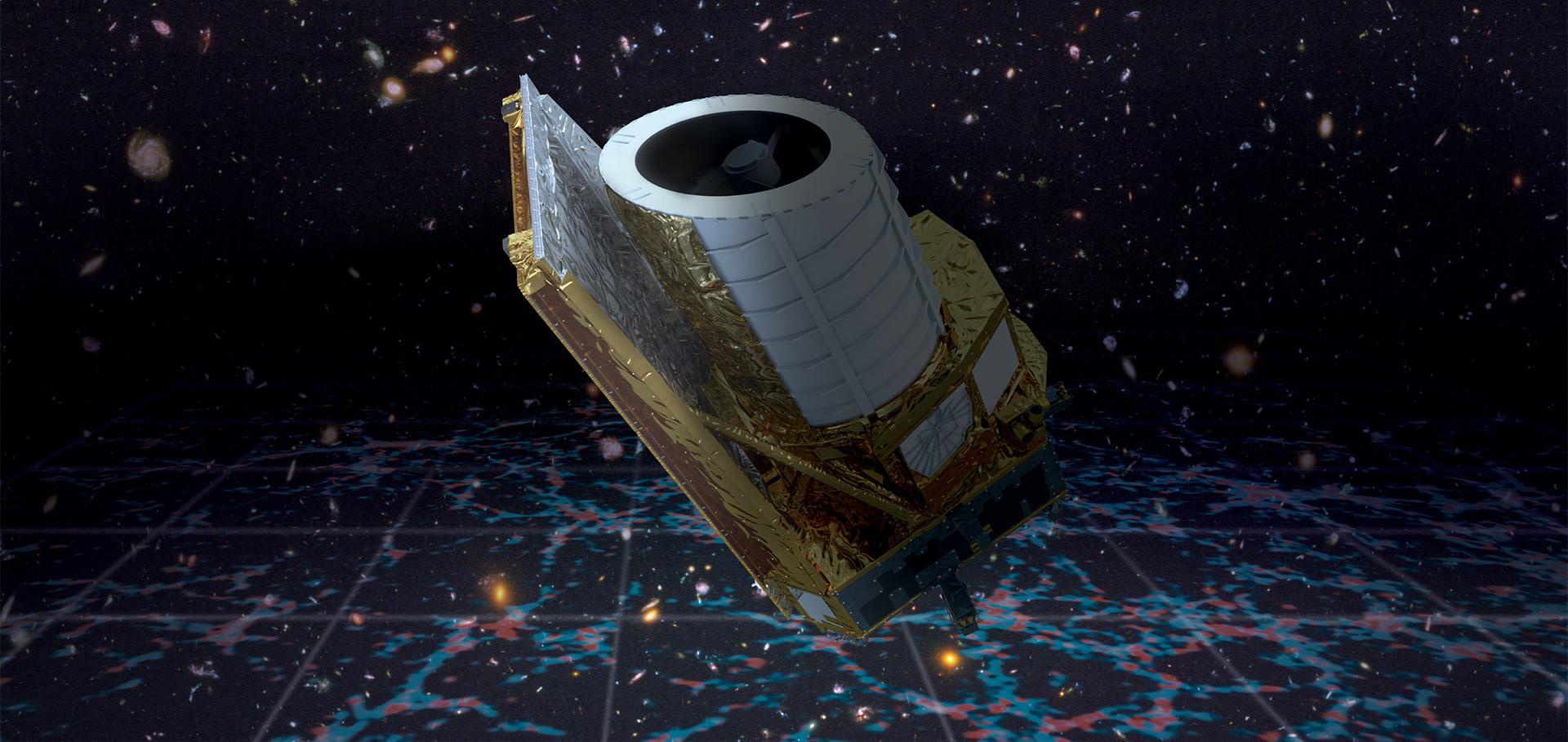
Euclid: Improving the efficiency of weak lensing shear bias calibration

Astronomy & Astrophysics EDP Sciences 683 (2024) a240

Authors:

H Jansen, M Tewes, T Schrabback, N Aghanim, A Amara, S Andreon, N Auricchio, M Baldi, E Branchini, M Brescia, J Brinchmann, S Camera, V Capobianco, C Carbone, VF Cardone, J Carretero, S Casas, M Castellano, S Cavuoti, A Cimatti, G Congedo, L Conversi, Y Copin, L Corcione, F Courbin, HM Courtois, A Da Silva, H Degaudenzi, J Dinis, F Dubath, X Dupac, M Farina, S Farrens, S Ferriol, M Frailis, E Franceschi, M Fumana, S Galeotta, B Gillis, C Giocoli, A Grazian, F Grupp, SVH Haugan, H Hoekstra, W Holmes, F Hormuth, A Hornstrup, P Hudelot, K Jahnke, B Joachimi, S Kermiche, A Kiessling, M Kilbinger, T Kitching, B Kubik, H Kurki-Suonio, S Ligori, PB Lilje, V Lindholm, I Lloro, E Maiorano, O Mansutti, O Marggraf, K Markovic, N Martinet, F Marulli, R Massey, E Medinaceli, S Mei, M Melchior, Y Mellier, M Meneghetti, E Merlin, G Meylan, L Miller, M Moresco, L Moscardini, E Munari, R Nakajima, S-M Niemi, C Padilla, S Paltani, F Pasian, K Pedersen, V Pettorino, S Pires, G Polenta, M Poncet, F Raison, A Renzi, J Rhodes, G Riccio, E Romelli, M Roncarelli, E Rossetti, R Saglia, D Sapone, B Sartoris, P Schneider, A Secroun, G Seidel, S Serrano, C Sirignano, G Sirri, J Skottfelt, L Stanco, P Tallada-Crespí, I Tereno, R Toledo-Moreo, F Torradeflot, I Tutusaus, EA Valentijn, L Valenziano, T Vassallo, A Veropalumbo, Y Wang, J Weller, G Zamorani, J Zoubian, C Colodro-Conde, V Scottez

Euclidpreparation

Astronomy & Astrophysics EDP Sciences 685 (2024) A108-A108

Authors:

E Lusso, S Fotopoulou, M Selwood, V Allevato, G Calderone, C Mancini, M Mignoli, M Scodeggio, L Bisigello, A Feltre, F Ricci, F La Franca, D Vergani, L Gabarra, V Le Brun, E Maiorano, E Palazzi, M Moresco, G Zamorani, G Cresci, K Jahnke, A Humphrey, H Landt, F Mannucci, A Marconi

Abstract:

The statistical distribution and evolution of key properties of active galactic nuclei (AGN), such as their accretion rate, mass, and spin, remains a subject of open debate in astrophysics. The ESA Euclid space mission, launched on July 1 2023, promises a breakthrough in this field. We create detailed mock catalogues of AGN spectra from the rest-frame near-infrared down to the ultraviolet – including emission lines – to simulate what Euclid will observe for both obscured (type 2) and unobscured (type 1) AGN. We concentrate on the red grisms of the NISP instrument, which will be used for the wide-field survey, opening a new window for spectroscopic AGN studies in the near-infrared. We quantify the efficiency in the redshift determination as well as in retrieving the emission line flux of the Hα+[N II] complex, as Euclid is mainly focused on this emission line, given that it is expected to be the brightest one in the probed redshift range. Spectroscopic redshifts are measured for 83% of the simulated AGN in the interval where the Hα is visible (i.e. 0.89 <  z <  1.83 at a line flux of > 2 × 10−16 erg s−1 cm−2, encompassing the peak of AGN activity at z ≃ 1 − 1.5) within the spectral coverage of the red grism. Outside this redshift range, the measurement efficiency decreases significantly. Overall, a spectroscopic redshift iscorrectly determined for about 90% of type 2 AGN down to an emission line flux of roughly 3 × 10−16 erg s−1 cm−2, and for type 1 AGN down to 8.5 × 10−16 erg s−1 cm−2. Recovered values for black hole mass show a small offset with respect to the input values by about 10%, but the agreement is good overall. With such a high spectroscopic coverage at z <  2, we will be able to measure AGN demography, scaling relations, and clustering from the epoch of the peak of AGN activity down to the present-day Universe for hundreds of thousands of AGN with homogeneous spectroscopic information

The VLBA CANDELS GOODS-North Survey – I. survey design, processing, data products, and source counts

Monthly Notices of the Royal Astronomical Society Oxford University Press 529:3 (2024) 2428-2442

Authors:

Roger P Deane, Jack F Radcliffe, Ann Njeri, Alexander Akoto-Danso, Gianni Bernardi, Oleg M Smirnov, Rob Beswick, Michael A Garrett, Matthew J Jarvis, Imogen H Whittam, Stephen Bourke, Zsolt Paragi

Abstract:

The past decade has seen significant advances in wide-field cm-wave very long baseline interferometry (VLBI), which is timely given the wide-area, synoptic survey-driven strategy of major facilities across the electromagnetic spectrum. While wide-field VLBI poses significant post-processing challenges that can severely curtail its potential scientific yield, many developments in the km-scale connected-element interferometer sphere are directly applicable to addressing these. Here we present the design, processing, data products, and source counts from a deep (11 μJy beam−1), quasi-uniform sensitivity, contiguous wide-field (160 arcmin2) 1.6 GHz VLBI survey of the CANDELS GOODS-North field. This is one of the best-studied extragalactic fields at milli-arcsecond resolution and, therefore, is well-suited as a comparative study for our Tera-pixel VLBI image. The derived VLBI source counts show consistency with those measured in the COSMOS field, which broadly traces the AGN population detected in arcsecond-scale radio surveys. However, there is a distinctive flattening in the S1.4GHz ∼100–500 μJy flux density range, which suggests a transition in the population of compact faint radio sources, qualitatively consistent with the excess source counts at 15 GHz that is argued to be an unmodelled population of radio cores. This survey approach will assist in deriving robust VLBI source counts and broadening the discovery space for future wide-field VLBI surveys, including VLBI with the Square Kilometre Array, which will include new large field-of-view antennas on the African continent at ≳1000 km baselines. In addition, it may be useful in the design of both monitoring and/or rapidly triggered VLBI transient programmes.

The discovery of a z=0.7092 OH megamaser with the MIGHTEE survey

Monthly Notices of the Royal Astronomical Society Oxford University Press 529:4 (2023) 3484-3494

Authors:

Matthew Jarvis, Ian Heywood, Anastasia Ponomareva, Rohan Varadaraj, Imogen Whittam, Hengxing Pan

Abstract:

We present the discovery of the most distant OH megamaser to be observed in the main lines, using data from the MeerKAT International Giga-Hertz Tiered Extragalactic Exploration (MIGHTEE) survey. At a newly measured redshift of 𝑧 = 0.7092, the system has strong emission in both the 1665 MHz (𝐿 ≈ 2500 L⊙) and 1667 MHz (𝐿 ≈ 4.5×10⁴ L⊙) transitions, with both narrow and broad components. We interpret the broad line as a high-velocity-dispersion component of the 1667 MHz transition, with velocity 𝑣 ∼ 330 km s−1 with respect to the systemic velocity. The host galaxy has a stellar mass of 𝑀★ = 2.95 × 10¹⁰ M⊙ and a star-formation rate of SFR = 371 M⊙ yr−1 , placing it ∼ 1.5 dex above the main sequence for star-forming galaxies at this redshift, and can be classified as an ultra-luminous infrared galaxy. Alongside the optical imaging data, which exhibits evidence for a tidal tail, this suggests that the OH megamaser arises from a system that is currently undergoing a merger, which is stimulating star formation and providing the necessary conditions for pumping the OH molecule to saturation. The OHM is likely to be lensed, with a magnification factor of ∼ 2.5, and perhaps more if the maser emitting region is compact and suitably offset relative to the centroid of its host galaxy’s optical light. This discovery demonstrates that spectral line mapping with the new generation of radio interferometers may provide important information on the cosmic merger history of galaxies.

The discovery of a z=0.7092 OH megamaser with the MIGHTEE survey

(2023)

Authors:

Matt J Jarvis, Ian Heywood, Sophie M Jewell, Roger P Deane, H-R Klöckner, Anastasia A Ponomareva, Natasha Maddox, Andrew J Baker, Alessandro Bianchetti, Kelley M Hess, Hayley Roberts, Giulia Rodighiero, Ilaria Ruffa, Francesco Sinigaglia, RG Varadaraj, IH Whittam, Elizabeth AK Adams, Maarten Baes, Eric J Murphy, Hengxing Pan, Mattia Vaccari