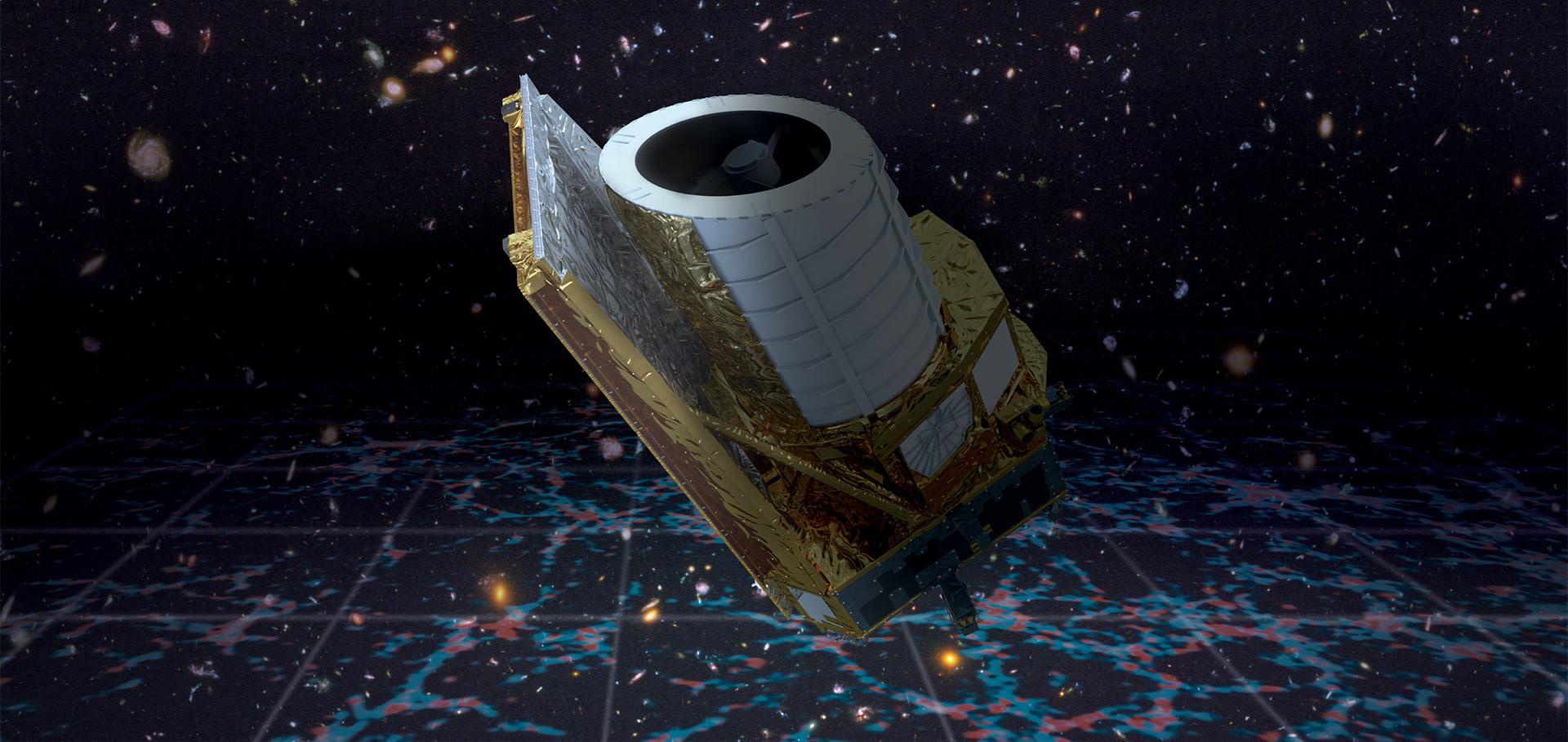
Euclid Quick Data Release (Q1)

Astronomy & Astrophysics EDP Sciences 711 (2026) a12

Authors:

F Gentile, E Daddi, D Elbaz, A Enia, B Magnelli, J-B Billand, P Corcho-Caballero, C Cleland, G De Lucia, C D’Eugenio, M Fossati, M Franco, C Lobo, Y Lyu, M Magliocchetti, GA Mamon, L Quilley, JG Sorce, M Tarrasse, M Bolzonella, F Durret, L Gabarra, S Guo, L Pozzetti, S Quai, F Shankar, V Sangalli, M Talia, M Baes, H Fu, M Girardi, J Matthee, PA Oesch, D Roberts, J Schaye, D Scott, L Spinoglio, B Altieri, A Amara, S Andreon, N Auricchio, C Baccigalupi, M Baldi, A Balestra, S Bardelli, R Bender, A Biviano, E Branchini, M Brescia, J Brinchmann, S Camera, G Cañas-Herrera, V Capobianco, C Carbone, J Carretero, S Casas, M Castellano, G Castignani, S Cavuoti, KC Chambers, A Cimatti, C Colodro-Conde, G Congedo, L Conversi, Y Copin, F Courbin, HM Courtois, M Cropper, A Da Silva, H Degaudenzi, C Dolding, H Dole, F Dubath, CAJ Duncan, X Dupac, S Dusini, S Escoffier, M Fabricius, M Farina, R Farinelli, S Ferriol, F Finelli, N Fourmanoit, M Frailis, E Franceschi, M Fumana, S Galeotta, K George, B Gillis, C Giocoli, J Gracia-Carpio, A Grazian, F Grupp, S Gwyn, SVH Haugan, J Hoar, W Holmes, IM Hook, F Hormuth, A Hornstrup, K Jahnke, M Jhabvala, B Joachimi, E Keihänen, S Kermiche, A Kiessling, B Kubik, M Kümmel, M Kunz, H Kurki-Suonio, AMC Le Brun, S Ligori, PB Lilje, V Lindholm, I Lloro, G Mainetti, D Maino, E Maiorano, O Mansutti, O Marggraf, M Martinelli, N Martinet, F Marulli, RJ Massey, E Medinaceli, S Mei, M Melchior, Y Mellier, M Meneghetti, E Merlin, G Meylan, A Mora, M Moresco, L Moscardini, R Nakajima, S-M Niemi, C Padilla, S Paltani, F Pasian, K Pedersen, WJ Percival, V Pettorino, S Pires, G Polenta, M Poncet, LA Popa, F Raison, A Renzi, J Rhodes, G Riccio, E Romelli, M Roncarelli, R Saglia, Z Sakr, D Sapone, B Sartoris, P Schneider, T Schrabback, A Secroun, G Seidel, S Serrano, P Simon, C Sirignano, G Sirri, J Skottfelt, L Stanco, J Steinwagner, P Tallada-Crespí, AN Taylor, HI Teplitz, I Tereno, N Tessore, S Toft, R Toledo-Moreo, F Torradeflot, I Tutusaus, L Valenziano, J Valiviita, T Vassallo, G Verdoes Kleijn, A Veropalumbo, Y Wang, J Weller, A Zacchei, G Zamorani, IA Zinchenko, E Zucca, V Allevato, M Ballardini, E Bozzo, C Burigana, R Cabanac, M Calabrese, A Cappi, D Di Ferdinando, JA Escartin Vigo, WG Hartley, M Huertas-Company, J Martín-Fleitas, S Matthew, N Mauri, RB Metcalf, A Pezzotta, M Pöntinen, I Risso, V Scottez, M Sereno, M Tenti, M Viel, M Wiesmann, Y Akrami, IT Andika, S Anselmi, M Archidiacono, F Atrio-Barandela, D Bertacca, M Bethermin, L Bisigello, A Blanchard, L Blot, H Böhringer, M Bonici, S Borgani, ML Brown, S Bruton, A Calabro, B Camacho Quevedo, F Caro, CS Carvalho, T Castro, F Cogato, S Conseil, T Contini, AR Cooray, O Cucciati, G Desprez, A Díaz-Sánchez, S Di Domizio, JM Diego, P Dimauro, P-A Duc, MY Elkhashab, Y Fang, A Finoguenov, A Fontana, F Fontanot, A Franco, K Ganga, J García-Bellido, T Gasparetto, V Gautard, R Gavazzi, E Gaztanaga, F Giacomini, F Gianotti, AH Gonzalez, G Gozaliasl, M Guidi, CM Gutierrez, A Hall, S Hemmati, H Hildebrandt, J Hjorth, JJE Kajava, Y Kang, V Kansal, D Karagiannis, K Kiiveri, J Kim, CC Kirkpatrick, S Kruk, L Legrand, M Lembo, F Lepori, G Leroy, GF Lesci, J Lesgourgues, L Leuzzi, TI Liaudat, A Loureiro, J Macias-Perez, EA Magnier, F Mannucci, R Maoli, CJAP Martins, L Maurin, M Miluzio, P Monaco, C Moretti, G Morgante, K Naidoo, A Navarro-Alsina, S Nesseris, D Paoletti, F Passalacqua, K Paterson, L Patrizii, A Pisani, D Potter, M Radovich, G Rodighiero, S Sacquegna, M Sahlén, DB Sanders, E Sarpa, C Scarlata, A Schneider, M Schultheis, D Sciotti, E Sellentin, LC Smith, SA Stanford, K Tanidis, G Testera, R Teyssier, S Tosi, A Troja, M Tucci, C Valieri, A Venhola, D Vergani, G Verza, P Vielzeuf, NA Walton

Abstract:

The well-known bimodality between star-forming discs and quiescent spheroids requires the existence of two main processes: galaxy quenching, causing the strong reduction of star formation, and morphological transformation, causing the transition from disc-dominated structures to bulge-dominated ones. In this paper, we aim to understand the link between these two processes and their relation with the stellar mass of galaxies and their local environment. Taking advantage of the first data released by the Euclid Collaboration, covering more than 60 deg 2 with space-based imaging and photometry, we analyse a mass-complete sample of nearly one million galaxies in the range 0.25 < z < 1 with M * > 10 9.5 M ⊙ , using a combination of photometric and spectroscopic redshifts. We divide the sample into four sub-populations of galaxies, based on their star-formation activity (star-forming and quiescent) and morphology (disc-dominated and bulge-dominated). We then analyse the physical properties of these populations and their relative abundances in the stellar mass versus local density plane. Together with confirming the passivity-density relation and the morphology-density relation, we find that quiescent discy galaxies are more abundant in the low-mass regime of high-density environment where log 10 (1 + δ ) > 1.3. At the same time, star-forming bulge-dominated galaxies are more common in field regions with log 10 (1 + δ ) < 0.8, preferentially at high masses. Building on these results and interpreting them through comparison with simulations, we propose a scenario where the evolution of galaxies in the field significantly differs from that in higher-density environments. The morphological transformation in the majority of field galaxies takes place before the onset of quenching and is mainly driven by secular processes taking place within the main sequence, leading to the formation of star-forming bulge-dominated galaxies as intermediate-stage galaxies. Conversely, quenching of star formation precedes morphological transformation for most galaxies in higher-density environments. This causes the formation of quiescent disc-dominated galaxies before their transition into bulge-dominated ones.

Euclid Quick Data Release (Q1)

Astronomy & Astrophysics EDP Sciences 711 (2026) a285

Authors:

Y Fu, R Bouwens, KI Caputi, D Vergani, M Scialpi, B Margalef-Bentabol, L Wang, M Bolzonella, M Banerji, E Bañados, A Feltre, Y Toba, J Calhau, F Tarsitano, PAC Cunha, A Humphrey, G Vietri, F Mannucci, S Bisogni, F Ricci, H Landt, L Spinoglio, T Matamoro Zatarain, D Stern, MJ Page, DM Alexander, G Zamorani, W Roster, M Salvato, Y Copin, JG Sorce, D Scott, Y-H Zhang, E Lusso, J Wolf, D Yang, HJA Rottgering, B Laloux, M Siudek, S Belladitta, Q Liu, V Allevato, K Kuijken, S Andreon, N Auricchio, C Baccigalupi, M Baldi, A Balestra, S Bardelli, P Battaglia, A Biviano, E Branchini, M Brescia, J Brinchmann, S Camera, G Cañas-Herrera, V Capobianco, C Carbone, J Carretero, S Casas, M Castellano, G Castignani, S Cavuoti, KC Chambers, A Cimatti, C Colodro-Conde, G Congedo, CJ Conselice, L Conversi, A Costille, F Courbin, HM Courtois, M Cropper, A Da Silva, H Degaudenzi, G De Lucia, C Dolding, H Dole, F Dubath, CAJ Duncan, X Dupac, S Dusini, S Escoffier, M Fabricius, M Farina, R Farinelli, S Ferriol, F Finelli, P Fosalba, N Fourmanoit, M Frailis, E Franceschi, P Franzetti, M Fumana, S Galeotta, K George, W Gillard, B Gillis, C Giocoli, J Gracia-Carpio, A Grazian, F Grupp, L Guzzo, SVH Haugan, H Hoekstra, W Holmes, IM Hook, F Hormuth, A Hornstrup, K Jahnke, M Jhabvala, B Joachimi, E Keihänen, S Kermiche, A Kiessling, B Kubik, M Kümmel, M Kunz, H Kurki-Suonio, R Laureijs, AMC Le Brun, S Ligori, PB Lilje, V Lindholm, I Lloro, G Mainetti, D Maino, E Maiorano, O Mansutti, S Marcin, O Marggraf, K Markovic, M Martinelli, N Martinet, F Marulli, RJ Massey, E Medinaceli, S Mei, M Melchior, Y Mellier, M Meneghetti, E Merlin, G Meylan, A Mora, M Moresco, L Moscardini, R Nakajima, C Neissner, RC Nichol, S-M Niemi, C Padilla, S Paltani, F Pasian, K Pedersen, WJ Percival, V Pettorino, S Pires, G Polenta, M Poncet, LA Popa, L Pozzetti, F Raison, R Rebolo, A Renzi, J Rhodes, G Riccio, E Romelli, M Roncarelli, E Rossetti, R Saglia, Z Sakr, D Sapone, B Sartoris, M Schirmer, P Schneider, T Schrabback, M Scodeggio, A Secroun, E Sefusatti, G Seidel, S Serrano, P Simon, C Sirignano, G Sirri, L Stanco, J-L Starck, J Steinwagner, C Surace, P Tallada-Crespí, D Tavagnacco, AN Taylor, HI Teplitz, I Tereno, N Tessore, S Toft, R Toledo-Moreo, F Torradeflot, I Tutusaus, L Valenziano, J Valiviita, T Vassallo, A Veropalumbo, D Vibert, Y Wang, J Weller, A Zacchei, E Zucca, M Ballardini, E Bozzo, C Burigana, R Cabanac, M Calabrese, A Cappi, D Di Ferdinando, JA Escartin Vigo, L Gabarra, WG Hartley, M Huertas-Company, J Martín-Fleitas, S Matthew, N Mauri, RB Metcalf, AA Nucita, A Pezzotta, M Pöntinen, C Porciani, I Risso, V Scottez, M Sereno, M Tenti, M Viel, M Wiesmann, Y Akrami, S Alvi, IT Andika, S Anselmi, M Archidiacono, F Atrio-Barandela, E Aubourg, D Bertacca, M Bethermin, L Bisigello, A Blanchard, L Blot, M Bonici, S Borgani, ML Brown, S Bruton, A Calabro, B Camacho Quevedo, F Caro, CS Carvalho, T Castro, F Cogato, S Conseil, AR Cooray, O Cucciati, G Daste, F De Paolis, G Desprez, A Díaz-Sánchez, JJ Diaz, S Di Domizio, JM Diego, P Dimauro, P-A Duc, MY Elkhashab, A Enia, Y Fang, AG Ferrari, A Finoguenov, F Fontanot, A Franco, K Ganga, J García-Bellido, T Gasparetto, V Gautard, E Gaztanaga, F Giacomini, F Gianotti, G Gozaliasl, M Gray, M Guidi, CM Gutierrez, A Hall, C Hernández-Monteagudo, H Hildebrandt, J Hjorth, JJE Kajava, Y Kang, V Kansal, D Karagiannis, K Kiiveri, J Kim, CC Kirkpatrick, S Kruk, V Le Brun, J Le Graet, L Legrand, M Lembo, F Lepori, G Leroy, GF Lesci, J Lesgourgues, TI Liaudat, A Loureiro, J Macias-Perez, M Magliocchetti, C Mancini, R Maoli, CJAP Martins, L Maurin, M Miluzio, P Monaco, C Moretti, G Morgante, S Nadathur, K Naidoo, P Natoli, A Navarro-Alsina, S Nesseris, D Paoletti, F Passalacqua, K Paterson, L Patrizii, A Pisani, D Potter, S Quai, M Radovich, P-F Rocci, G Rodighiero, S Sacquegna, M Sahlén, DB Sanders, E Sarpa, C Scarlata, A Schneider, D Sciotti, E Sellentin, F Shankar, LC Smith, E Soubrie, K Tanidis, C Tao, G Testera, R Teyssier, S Tosi, A Troja, M Tucci, C Valieri, A Venhola, G Verza, P Vielzeuf, A Viitanen, NA Walton, JR Weaver

Abstract:

The slitless spectroscopy mode of the Near-Infrared Spectrometer and Photometer (NISP) on board the Euclid telescope has enabled efficient spectroscopy of objects within a large field of view. Nevertheless, the relatively low spectral resolution, overlapping spectra, and contamination pose challenges to source classification and redshift determination using the NISP spectra alone. In this work, we present a large and homogeneous sample of bright quasars identified from the Euclid Quick Data Release (Q1), constructed by combining high-purity candidate selections from Gaia and WISE with the new spectroscopic capabilities of Euclid . Through visual inspection of the Euclid spectra of these quasar candidates, we identify approximately 3500 quasars and determine reliable redshifts in the range of 0 < z ≲ 4.8. Of these, 2686 are new spectroscopic identifications relative to existing public compilations. We generated the first Euclid composite spectrum of quasars covering rest-frame near-ultraviolet (NUV) to near-infrared (NIR) wavelengths without telluric lines, which will be pivotal to NIR quasar spectral analysis. We obtained an empirical spectroscopic depth of J E ≲ 21.5 and H E ≲ 21.3 at the sensitivity of the Wide Field Survey, beyond which the number of securely identified quasars declines sharply. Accordingly, the sample presented in this paper comprises spectroscopically confirmed quasars brighter than these limits. We analysed morphological parameters from the Visible Camera (VIS) using Sérsic and model-independent (CAS) metrics, and a deep-learning point spread function fraction ( f PSF ) to track nuclear dominance. The VIS morphologies show a clear redshift dependence: at low redshift ( z < 0.5), obvious host structures are common and a single Sérsic model fits about half of the sources; at intermediate redshift (0.5 < z < 2), the nuclear component dominates, with 90% of the Sérsic fits saturating at the upper index limit. In this intermediate redshift regime, f PSF is available, and we use it as a more reliable compactness measure than the single-Sérsic and CAS parameters to quantify nuclear versus host emission. We also explore the novel Euclid NIR colour space and discuss the role of these quasars in refining active galactic nucleus selection techniques for future Euclid data releases.

Euclid: Precise inference of defocus wavefront error from image diffraction spike measurements

ArXiv 2606.25625 (2026)

Authors:

D Neumann, L Miller, H Hoekstra, K Kuijken, IH Whittam, NE Chisari, R Nakajima, B Altieri, A Amara, S Andreon, N Auricchio, C Baccigalupi, M Baldi, S Bardelli, A Basset, P Battaglia, A Biviano, E Branchini, M Brescia, S Camera, G Cañas-Herrera, V Capobianco, C Carbone, J Carretero, M Castellano, G Castignani, S Cavuoti, KC Chambers, A Cimatti, C Colodro-Conde, G Congedo, CJ Conselice, L Conversi, Y Copin, F Courbin, HM Courtois, M Cropper, H Degaudenzi, G De Lucia, H Dole, F Dubath, X Dupac, M Farina, R Farinelli, S Farrens, S Ferriol, S Fotopoulou, N Fourmanoit, M Frailis, E Franceschi, M Fumana, S Galeotta, K George, B Gillis, C Giocoli, P Gómez-Alvarez, J Gracia-Carpio, A Grazian, F Grupp, SVH Haugan, W Holmes, F Hormuth, A Hornstrup, K Jahnke, M Jhabvala, B Joachimi, S Kermiche, A Kiessling, M Kilbinger, R Kohley, B Kubik, M Kunz, H Kurki-Suonio, R Laureijs, AMC Le Brun, S Ligori, PB Lilje, V Lindholm, I Lloro, G Mainetti, O Mansutti, O Marggraf, M Martinelli, N Martinet, F Marulli, RJ Massey, E Medinaceli, S Mei, M Meneghetti, E Merlin, G Meylan, A Mora, M Moresco, C Moretti, L Moscardini, C Neissner, RC Nichol, S-M Niemi, C Padilla, S Paltani, F Pasian, K Pedersen, WJ Percival, V Pettorino, A Pezzotta, S Pires, G Polenta, M Poncet, LA Popa, GD Racca, F Raison, A Renzi, J Rhodes, G Riccio, E Romelli, M Roncarelli, R Saglia, Z Sakr, D Sapone, B Sartoris, M Schirmer, P Schneider, T Schrabback, A Secroun, E Sihvola, P Simon, C Sirignano, G Sirri, A Spurio Mancini, L Stanco, P Tallada-Crespí, AN Taylor, I Tereno, N Tessore, S Toft, R Toledo-Moreo, F Torradeflot, I Tutusaus, L Valenziano, J Valiviita, T Vassallo, A Veropalumbo, Y Wang, J Weller, G Zamorani, FM Zerbi, A Gregorio, A Loureiro, M Sereno

Probing the environments of FRI and FRII radio galaxies in LoTSS DR2 with galaxy clusters

Astronomy & Astrophysics EDP Sciences 710 (2026) A326-A326

Authors:

Tong Pan, Yuming Fu, HJA Rottgering, JMGHJ de Jong, MJ Hardcastle, B Mingo, L Clews, M Magliocchetti, JW Petley, Bohan Yue

Abstract:

Aims. The origin of the morphological dichotomy between Fanaroff-Riley Class I (FRI) and Class II (FRII) radio galaxies has long been debated. In this study, we investigate whether the cluster-scale environment plays a significant role in shaping the morphology of FRIs and FRIIs. Methods. Using the new morphologically classified catalogue from the second data release of the LOFAR Two-metre Sky Survey (LoTSS DR2), we construct two samples at z  < 0.4: a volume-limited sample with L 144 > 4 × 10 24 W Hz −1 and a paired sample in which each FRII is matched to the nearest FRI in luminosity and redshift. We cross-match these samples with a recent galaxy cluster catalogue based on the DESI Legacy Imaging Survey. A galaxy is considered associated with a cluster with M 500  > 0.47 × 10 14   M ⊙ if the redshift difference between the galaxy and the cluster centre is below 0.01, and the projected distance between the two is smaller than 2 R 500 . Results. In the volume-limited sample, 48.6 −1.8 +1.8 % of FRIs and 30.6 −2.3 +2.5 % of FRIIs are associated with clusters. In the paired sample, 45.6 −3.1 +3.1 % of FRIs and 32.6 −2.8 +3.0 % of FRIIs are associated with clusters. This difference in cluster match fractions between FRIs and FRIIs in both samples becomes more pronounced at higher radio luminosities ( L 144 MHz > 10 26 W Hz −1 ). In the volume-limited sample, 55.6 −9.6 +9.2 % of luminous FRIs and 19.0 −4.6 +5.7 % of luminous FRIIs are associated with clusters. In the paired sample, 50.0 −12.9 +12.9 % of luminous FRIs and 6.7 −3.9 +9.5 % of luminous FRIIs are associated with clusters. Nevertheless, those FRIs and FRIIs that are associated with clusters show similar properties. In particular, the distributions of radio luminosity and stellar mass as functions of cluster richness and M 500 are similar for FRIs and FRIIs. The radial density profiles of cluster-associated FRIs and FRIIs both peak at 0.5 × R 500 and decline beyond R 500 , showing very similar spatial distributions within clusters. Furthermore, in the volume-limited sample, 74.8 −2.3 +2.2 % of cluster-associated FRIs and 61.9 −4.6 +4.4 % of cluster-associated FRIIs are identified as brightest cluster galaxies (BCGs). In the paired sample, 78.1 −4.0 +3.5 % of cluster-associated FRIs and 65.9 −5.3 +4.9 % of cluster-associated FRIIs are identified as BCGs. The median properties of these FRI-BCGs and FRII-BCGs, as well as those of their host clusters, do not show significant differences. Conclusions. Compared to FRIs, FRIIs are less frequently found in galaxy clusters, particularly at high radio luminosities. This pattern may be explained by the jet disruption scenario, in which the dense gas in galaxy clusters can slow down or disturb radio jets, making it more difficult for powerful FRII structures to form or remain stable. However, when FRIs and FRIIs do reside in clusters, they appear to inhabit similar environments in terms of richness, mass, and radial position. These findings suggest that, while the cluster-scale environment may influence the cluster match fraction, the morphological distinction between FRIs and FRIIs is unlikely to be primarily driven by cluster-scale properties alone. Improved estimates of cluster richness and mass will help to further clarify the extent to which the cluster environment influences the radio morphology of FRIs and FRIIs.

Applications of 1.4 GHz diagnostics to Type Ia Supernova host galaxies

Monthly Notices of the Royal Astronomical Society Oxford University Press 549:1 (2026) stag832

Authors:

S Ramaiya, MJ Jarvis, M Vincenzi, M Sullivan, IH Whittam

Abstract:

Type Ia supernova (SN Ia) standardization parameters exhibit evidence for systematic variation across the host galaxy star formation rate–stellar mass (SFR) plane, motivating the incorporation of galaxy SFR information in cosmological inference. SFRs are commonly estimated via spectral energy distribution (SED) fitting with far-infrared (FIR) measurements to account for dust-obscured star formation. Such FIR coverage will, however, be limited for upcoming time-domain surveys such as the Rubin Observatory Legacy Survey of Space and Time (LSST), necessitating the use of alternative SFR tracers. Here, we reconstruct the SFR– plane using 1.4 GHz diagnostics, to test the consistency of host classifications against FIR-constrained SED-based estimates. Within this plane, SN Ia host galaxies are divided into three regions: Region 1 (low mass), Region 2 (high-mass star forming), and Region 3 (high-mass passive). We find that per cent of SN hosts retain identical region assignments when using radio versus FIR-constrained SED-derived SFRs. Measuring SN Ia nuisance parameters () within each subregion, we find consistent values between the two SFR– plane reconstructions, indicating limited sensitivity to SFR estimator choice, with the largest deviations in Region 3 at . Across the three 1.4 GHz SFR– subregions, we confirm the region-dependent variation in SN Ia standardization parameters – particularly – reported in our earlier SED-based analysis. With near-complete radio coverage of the LSST footprint anticipated from current and forthcoming radio continuum surveys (e.g. Square Kilometre Array), radio SFR calibrations will become an increasingly useful and scalable approach to host galaxy classification, supporting the construction of robust SN Ia subsamples for precision cosmology.