Direct Imaging Discovery of Giant Exoplanet β Pictoris d: A Decade-long Game of Hide-and-seek

The Astrophysical Journal Letters American Astronomical Society 1006:1 (2026) L10-L10

Authors:

Ben J Sutlieff, Markus J Bonse, Valentin Christiaens, Clémence Fontanive, Elisabeth C Matthews, Luke T Parker, Tim D Pearce, Jayne L Birkby, Beth A Biller, Trent J Dupuy, Emily O Garvin, Leyla Iskandarli, Jens Kammerer, Yifan Zhou, Robert J De Rosa, Aarynn L Carter, Sasha Hinkley, Matthew A Kenworthy, William O Balmer, Iain Hammond, James Mang, Caroline V Morley, Mark J Neeser, Olivier Absil, Anthony Boccaletti

Abstract:

We report the direct imaging discovery of a third exoplanet in the β Pictoris (β Pic) system. We detect β Pictoris d (β Pic d) in noncoronagraphic observations obtained with the Very Large Telescope (VLT) Enhanced Resolution Imager and Spectrograph (ERIS), as well as multi-epoch archival datasets from the JWST Near Infrared Camera (NIRCam) and VLT/SPHERE. Astrometric measurements over an 11 yr baseline demonstrate that it is consistent with a gravitationally bound source with orbital motion. Joint multi-planet orbit fits of all three planets in the system yield a semimajor axis of 26.0−6.1+2.2 au and inclination 89.0−0.6+0.7 deg for planet d. β Pic d has a larger orbital semimajor axis than the other known planets in the system, but is coplanar with the inner two planets, and its orbit is consistent with sculpting the inner edge of the debris disk. β Pic d has a contrast of ΔL′=12.11±0.15 mag, with colors and luminosity that closely match those of 51 Eri b, another exoplanet in the β Pic moving group. Its VLT/ERIS and JWST/NIRCam colors are distinct from those of free-floating planetary-mass objects of a similar age and temperature. Its red F410M − F444W color indicates strong CO2 absorption in its atmosphere and suggests significant enhancement in metals compared to free-floating objects. From the ATMO hot-start evolutionary models, we estimate an effective temperature of 600−60+45 K and mass of 2.4 ± 0.6 MJup, which also closely matches similar estimates for 51 Eri b. β Pic d is among the lowest-mass exoplanets imaged from the ground. This discovery highlights the deep sensitivity achievable with ground-based imaging in the mid-infrared and the discovery potential of future high-contrast observations with the Extremely Large Telescope.

Glossy Silicate Clouds on the Scorched Dayside of LTT9779b

Astrophysical Journal Letters 1005:2 (2026)

Authors:

S Saha, JS Jenkins, J Brande, R Ashtari, IJM Crossfield, S Stamer, D Dragomir, KB Stevenson, V Parmentier, TM Evans-Soma, T Daylan, H Beltz, E Esparza-Borges

Abstract:

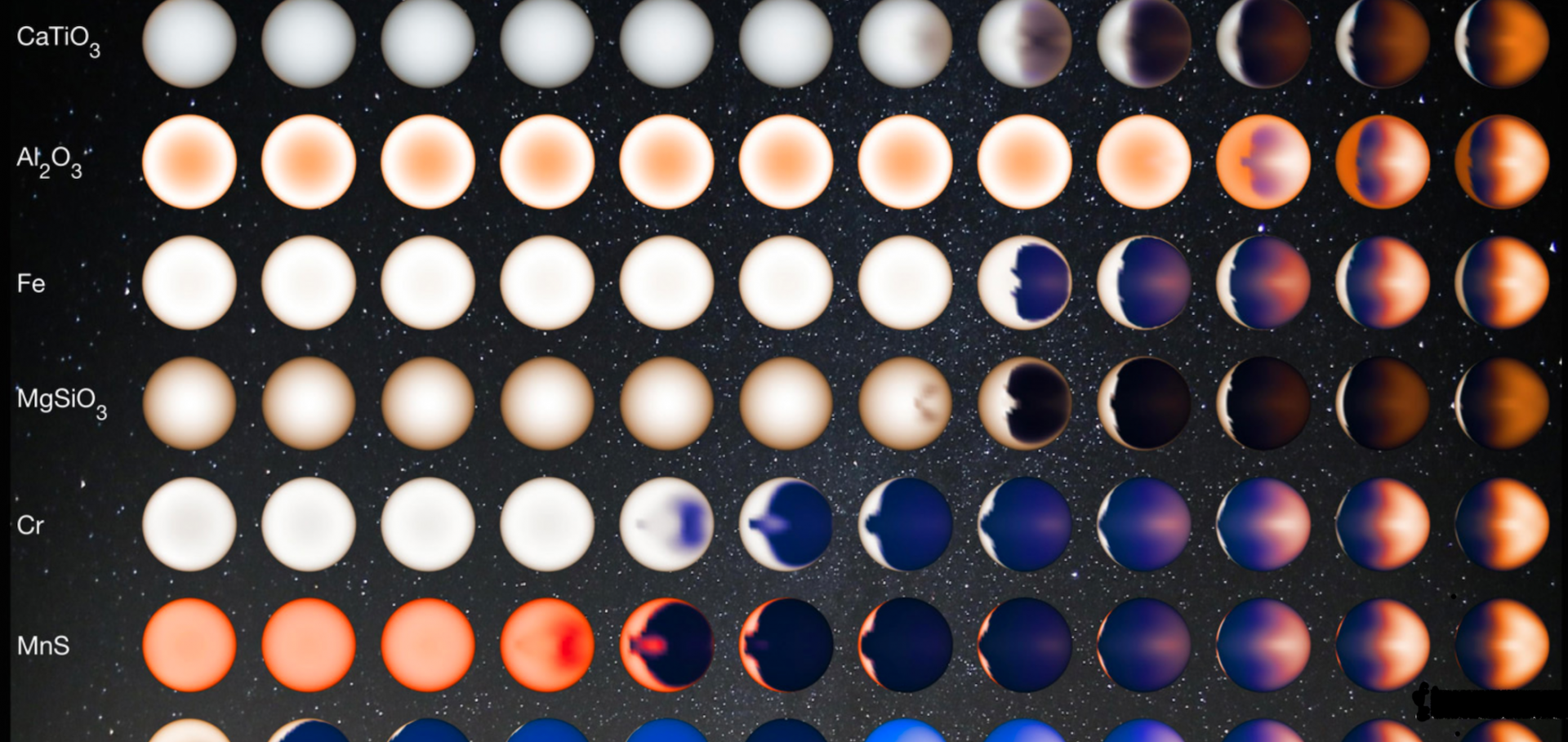
Discovered deep within the “Neptunian desert,” LTT9779b remains the only known ultrahot Neptune, prompting significant speculation regarding its unique formation and evolutionary history. Its exceptionally high geometric albedo has previously been attributed either to the presence of clouds or to an extremely metal-rich atmosphere. Here, we present a comprehensive panchromatic analysis of its dayside atmosphere using JWST NIRISS and NIRSpec/G395H observations to characterize its atmospheric structure and composition. Leveraging the exceptional signal-to-noise ratio (SNR) in the observed spectra, we report a 3σ-to-5σ detection of dayside clouds, with strong evidence for Mg2SiO4(s) (silicate) condensation. This constitutes the first statistically significant detection of clouds on the dayside of a Neptunian-mass exoplanet. We demonstrate that a highly reflective cloud deck, rather than an extremely high-metallicity atmosphere, is the most likely explanation for the planet’s anomalously high optical albedo. Furthermore, our atmospheric retrievals yield robust detections of both CO (∼4.88σ) and CO2 (∼8.76σ), while providing tentative constraints on the H2O abundance and upper limits on SiO, TiO, and VO. Finally, our analysis places a robust constraint on the C/O ratio of 0.984 ± 0.019. This aligns LTT9779b with other known ultrahot Jupiters exhibiting supersolar C/O ratios, suggesting a broader trend driven by the sequestration of oxygen-bearing condensates in ultrahot atmospheres.

A parameterised approach to disequilibrium retrievals in the JWST era: Application to NIRCam observations of HD 189733b

ArXiv 2607.06491 (2026)

Authors:

Jake Taylor, Shang-Min Tsai, Vivien Parmentier, Chloe Fisher, Michael Line

A calibrated Cassini/VIMS catalog of Jupiter spectral cubes from the 2000–2001 flyby

(2026)

Authors:

Asier Anguiano-Arteaga, Patrick Irwin, Santiago Pérez-Hoyos, Davide Grassi, Emiliano D'Aversa

Abstract:

Cassini observed Jupiter during its 2000–2001 gravity-assist flyby, acquiring a valuable set of Visible and Infrared Mapping Spectrometer (VIMS) observations over a wide range of viewing geometries and observing conditions. These data comprise visible and infrared spectral cubes covering the VIS channel from 0.35 to 1.05 µm and the IR channel from 0.9 to 5.1 µm. We present a calibrated catalog of these Jupiter VIMS observations,  excluding satellite-targeted observations, designed to provide a homogeneous and validated set of spectral products for future Jovian studies.Starting from the raw archive cubes, we developed a processing workflow that combines ISIS/SPICE-based geometry recovery with dedicated radiometric calibration procedures for both VIMS channels. The final products are delivered as multi-extension FITS files containing calibrated I/F spectral cubes, wavelength and FWHM vectors, and geometry backplanes for incidence, emission, and phase angles, planetocentric latitude, positive-east longitude, pixel resolution, and azimuth angle. The workflow also addresses several issues affecting the original data set, including saturation, VIS pointing-related offsets between radiometric cubes and geometric backplanes, channel-dependent dark-signal artifacts, and a subset of IR approach-phase for which the standard ISIS calibration pipeline can produce over-scaled reflected spectra.The resulting catalog provides a uniform, documented, validated, and publicly available set of Cassini/VIMS Jupiter products. By combining calibrated VIS and IR cubes with wavelength information and geometry backplanes, these products facilitate a wide range of applications in the study of Jupiter and its atmosphere.

Cold Temperatures, Dark Clouds, or Missing Absorption: What Does the 5-Micron Window Tell Us about the Ice Giants?

(2026)

Authors:

Michael Roman, Leigh Fletcher, Oliver King, Simon Toogood, Heidi Hammel, Patrick Irwin, Joseph Penn, Imke de Pater, Henrik Melin, Stefanie Miliam

Abstract:

JWST-NIRSpec observations are providing our first detailed view of the Ice Giants in the 5-micron spectral window [1]. Observations of Jupiter and Saturn (see Figure) at 5 microns have historically revealed important insights into their tropospheric composition, along with striking images of clouds silhouetted against the glowing thermal emission from deeper atmospheric layers [2]. Comparable observations of the colder Ice Giants, however, have long remained beyond observational reach—until now.In this talk, we present JWST-NIRSpec 5-micron observations of the Ice Giants and discuss their implications. We examine what these observations reveal about the tropospheric temperatures, clouds, and composition of Uranus and Neptune, as well as what they may imply for current radiative transfer models at these wavelengths.In particular, we find that the JWST data may suggest sub-adiabatic temperature gradients near the cloud layers, resulting in colder temperatures in the deeper atmosphere. However, these conclusions depend sensitively on the scattering properties of Ice Giant clouds and on accurate modelling of the gaseous opacity, both of which, we argue, remain uncertain under these conditions.Figure: Saturn at 5 microns (left, in red) from Cassini, with hazes shown in green (Image credits: NASA/JPL-Caltech/University of Arizona), compared to Uranus at 5 microns from JWST-NIRSpec [1].[1] Roman, M.T., et al., The Infrared Spectrum of Uranus Revealed with JWST (submitted)[2] Wong, M.H., Bjoraker, G.L., Goullaud, C., Stephens, A.W., Luszcz-Cook, S.H.,1047Atreya, S.K., Pater, I., Brown, S.T.: Deep clouds on jupiter. Remote Sensing104815(3), 702 (2023)