

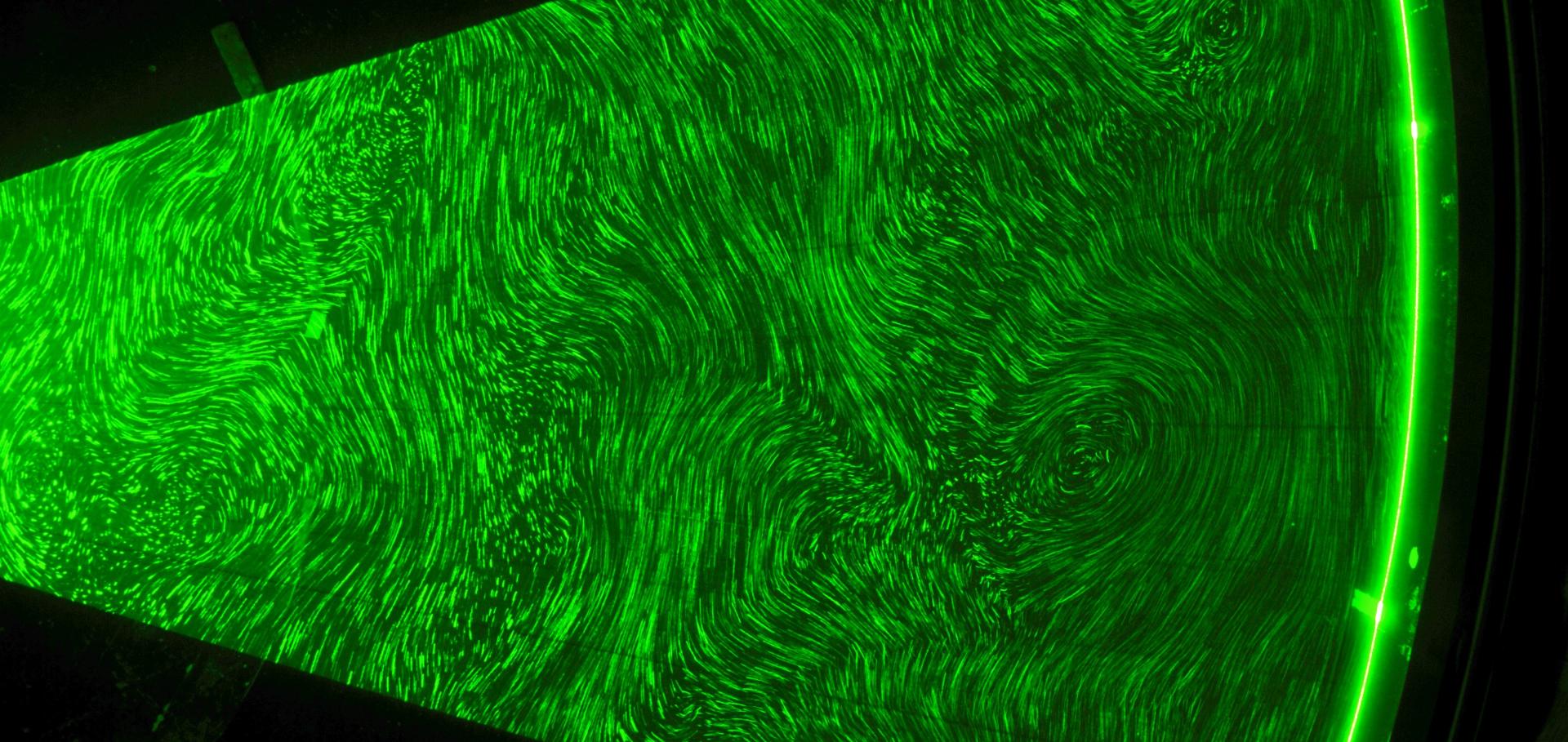
Waves, turbulence and diffusion in Beta-Plumes: Rotating tank experiments at TurLab, Turin
University of Oxford (2025)
Abstract:
This dataset provides horizontal flow fields (velocity, relative vorticity, divergence, and shear strain rate) from nine rotating turbulence experiments carried out at TurLab at the University of Turin between November 2016 and February 2017 by a team led by Oxford scientists in collaboration with others at the time from Università degli Studi di Torino, University of South Florida, Università del Piemonte Orientale and Sapienza Università di Roma. The experimental device was a rotating cylinder, 5 m in diameter filled with fresh water to a depth of 56 cm. The tank had a conical bottom, sloping upwards towards the centre from the outer edge over a radius of 2.25 m at an angle of 11.1◦. The flow was mechanically forced by a moving comb of vertical paddles partially immersed in the water, which moved backwards and forwards along a near-radial line over 100–150 s. The resulting flow was visualised using a laser sheet and microscopic particles, imaged using two cameras, and then processed into horizontal velocity fields and derived quantities using UVMAT/CIV (http://servforge.legi. grenoble-inp.fr/projects/soft-uvmat). The main quantity varied between the experiments included in this dataset is the rotation period of the tank. There were minor differences in the comb configuration at each rotation period. †Experimental dataset of sandwiched baroclinic flows over a bottom conical plate
University of Oxford (2025)
Abstract:
This dataset comprises time-resolved, two-component horizontal velocity fields from experiments in a rotating, differentially heated fluid annulus. The experiments were conducted at the GFDLab, University of Oxford.Barotropic instability
Chapter in , Elsevier (2025)
Abstract:
Barotropic instability represents a class of instabilities, usually of parallel shear flows, for which gravity and buoyancy play a negligible role, at least in their energetics. It is not restricted to purely barotropic fluids (for which ρ = ρ(p), where ρ is density and p is pressure) but can also apply to flows which are stratified and exhibit vertical shear, often leading to instabilities with mixed barotropic and baroclinic characteristics. The primary attribute of barotropic instability is usually taken to be the dominance of energy exchanges in which the kinetic energy of a perturbation grows principally at the expense of the kinetic energy of the basic state. Here we present an introduction to the basic mechanisms involved and the factors that determine the necessary and/or sufficient conditions for instability. Several examples are presented and the occurrence and subsequent nonlinear evolution of the instability is illustrated with reference to both laboratory experiments and observations in the atmospheres and oceans of the Earth and other planets in the Solar System.Predicting internal boundary layer growth following a roughness change in thermally neutral and stable boundary layers
Journal of Fluid Mechanics Cambridge University Press 1016 (2025) R4
Characterising turbulent cascades and zonal jet formation processes from observations of cloud level winds on Jupiter and Saturn
Copernicus Publications (2025)