
Home
Department Of Physics text logo
  • Research
    • Our research
    • Our research groups
    • Our research in action
    • Research funding support
    • Summer internships for undergraduates
  • Study
    • Undergraduates
    • Postgraduates
  • Engage
    • For young people
    • For teachers
    • For the public
    • For alumni
    • For business
  • Support
Menu
CMP
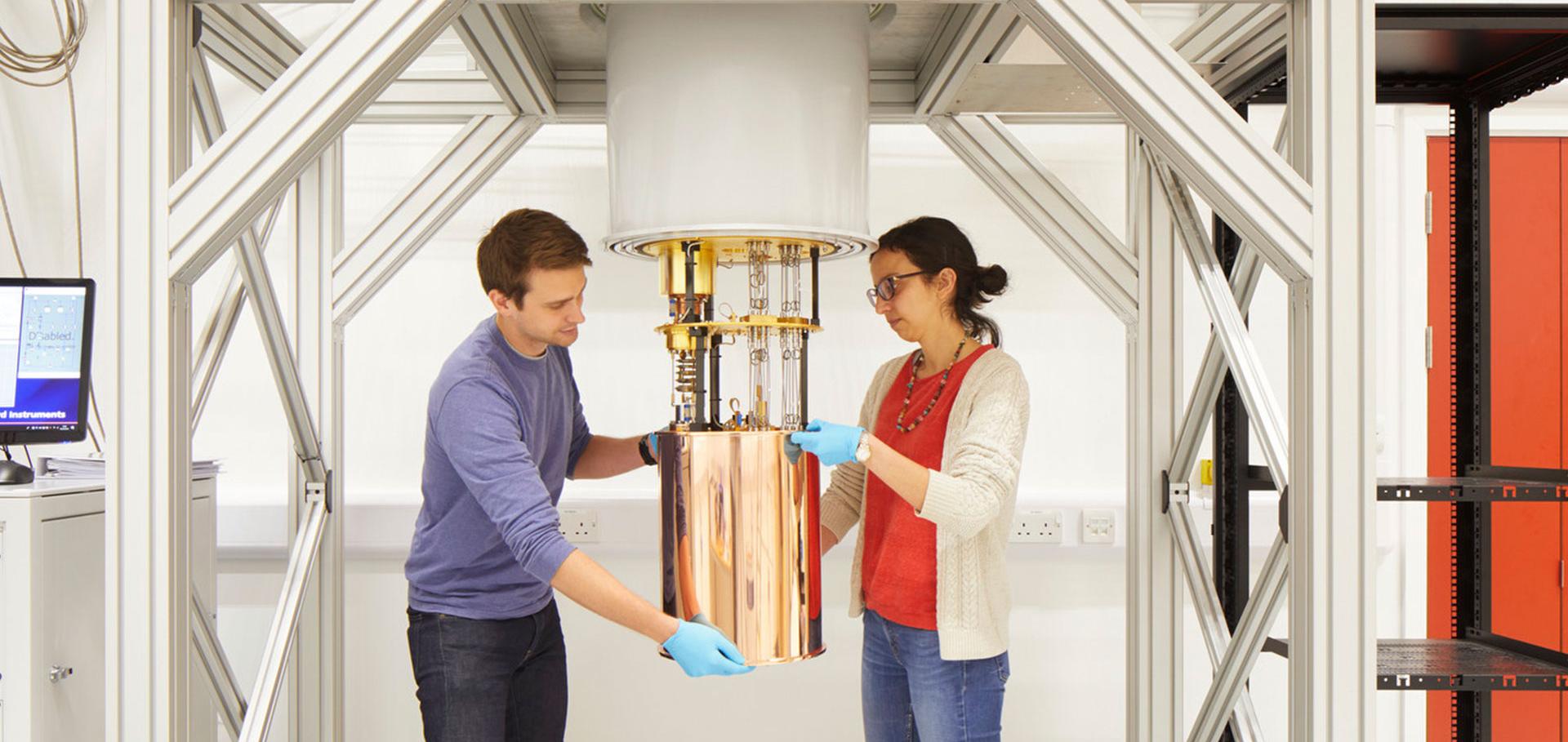
Credit: Jack Hobhouse

Dr Mustafa Bakr

Quantum Technology Research Fellow

Research theme

  • Quantum information and computation

Sub department

  • Condensed Matter Physics

Research groups

  • Superconducting quantum devices
mustafa.bakr@physics.ox.ac.uk
  • About
  • Publications

High Coherence in a Tileable 3D Integrated Superconducting Circuit Architecture

(2021)

Authors:

Peter A Spring, Shuxiang Cao, Takahiro Tsunoda, Giulio Campanaro, Simone D Fasciati, James Wills, Vivek Chidambaram, Boris Shteynas, Mustafa Bakr, Paul Gow, Lewis Carpenter, James Gates, Brian Vlastakis, Peter J Leek
More details from the publisher
Details from ArXiV

Improving dispersive readout of a superconducting qubit by machine learning on path signature

Authors:

Shuxiang Cao, Zhen Shao, Jian-Qing Zheng, Mustafa Bakr, Peter Leek, Terry Lyons

Abstract:

One major challenge that arises from quantum computing is to implement fast, high-accuracy quantum state readout. For superconducting circuits, this problem reduces to a time series classification problem on readout signals. We propose that using path signature methods to extract features can enhance existing techniques for quantum state discrimination. We demonstrate the superior performance of our proposed approach over conventional methods in distinguishing three different quantum states on real experimental data from a superconducting transmon qubit.
Details from ORA

Quantum mechanics in a spherical wedge: Complete solution and implications for angular momentum theory

American Journal of Physics American Association of Physics Teachers (AAPT) 94:12 (2026) 1108-1116

Authors:

Mustafa Bakr, Smain Amari

Abstract:

We solve the stationary Schrödinger equation for a particle confined to a three-dimensional spherical wedge. Although the differential equation is the familiar one in spherical coordinates, the altered boundary conditions reorganize the angular and radial spectra. The azimuthal wavefunctions become standing waves, so rotations about the z axis no longer preserve the physical domain and Lz is not a good quantum number. The angular separation index may consequently take non-integer values, while the complete wavefunctions and energies remain exactly calculable. We also compare azimuthal confinement with polar and radial truncations, showing that each changes a different part of the spectrum and preserves different rotational symmetries. Applied to a Coulomb potential, the model illustrates how the familiar integer quantum numbers of hydrogen arise from the periodic full-sphere domain rather than from the radial potential alone. The spherical wedge therefore provides an accessible example of how boundary conditions and operator domains determine angular momentum quantization.
More details from the publisher

Full vectorial Maxwell equations with continuous angular indices—part I: analytic framework

Proceedings of the Royal Society A Mathematical Physical and Engineering Science The Royal Society 482:2348 (2026) 20250785

Abstract:

Abstract This article presents a mathematical framework for solving Maxwell's equations in spherical geometries with continuous angular indices. We extend beyond standard discrete harmonic decomposition to a continuous spectral representation using generalized spectral integrals, capturing electromagnetic solutions that exhibit singular behaviour yet yield finite-energy fields at the geometric centre. For continuous angular indices ℓ,m∈R, we study the existence and uniqueness of solutions in weighted Sobolev spaces Hα(ℓ,m)s(Ω) following the framework established in Adams & Fournier (Adams, Fournier. 2003 Sobolev spaces, 2nd edn) and Reed & Simon (Reed, Simon. 1975 Methods of modern mathematical physics II: Fourier analysis, self-adjointness), prove finite energy for ℓ>−12, and construct explicit spectral kernels via biorthogonal function systems. The framework encompasses non-separable spherical modes where field components couple through vectorial curl operations.
More details from the publisher
More details

Full vectorial maxwell equations with continuous angular indices—part II: numerical solvers and convergence analysis

Proceedings of the Royal Society A The Royal Society 482:2348 (2026) 20250786

Abstract:

Abstract In part I of this work, we established an analytic framework for solving Maxwell's equations in spherical geometry with continuous angular indices (ℓ,m)∈R2, proving finite-energy conditions for singular solutions and formulating continuous spectral integrals in weighted Sobolev spaces. In this companion article (part II), we develop and validate numerical methods that operationalize this framework. We introduce a Galerkin discretization of the coupled angular operator on divergence-free continuous-index vector bases. To reconstruct physical fields, we complement this with an Eisenstein-type spectral integral, evaluated by mapped Gauss–Legendre quadrature. These methods explicitly account for non-orthogonality of the basis and the singular behaviour near the origin. The block formulation acts on the full matrix-valued angular Maxwell operator and is not restricted to the wedge and cone geometries used below as analytically tractable benchmarks. We analyse and numerically demonstrate convergence. The hybrid pipeline is validated by reproducing eigenmode frequencies of spherical cavities with wedge and cone modifications to within 1−2% of full-wave high-frequency structure simulator (HFSS) simulations. Together with part I, this paper completes a unified analytic–computational framework for singular electromagnetic fields with continuous angular indices.
More details from the publisher

Pagination

  • First page First
  • Previous page Prev
  • Page 1
  • Page 2
  • Current page 3
  • Page 4
  • Page 5
  • Page 6
  • Page 7
  • Page 8
  • Page 9
  • …
  • Next page Next
  • Last page Last

Footer Menu

  • Contact us
  • Giving to the Dept of Physics
  • Work with us
  • Media

User account menu

  • Log in

Follow us

FIND US

Clarendon Laboratory,

Parks Road,

Oxford,

OX1 3PU

CONTACT US

Tel: +44(0)1865272200

University of Oxfrod logo Department Of Physics text logo
IOP Juno Champion logo Athena Swan Silver Award logo

© University of Oxford - Department of Physics

Cookies | Privacy policy | Accessibility statement

Built by: Versantus

  • Home
  • Research
  • Study
  • Engage
  • Our people
  • News & Comment
  • Events
  • Our facilities & services
  • About us
  • Giving to Physics
  • Current students
  • Staff intranet