Home
Department Of Physics text logo
  • Research
    • Our research
    • Our research groups
    • Our research in action
    • Research funding support
    • Summer internships for undergraduates
  • Study
    • Undergraduates
    • Postgraduates
  • Engage
    • For alumni
    • For business
    • For schools
    • For the public
  • Support
Menu
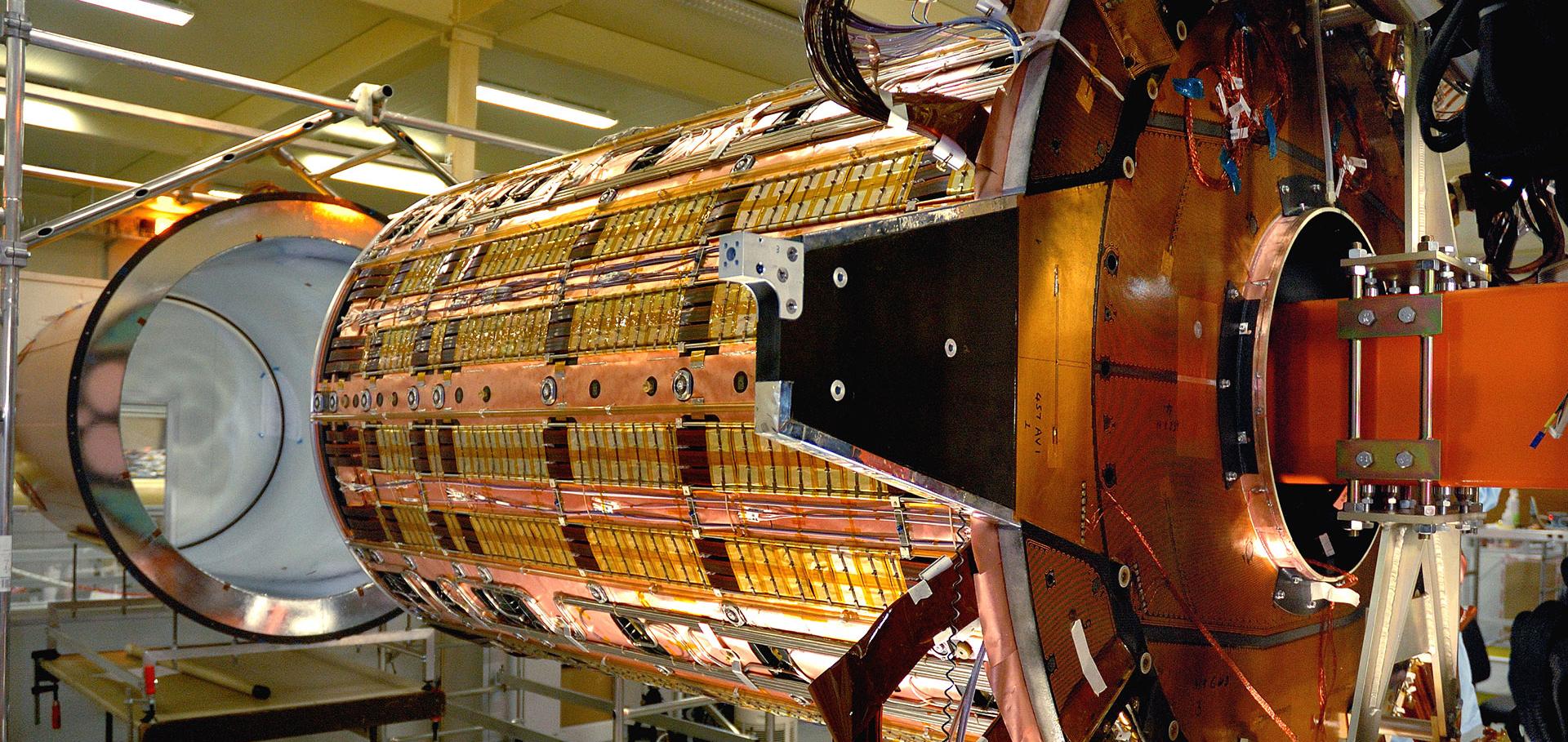
Insertion of STC into TRT at the Department of Physics, Oxford
Credit: CERN

Philip Burrows

Professor of Physics

Sub department

  • Particle Physics
Philip.Burrows@physics.ox.ac.uk
Telephone: 01865 (2)73451
Denys Wilkinson Building, room 615a
  • About
  • Publications

Experimental study of wakefields driven by a self-modulating proton bunch in plasma

Physical Review Accelerators and Beams American Physical Society 23:8 (2020) 81302

Authors:

M Turner, P Muggli, E Adli, R Agnello, M Aladi, Y Andrebe, O Apsimon, R Apsimon, A-M Bachmann, Ma Baistrukov, F Batsch, M Bergamaschi, P Blanchard, Pn Burrows, B Buttenschoen, A Caldwell, J Chappell, E Chevallay, M Chung, Da Cooke, H Damerau, C Davut, G Demeter, Lh Deubner, A Dexter, Gp Djotyan, S Doebert, J Farmer, A Fasoli, Vn Fedosseev, R Fiorito, Ra Fonseca, F Friebel, I Furno, L Garolfi, S Gessner, B Goddard, I Gorgisyan, Aa Gorn, E Granados, M Granetzny, O Grulke, E Gschwendtner, V Hafych, A Hartin, A Helm, Jr Henderson, A Howling, M Huether, R Jacquier

Abstract:

We study experimentally the longitudinal and transverse wakefields driven by a highly relativistic proton bunch during self-modulation in plasma. We show that the wakefields’ growth and amplitude increase with increasing seed amplitude as well as with the proton bunch charge in the plasma. We study transverse wakefields using the maximum radius of the proton bunch distribution measured on a screen downstream from the plasma. We study longitudinal wakefields by externally injecting electrons and measuring their final energy. Measurements agree with trends predicted by theory and numerical simulations and validate our understanding of the development of self-modulation. Experiments were performed in the context of the Advanced Wakefield Experiment (AWAKE).
More details from the publisher
Details from ORA
More details

The Laser-hybrid Accelerator for Radiobiological Applications

(2020)

Authors:

G Aymar, T Becker, S Boogert, M Borghesi, R Bingham, C Brenner, PN Burrows, T Dascalu, OC Ettlinger, S Gibson, T Greenshaw, S Gruber, D Gujral, C Hardiman, J Hughes, WG Jones, K Kirkby, A Kurup, J-B Lagrange, K Long, W Luk, J Matheson, P McKenna, R Mclauchlan, Z Najmudin, HT Lau, JL Parsons, J Pasternak, J Pozimski, K Prise, M Puchalska, P Ratoff, G Schettino, W Shields, S Smith, J Thomason, S Towe, P Weightman, C Whyte, R Xiao
More details from the publisher
Details from ArXiV

The role of CLIC in Europe's course to the high-energy frontier

(2020)

Authors:

PN Burrows, L Linssen, A Robson, D Schulte, S Stapnes
More details from the publisher

A test facility for the international linear collider at SLAC end station a for prototypes of beam delivery and IR components

Proceedings of NANOBEAM 2005, 36th ICFA Advanced Beam Dynamics Workshop (2020) 271-274

Authors:

MD Hildreth, R Erickson, J Frisch, C Hast, RK Jobe, L Keller, T Markiewicz, T Maruyama, D McCormick, J Nelson, T Nelson, N Phinney, T Raubenheimer, M Ross, A Seryi, S Smith, Z Szalata, P Tenenbaum, M Woodley, M Woods, D Angal-Kalinin, C Beard, C Densham, J Greenhalgh, F Jackson, A Kalinin, F Zimmermann, I Zagorodnov, Y Sugimoto, S Walston, J Smith, D Burton, R Tucker, N Shales, R Barlow, A Mercer, G Kurevlev, P Burrows, G Christian, C Clarke, A Hartin, S Molloy, G White, W Mueller, T Weiland, N Watson, D Bailey, D Cussans, Y Kolomensky, M Slater, M Thomson, D Ward, S Boogert, A Liapine, S Malton, DJ Miller, M Wing, R Arnold, N Sinev, E Torrence

Abstract:

The SLAC Linac can deliver damped bunches with ILC parameters for bunch charge and bunch length to End Station A. A 10Hz beam at 28.5 GeV energy can be delivered there, parasitic with PEP-II operation. We plan to use this facility to test prototype components of the Beam Delivery System and Interaction Region. We discuss our plans for this ILC Test Facility and preparations for carrying out experiments related to collimator wakefields and energy spectrometers. We also plan an interaction region mockup to investigate effects from backgrounds and beam-induced electromagnetic interference[1].

Prototyping and beam tests of beam-feedback hardware for ILC collision optimisation

Proceedings of NANOBEAM 2005, 36th ICFA Advanced Beam Dynamics Workshop (2020) 217-230

Authors:

R Barlow, M Dufau, A Kalinin, G Myatt, C Perry, P Burrows, G Christian, C Clarke, H Dabiri-Khah, A Hartin, S Molloy, C Swinson, G White, C Adolphsen, R Arnold, J Frisch, L Hendrickson, K Jobe, T Markiewicz, D McCormick, J Nelson, M Ross, A Seryi, S Smith, T Smith, M Woodley, M Woods

Abstract:

The small vertical spot size at the International Linear Collider (ILC) will make the luminosity very sensitive to ground motion and facilities noise. Three generations of prototype feedback system have been developed and tested to correct for the relative beam misalignment caused by this. These systems were based on fast analogue beam position monitor (BPM) processors aimed at correcting the beam within the short (~ 270 ns) bunch crossing of the warm (X-band) machine. Future generations of feedback prototype will be aimed towards the cold (superconducting) ILC design, where a much longer bunch train of ~ 1 ms would allow the use of a digital processor to employ more sophisticated feedback algorithms. Details and results from the first three prototype systems are discussed and the development of a digital feedback processor for future tests is described. Plans to irradiate a BPM with background particles, of similar flux to that expected in the ILC interaction region, are also discussed.

Pagination

  • First page First
  • Previous page Prev
  • …
  • Page 16
  • Page 17
  • Page 18
  • Page 19
  • Current page 20
  • Page 21
  • Page 22
  • Page 23
  • Page 24
  • …
  • Next page Next
  • Last page Last

Footer Menu

  • Contact us
  • Giving to the Dept of Physics
  • Work with us
  • Media

User account menu

  • Log in

Follow us

FIND US

Clarendon Laboratory,

Parks Road,

Oxford,

OX1 3PU

CONTACT US

Tel: +44(0)1865272200

University of Oxfrod logo Department Of Physics text logo
IOP Juno Champion logo Athena Swan Silver Award logo

© University of Oxford - Department of Physics

Cookies | Privacy policy | Accessibility statement

Built by: Versantus

  • Home
  • Research
  • Study
  • Engage
  • Our people
  • News & Comment
  • Events
  • Our facilities & services
  • About us
  • Giving to Physics
  • Current students
  • Staff intranet