Home
Department Of Physics text logo
  • Research
    • Our research
    • Our research groups
    • Our research in action
    • Research funding support
    • Summer internships for undergraduates
  • Study
    • Undergraduates
    • Postgraduates
  • Engage
    • For alumni
    • For business
    • For schools
    • For the public
  • Support
Menu
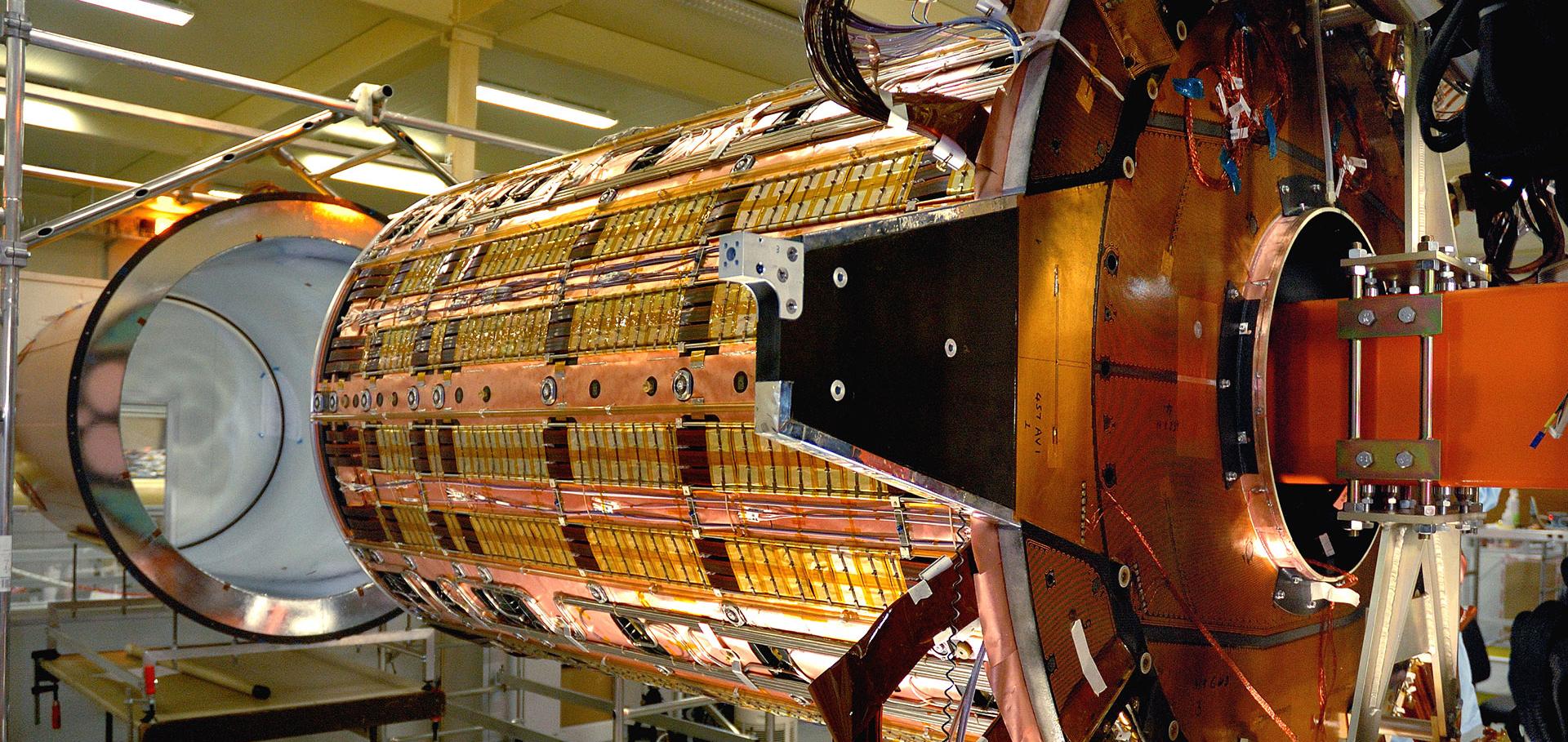
Insertion of STC into TRT at the Department of Physics, Oxford
Credit: CERN

Philip Burrows

Professor of Physics

Sub department

  • Particle Physics
Philip.Burrows@physics.ox.ac.uk
Telephone: 01865 (2)73451
Denys Wilkinson Building, room 615a
  • About
  • Publications

The study of high-frequency pick-ups for electron beam position measurements in the AWAKE common beamline

Proceedings of the 13th International Beam Instrumentation Conference (IBIC 2024) JACoW Publishing (2024)

Authors:

C Pazuka, M Krupa, S Lefèvre, Philip Burrows, B Spear, W Zhang

Abstract:

The common beamline of the AWAKE experiment at CERN involves the co-propagation of two particle beams: protons with 48 nC bunch charge and 250 ps bunch length, and electrons with up to 600 pC bunch charge and approximately 4 ps bunch length. The existing operational beam position monitors at AWAKE cannot measure the electron bunches whilst the more-intense proton bunches are present, due to their low operating frequency. In order to try to address this challenge, two different types of high-frequency pick-ups were studied, a conical-shaped button pick-up and a Cherenkov diffraction radiation-based pick-up designed to operate at around 30 GHz. Both devices were installed at AWAKE and were connected to two identical read-out systems designed by TRIUMF. This contribution presents and discusses the results obtained from beam-based measurements during the current experimental year.
Details from ORA
More details from the publisher

Empty-bucket techniques for spill-quality improvement at the CERN Super Proton Synchrotron

Physical Review Accelerators and Beams American Physical Society (APS) 27:7 (2024) 74001

Authors:

Pablo A Arrutia Sota, Matthew A Fraser, Gregoire Hagmann, Verena Kain, Giulia Papotti, Arthur Spierer, Francesco M Velotti, Philip N Burrows, Roberto Piandani

Abstract:

<jats:p>Synchrotrons can provide long spills of particles by employing resonant extraction where the circulating beam is slowly ejected over thousands to millions of turns by exploiting the amplitude growth caused by a transverse resonance. In the CERN Super Proton Synchrotron (SPS), this method is used to satisfy the experimental requests of the North Area. However, the extracted particle flux is modulated by power-converter ripple, an issue shared across all sychrotrons that perform resonant extraction. In order to suppress such modulations, empty-bucket techniques can be employed, which take advantage of chromaticity to quickly accelerate particles into resonant motion by using a longitudinal rf system. This paper explores empty-bucket techniques via theory, simulation, and measurement, providing a systematic characterization with general applicability to any machine. Additionally, the operational implementation in the SPS is detailed, where the impact on the beam profile and extracted intensity is addressed.</jats:p> <jats:sec> <jats:title/> <jats:supplementary-material> <jats:permissions> <jats:copyright-statement>Published by the American Physical Society</jats:copyright-statement> <jats:copyright-year>2024</jats:copyright-year> </jats:permissions> </jats:supplementary-material> </jats:sec>
More details from the publisher

A compact water window X-ray source based on inverse Compton scattering

Proceedings of the 15th International Particle Accelerator Conference JACoW Publishing (2024) 441-444

Abstract:

X-rays in the water window (2.33 nm to 4.40 nm wavelength) can be used to provide high quality images of wet biological samples. Given the limited availability of current generation light sources in this energy range, table-top water window X-ray sources have been proposed as alternatives. We present start-to-end simulations in RF-Track of a water window X-ray source based on inverse Compton scattering. A brazing-free electron gun with a maximum beam energy of 7 MeV is considered, providing photon energies covering the full water window range. Performance estimates for the gun operating with copper and cesium telluride cathodes are presented. The cesium telluride cathode, combined with a burst mode Fabry-Perot cavity, allows for an increase in flux by orders of magnitude compared to single bunch copper cathode operation. A beamline of 1 m was determined to be sufficient to produce a high photon flux.
More details from the publisher
Details from ORA

ATF2-3 hardware upgrade and new experimental results to maximize luminosity potential of linear colliders

Proceedings of the 15th International Particle Accelerator Conference JACoW Publishing (2024) 996-999

Abstract:

The ATF2-3 beamline is the only facility in the world for testing the Final Focus Beamline of linear colliders and is essential for the ILC and the CLIC projects. A vertical electron beam size of 41 nm (within 10% of the target), a closed-loop intra-bunch feedback of latency 133 ns, and direct stabilization of the beam position at the Interaction Point to 41 nm (limited by IP BPM resolution) have all been achieved at ATF2. These results fulfilled the two main ATF2 design goals, but were obtained with reduced aberration optics and a bunch population of approximately 10% of the nominal value of 10^10 electrons. Recent studies indicate that the beam degradation with the beam intensity is due to the effects of wakefields. To overcome this intensity limitation, hardware upgrades including new vacuum chambers, magnets, IP-Beam Size Monitor laser, cavity BPMs, wakefield mitigation station, as well as a comprehensive R&D program to maximize the luminosity potential are being pursued in the framework of the ILC Technology Network. This new R&D program focuses on the study of wakefield mitigation techniques, correction of higher-order aberrations, tuning strategies, including AI techniques, as well as beam instrumentation issues, such as the BPMs, advanced Cherenkov Diffractive Radiation monitors, and fast feedback systems, among others. This paper summarizes the hardware upgrades, the R&D program and the results of the Fall 2023-Winter 2024 experimental campaign performed in ATF2-3.
More details from the publisher
Details from ORA

Beam studies using a Cherenkov diffraction based beam position monitor for AWAKE

Proceedings of the 15th International Particle Accelerator Conference JACoW Publishing (2024) 2327-2330

Abstract:

A beam position monitor based on Cherenkov diffraction radiation (ChDR) is being investigated as a way to disentangle the signals generated by the electromagnetic fields of a short-pulse electron bunch from a long proton bunch co-propagating in the AWAKE plasma acceleration experiment at CERN. These ChDR BPMs have undergone renewed testing under a variety of beam conditions with proton and electron bunches in the AWAKE common beamline, at 3 different frequency ranges between 20-110 GHz to quantify the effectiveness of discriminating the electron beam position with and without proton bunches present. These results indicate an increased sensitivity to the electron beam position in the highest frequency bands. Furthermore, high frequency studies investigating the proton bunch spectrum show that a much higher frequency regime is needed to exclude the proton signal than previously expected.
More details from the publisher
Details from ORA

Pagination

  • First page First
  • Previous page Prev
  • Page 1
  • Page 2
  • Page 3
  • Page 4
  • Current page 5
  • Page 6
  • Page 7
  • Page 8
  • Page 9
  • …
  • Next page Next
  • Last page Last

Footer Menu

  • Contact us
  • Giving to the Dept of Physics
  • Work with us
  • Media

User account menu

  • Log in

Follow us

FIND US

Clarendon Laboratory,

Parks Road,

Oxford,

OX1 3PU

CONTACT US

Tel: +44(0)1865272200

University of Oxfrod logo Department Of Physics text logo
IOP Juno Champion logo Athena Swan Silver Award logo

© University of Oxford - Department of Physics

Cookies | Privacy policy | Accessibility statement

Built by: Versantus

  • Home
  • Research
  • Study
  • Engage
  • Our people
  • News & Comment
  • Events
  • Our facilities & services
  • About us
  • Giving to Physics
  • Current students
  • Staff intranet