Home
Department Of Physics text logo
  • Research
    • Our research
    • Our research groups
    • Our research in action
    • Research funding support
    • Summer internships for undergraduates
  • Study
    • Undergraduates
    • Postgraduates
  • Engage
    • For alumni
    • For business
    • For schools
    • For the public
  • Support
Menu
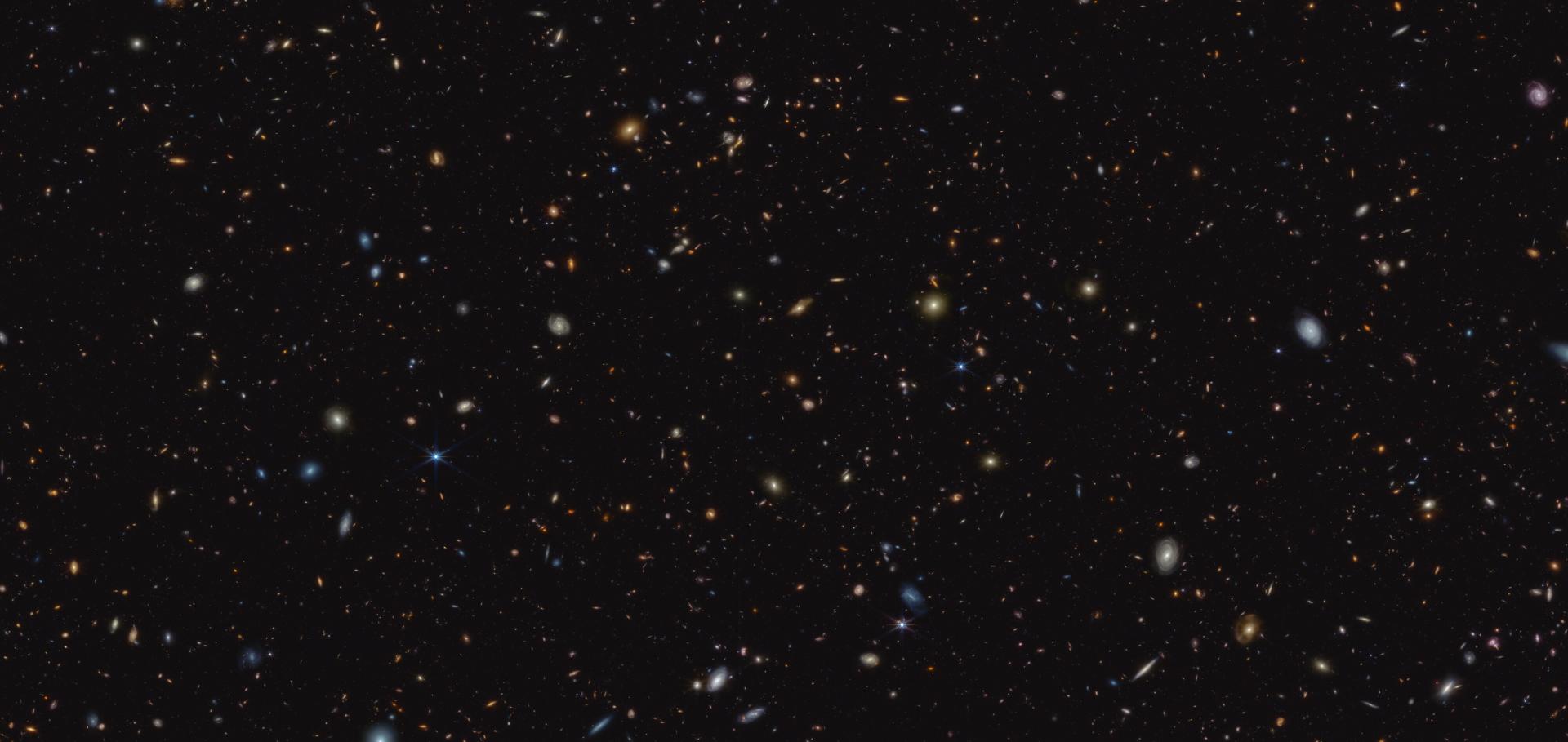
An image of the GOODS-South field as observed by JWST. More than 45,000 galaxies are visible here.

An image of the GOODS-South field as observed by JWST. More than 45,000 galaxies are visible here. In this image, blue, green, and red were assigned to Webb’s NIRCam (Near-Infrared Camera) data at 0.9, 1.15, and 1.5 microns; 2.0, 2.77, and 3.55 microns; and 3.56, 4.1, and 4.44 microns (F090W, F115W, and F150W; F200W, F277W, and F335M; and F356W, F410M, and F444W), respectively.

Credit: NASA, ESA, CSA, B. Robertson (UC Santa Cruz), B. Johnson (Center for Astrophysics, Harvard & Smithsonian), S. Tacchella (Univers

Dr Jacopo Chevallard

Visitor

Research theme

  • Astronomy and astrophysics

Sub department

  • Astrophysics

Research groups

  • Galaxy formation and evolution
jacopo.chevallard@physics.ox.ac.uk
Telephone: 01865 273467
Denys Wilkinson Building, room 463
  • About
  • Publications

JADES: Detecting [OIII]λ4363 emitters and testing strong line calibrations in the high-z Universe with ultra-deep JWST/NIRSpec spectroscopy up to z ∼ 9.5

Astronomy & Astrophysics EDP Sciences 681 (2023) A70-A70

Authors:

Isaac H Laseter, Michael V Maseda, Mirko Curti, Roberto Maiolino, Francesco D’Eugenio, Alex J Cameron, Tobias J Looser, Santiago Arribas, William M Baker, Rachana Bhatawdekar, Kristan Boyett, Andrew J Bunker, Stefano Carniani, Stephane Charlot, Jacopo Chevallard, Emma Curtis-lake, Eiichi Egami, Daniel J Eisenstein, Kevin Hainline, Ryan Hausen, Zhiyuan Ji, Nimisha Kumari, Michele Perna, Tim Rawle, Hans-Walter Rix

Abstract:

We present ten novel [OIII]λ4363 auroral line detections up to z~ 9.5 measured from ultra-deep JWST/NIRSpec MSA spectroscopy from the JWST Advanced Deep Extragalactic Survey (JADES). We leverage the deepest spectroscopic observations taken thus far with NIRSpec to determine electron temperatures and oxygen abundances using the direct Te method. We directly compare these results against a suite of locally calibrated strong-line diagnostics and recent high-z calibrations. We find the calibrations fail to simultaneously match our JADES sample, thus warranting a self-consistent revision of these calibrations for the high-z Universe. We find a weak dependence between R2 and O3O2 with metallicity, thus suggesting these line ratios are inefficient in the high-z Universe as metallicity diagnostics and degeneracy breakers. We find R3 and R23 are still correlated with metallicity, but we find a tentative flattening of these diagnostics, thus suggesting future difficulties when applying these strong line ratios as metallicity indicators in the high-z Universe. We also propose and test an alternative diagnostic based on a different combination of R3 and R2 with a higher dynamic range. We find a reasonably good agreement (median offset of 0.002 dex, median absolute offset of 0.13 dex) with the JWST sample at low metallicity, but future investigations are required on larger samples to probe past the turnover point. At a given metallicity, our sample demonstrates higher ionization and excitation ratios than local galaxies with rest-frame EWs(Hβ) ≈ 200-300 Å. However, we find the median rest-frame EWs(Hβ) of our sample to be~2× less than the galaxies used for the local calibrations. This EW discrepancy combined with the high ionization of our galaxies does not offer a clear description of [OIII]λ4363 production in the high-z Universe, thus warranting a much deeper examination into the factors influencing these processes
More details from the publisher
Details from ORA
More details

JADES Initial Data Release for the Hubble Ultra Deep Field: Revealing the Faint Infrared Sky with Deep JWST NIRCam Imaging

The Astrophysical Journal: Supplement Series American Astronomical Society 269:1 (2023) 16-16

Authors:

Marcia J Rieke, Brant Robertson, Sandro Tacchella, Kevin Hainline, Benjamin D Johnson, Ryan Hausen, Zhiyuan Ji, Christopher NA Willmer, Daniel J Eisenstein, Dávid Puskás, Stacey Alberts, Santiago Arribas, William M Baker, Stefi Baum, Rachana Bhatawdekar, Nina Bonaventura, Kristan Boyett, Andrew J Bunker, Alex J Cameron, Stefano Carniani, Stephane Charlot, Jacopo Chevallard, Zuyi Chen, Mirko Curti, Emma Curtis-Lake, Aayush Saxena

Abstract:

JWST has revolutionized the field of extragalactic astronomy with its sensitive and high-resolution infrared view of the distant Universe. Adding to the new legacy of JWST observations, we present the first NIRCam imaging data release from the JWST Advanced Deep Extragalactic Survey (JADES), providing nine filters of infrared imaging of ∼25 arcmin2 covering the Hubble Ultra Deep Field and portions of Great Observatories Origins Deep Survey South. Utilizing 87 on-sky dual-filter hours of exposure time, these images reveal the deepest ever near-infrared view of this iconic field. We supply carefully constructed nine-band mosaics of the JADES bands, as well as matching reductions of five additional bands from the JWST Extragalactic Medium-band Survey. Combining with existing Hubble Space Telescope imaging, we provide 23-band space-based photometric catalogs and photometric redshifts for ≈47,500 sources. To promote broad engagement with JADES, we have created an interactive FitsMap website to provide an interface for professional researchers and the public to experience these JWST data sets. Combined with the first JADES NIRSpec data release, these public JADES imaging and spectroscopic data sets provide a new foundation for discoveries of the infrared Universe by the worldwide scientific community
More details from the publisher
Details from ORA
More details

JEMS: A Deep Medium-band Imaging Survey in the Hubble Ultra Deep Field with JWST NIRCam and NIRISS

The Astrophysical Journal: Supplement Series American Astronomical Society 268:2 (2023) 64-64

Authors:

Christina C Williams, Sandro Tacchella, Michael V Maseda, Brant E Robertson, Benjamin D Johnson, Chris J Willott, Daniel J Eisenstein, Christopher NA Willmer, Zhiyuan Ji, Kevin N Hainline, Jakob M Helton, Stacey Alberts, Stefi Baum, Rachana Bhatawdekar, Kristan Boyett, Andrew J Bunker, Stefano Carniani, Stephane Charlot, Jacopo Chevallard, Emma Curtis-Lake, Anna de Graaff, Eiichi Egami, Marijn Franx, Nimisha Kumari, Roberto Maiolino

Abstract:

We present JWST Extragalactic Medium-band Survey, the first public medium-band imaging survey carried out using JWST/NIRCam and NIRISS. These observations use ∼2 and ∼4 μm medium-band filters (NIRCam F182M, F210M, F430M, F460M, F480M; and NIRISS F430M and F480M in parallel) over 15.6 arcmin2 in the Hubble Ultra Deep Field (UDF), thereby building on the deepest multiwavelength public data sets available anywhere on the sky. We describe our science goals, survey design, NIRCam and NIRISS image reduction methods, and describe our first data release of the science-ready mosaics, which reach 5σ point-source limits (AB mag) of ∼29.3-29.4 in 2 μm filters and ∼28.2-28.7 at 4 μm. Our chosen filters create a JWST imaging survey in the UDF that enables novel analysis of a range of spectral features potentially across the redshift range of 0.3 < z < 20, including Paschen-α, Hα+[N ii], and [O iii]+Hβ emission at high spatial resolution. We find that our JWST medium-band imaging efficiently identifies strong line emitters (medium-band colors >1 mag) across redshifts 1.5 < z < 9.3, most prominently Hα+[N ii] and [O iii]+Hβ. We present our first data release including science-ready mosaics of each medium-band image available to the community, adding to the legacy value of past and future surveys in the UDF. This survey demonstrates the power of medium-band imaging with JWST, informing future extragalactic survey strategies using JWST observations
More details from the publisher
Details from ORA
More details

A SPectroscopic Survey of Biased Halos in the Reionization Era (ASPIRE): JWST Discovers an Overdensity around a Metal Absorption-selected Galaxy at z ∼ 5.5

The Astrophysical Journal Letters American Astronomical Society 956:2 (2023) l40

Authors:

Yunjing Wu, Feige Wang, Zheng Cai, Xiaohui Fan, Kristian Finlator, Jinyi Yang, Joseph F Hennawi, Fengwu Sun, Jaclyn B Champagne, Xiaojing Lin, Zihao Li, Zuyi Chen, Eduardo Bañados, George D Becker, Sarah EI Bosman, Gustavo Bruzual, Stephane Charlot, Hsiao-Wen Chen, Jacopo Chevallard, Anna-Christina Eilers, Emanuele Paolo Farina, Xiangyu Jin, Hyunsung D Jun, Koki Kakiichi, Mingyu Li, Weizhe Liu, Maria A Pudoka, Wei Leong Tee, Zhang-Liang Xie, Siwei Zou
More details from the publisher
More details

The Mass–Metallicity Relation of Dwarf Galaxies at Cosmic Noon from JWST Observations

The Astrophysical Journal Letters American Astronomical Society 955:1 (2023) L18-L18

Authors:

Mingyu Li, Zheng Cai, Fuyan Bian, Xiaojing Lin, Zihao Li, Yunjing Wu, Fengwu Sun, Shiwu Zhang, Emmet Golden-Marx, Zechang Sun, Siwei Zou, Xiaohui Fan, Eiichi Egami, Stephane Charlot, Gustavo Bruzual, Jacopo Chevallard

Abstract:

We present the mass-metallicity relation (MZR) at $z=2-3$ in the stellar mass range of $M_\star\approx 10^{6.5}-10^{9.5}M_\odot$ using 55 dwarf galaxies in the Abell 2744 and SMACS J0723-3732 galaxy cluster fields. These dwarf galaxies are identified and confirmed by deep JWST/NIRISS imaging and slitless grism spectroscopic observations. Taking advantage of the gravitational lensing effect, we extend the previous MZR relation at $z=2-3$ to a much lower mass regime by more than 2.5 orders of magnitude compared with previous studies. We find that the MZR has a shallower slope at the low-mass end ($M_\star<10^{9}M_\odot$) compared to that at the high-mass end ($M_\star>10^{9}M_\odot$), with a slope turnover point at around the stellar mass of $10^9 M_\odot$. This implies that dominating feedback processes in dwarf galaxies may be different from that in galaxies with higher mass. From $z=3$ to $z=2$, the metallicity of the dwarf galaxies is enhanced by $\approx0.1$ dex for a given stellar mass, consistent with the mild evolution found in galaxies with higher mass. Further, we confirm the existence of a 3D relation between the gas-phase metallicity, stellar mass, and star formation rate, i.e., fundamental metallicity relation (FMR), in dwarf galaxies at $z=2-3$. Our derived FMR, which has no significant redshift evolution, can be used as a benchmark to understand the origin of the anti-correlation between SFR and metallicity of dwarf galaxies in the high-redshift Universe.Comment: 16 pages, 4 figures, 1 table, submitted to AAS Journal; welcome comment
More details from the publisher
Details from ORA
More details

Pagination

  • First page First
  • Previous page Prev
  • …
  • Page 6
  • Page 7
  • Page 8
  • Page 9
  • Current page 10
  • Page 11
  • Page 12
  • Page 13
  • Page 14
  • …
  • Next page Next
  • Last page Last

Footer Menu

  • Contact us
  • Giving to the Dept of Physics
  • Work with us
  • Media

User account menu

  • Log in

Follow us

FIND US

Clarendon Laboratory,

Parks Road,

Oxford,

OX1 3PU

CONTACT US

Tel: +44(0)1865272200

University of Oxfrod logo Department Of Physics text logo
IOP Juno Champion logo Athena Swan Silver Award logo

© University of Oxford - Department of Physics

Cookies | Privacy policy | Accessibility statement

Built by: Versantus

  • Home
  • Research
  • Study
  • Engage
  • Our people
  • News & Comment
  • Events
  • Our facilities & services
  • About us
  • Giving to Physics
  • Current students
  • Staff intranet