Home
Department Of Physics text logo
  • Research
    • Our research
    • Our research groups
    • Our research in action
    • Research funding support
    • Summer internships for undergraduates
  • Study
    • Undergraduates
    • Postgraduates
  • Engage
    • For alumni
    • For business
    • For schools
    • For the public
  • Support
Menu
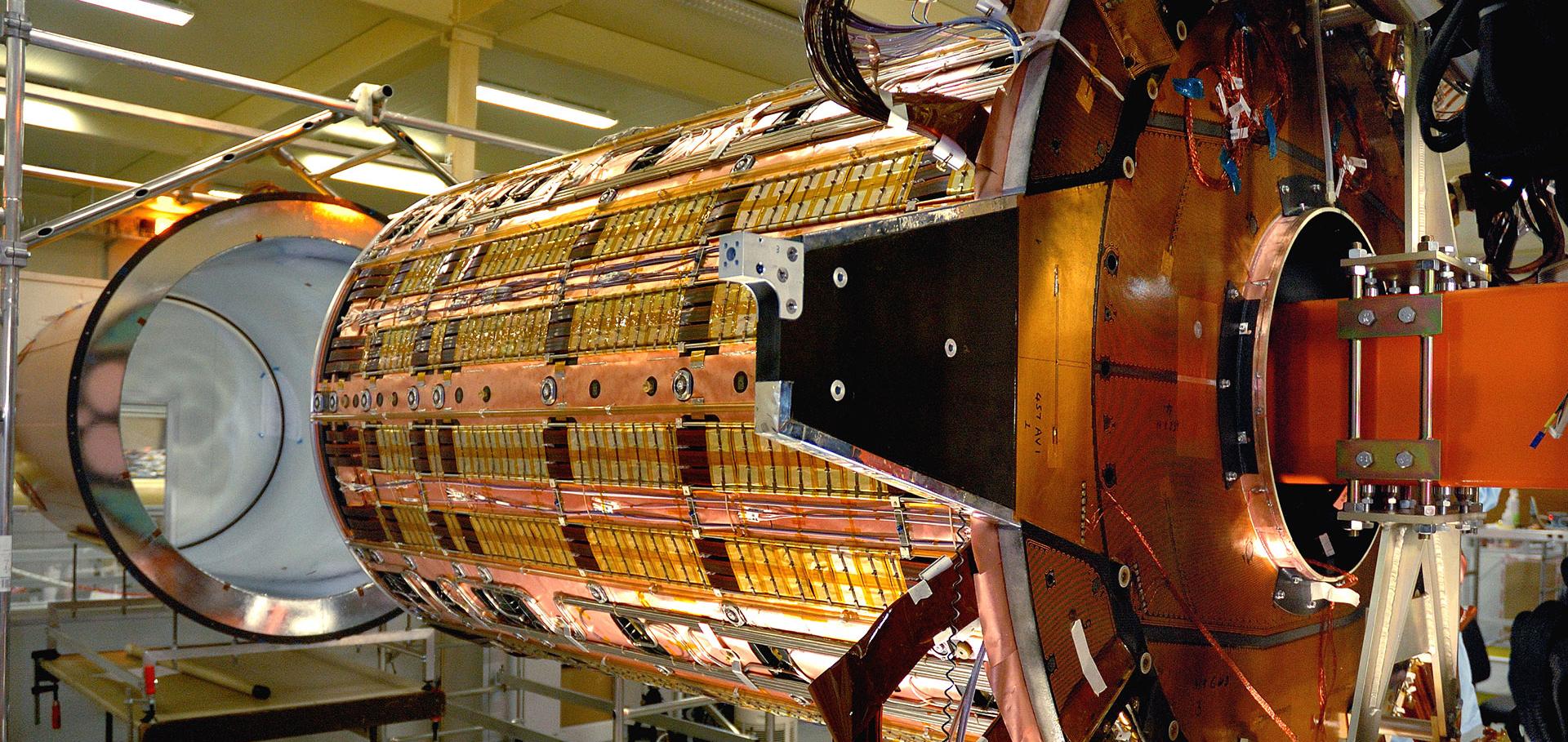
Insertion of STC into TRT at the Department of Physics, Oxford
Credit: CERN

Professor Amanda Cooper-Sarkar

Emeritus Professor

Research theme

  • Fundamental particles and interactions

Sub department

  • Particle Physics

Research groups

  • ATLAS
Amanda.Cooper-Sarkar@physics.ox.ac.uk
Telephone: 01865 (2)73406
Denys Wilkinson Building, room 659
  • About
  • Publications

A search for the decays of stopped long-lived particles at $$ \sqrt{\mathrm{s}} $$ = 13 TeV with the ATLAS detector

Journal of High Energy Physics Springer 2021:7 (2021) 173

Authors:

G Aad, B Abbott, DC Abbott, A Abed Abud, K Abeling, DK Abhayasinghe, SH Abidi, OS AbouZeid, NL Abraham, H Abramowicz, H Abreu, Y Abulaiti, AC Abusleme Hoffman, BS Acharya, B Achkar, L Adam, C Adam Bourdarios, L Adamczyk, L Adamek, J Adelman, A Adiguzel, S Adorni, T Adye, AA Affolder, Y Afik

Abstract:

A bstract A search for long-lived particles, which have come to rest within the ATLAS detector, is presented. The subsequent decays of these particles can produce high-momentum jets, resulting in large out-of-time energy deposits in the ATLAS calorimeters. These de- cays are detected using data collected during periods in the LHC bunch structure when collisions are absent. The analysed dataset is composed of events from proton-proton collisions produced by the Large Hadron Collider at a centre-of-mass energy of $$ \sqrt{s} $$ s = 13 TeV and recorded by the ATLAS experiment during 2017 and 2018. The dataset used for this search corresponds to a total live time of 579 hours. The results of this search are used to derive lower limits on the mass of gluino R -hadrons, assuming a branching fraction $$ \mathcal{B}\left(\overset{\sim }{g}\to q\overline{q}{\chi}_1^0\right) $$ B g ~ → q q ¯ χ 1 0 = 100%, with masses of up to 1 . 4 TeV excluded for gluino lifetimes of 10 − 5 to 10 3 s.
More details from the publisher
Details from ORA
More details
More details

Search for supersymmetry in events with four or more charged leptons in 139 fb−1 of $$ \sqrt{s} $$ = 13 TeV pp collisions with the ATLAS detector

Journal of High Energy Physics Springer 2021:7 (2021) 167

Authors:

G Aad, B Abbott, DC Abbott, A Abed Abud, K Abeling, DK Abhayasinghe, SH Abidi, OS AbouZeid, NL Abraham, H Abramowicz, H Abreu, Y Abulaiti, BS Acharya, B Achkar, L Adam, C Adam Bourdarios, L Adamczyk, L Adamek, J Adelman, A Adiguzel, S Adorni, T Adye, AA Affolder, Y Afik, C Agapopoulou

Abstract:

A bstract A search for supersymmetry in events with four or more charged leptons (electrons, muons and τ -leptons) is presented. The analysis uses a data sample corresponding to 139 fb − 1 of proton-proton collisions delivered by the Large Hadron Collider at $$ \sqrt{s} $$ s = 13 TeV and recorded by the ATLAS detector. Four-lepton signal regions with up to two hadronically decaying τ -leptons are designed to target several supersymmetric models, while a general five-lepton signal region targets any new physics phenomena leading to a final state with five charged leptons. Data yields are consistent with Standard Model expectations and results are used to set upper limits on contributions from processes beyond the Standard Model. Exclusion limits are set at the 95% confidence level in simplified models of general gauge-mediated supersymmetry, excluding higgsino masses up to 540 GeV. In R -parity-violating simplified models with decays of the lightest supersymmetric particle to charged leptons, lower limits of 1 . 6 TeV, 1 . 2 TeV, and 2 . 5 TeV are placed on wino, slepton and gluino masses, respectively.
More details from the publisher
Details from ORA
More details

Measurement of the production cross section of pairs of isolated photons in $pp$ collisions at 13 TeV with the ATLAS detector

ArXiv 2107.0933 (2021)
Details from ArXiV

Search for exotic decays of the Higgs boson into long-lived particles in $pp$ collisions at $\sqrt{s} = 13$ TeV using displaced vertices in the ATLAS inner detector

ArXiv 2107.06092 (2021)
Details from ArXiV

Search for squarks and gluinos in final states with one isolated lepton, jets, and missing transverse momentum at root s=13 TeV with the ATLAS detector

European Physical Journal C Springer Nature 81:7 (2021) 600

Authors:

G Aad, B Abbott, Dc Abbott, A Abed Abud, K Abeling, Dk Abhayasinghe, Sh Abidi, Os AbouZeid, Nl Abraham, H Abramowicz, H Abreu, Y Abulaiti, Bs Acharya, B Achkar, L Adam, C Adam Bourdarios, L Adamczyk, L Adamek, J Adelman, A Adiguzel, S Adorni, T Adye, Aa Affolder, Y Afik, C Agapopoulou, Mn Agaras, A Aggarwal, C Agheorghiesei, Ja Aguilar-Saavedra, A Ahmad, F Ahmadov, Ws Ahmed, X Ai, G Aielli, S Akatsuka, M Akbiyik, Tpa Akesson, E Akilli, Av Akimov, K Al Khoury, Gl Alberghi, J Albert, Mj Alconada Verzini, S Alderweireldt, M Aleksa, In Aleksandrov, T Alexopoulos, C Alexa, Alan Barr, Ej Gallas

Abstract:

The results of a search for gluino and squark pair production with the pairs decaying via the lightest charginos into a final state consisting of two W bosons, the lightest neutralinos (χ~10), and quarks, are presented: the signal is characterised by the presence of a single charged lepton (e± or μ±) from a W boson decay, jets, and missing transverse momentum. The analysis is performed using 139 fb- 1 of proton–proton collision data taken at a centre-of-mass energy s=13 delivered by the Large Hadron Collider and recorded by the ATLAS experiment. No statistically significant excess of events above the Standard Model expectation is found. Limits are set on the direct production of squarks and gluinos in simplified models. Masses of gluino (squark) up to 2.2 (1.4) are excluded at 95% confidence level for a light χ~10.
More details from the publisher
Details from ORA
More details

Pagination

  • First page First
  • Previous page Prev
  • …
  • Page 167
  • Page 168
  • Page 169
  • Page 170
  • Current page 171
  • Page 172
  • Page 173
  • Page 174
  • Page 175
  • …
  • Next page Next
  • Last page Last

Footer Menu

  • Contact us
  • Giving to the Dept of Physics
  • Work with us
  • Media

User account menu

  • Log in

Follow us

FIND US

Clarendon Laboratory,

Parks Road,

Oxford,

OX1 3PU

CONTACT US

Tel: +44(0)1865272200

University of Oxfrod logo Department Of Physics text logo
IOP Juno Champion logo Athena Swan Silver Award logo

© University of Oxford - Department of Physics

Cookies | Privacy policy | Accessibility statement

Built by: Versantus

  • Home
  • Research
  • Study
  • Engage
  • Our people
  • News & Comment
  • Events
  • Our facilities & services
  • About us
  • Giving to Physics
  • Current students
  • Staff intranet