Home
Department Of Physics text logo
  • Research
    • Our research
    • Our research groups
    • Our research in action
    • Research funding support
    • Summer internships for undergraduates
  • Study
    • Undergraduates
    • Postgraduates
  • Engage
    • For alumni
    • For business
    • For schools
    • For the public
  • Support
Menu
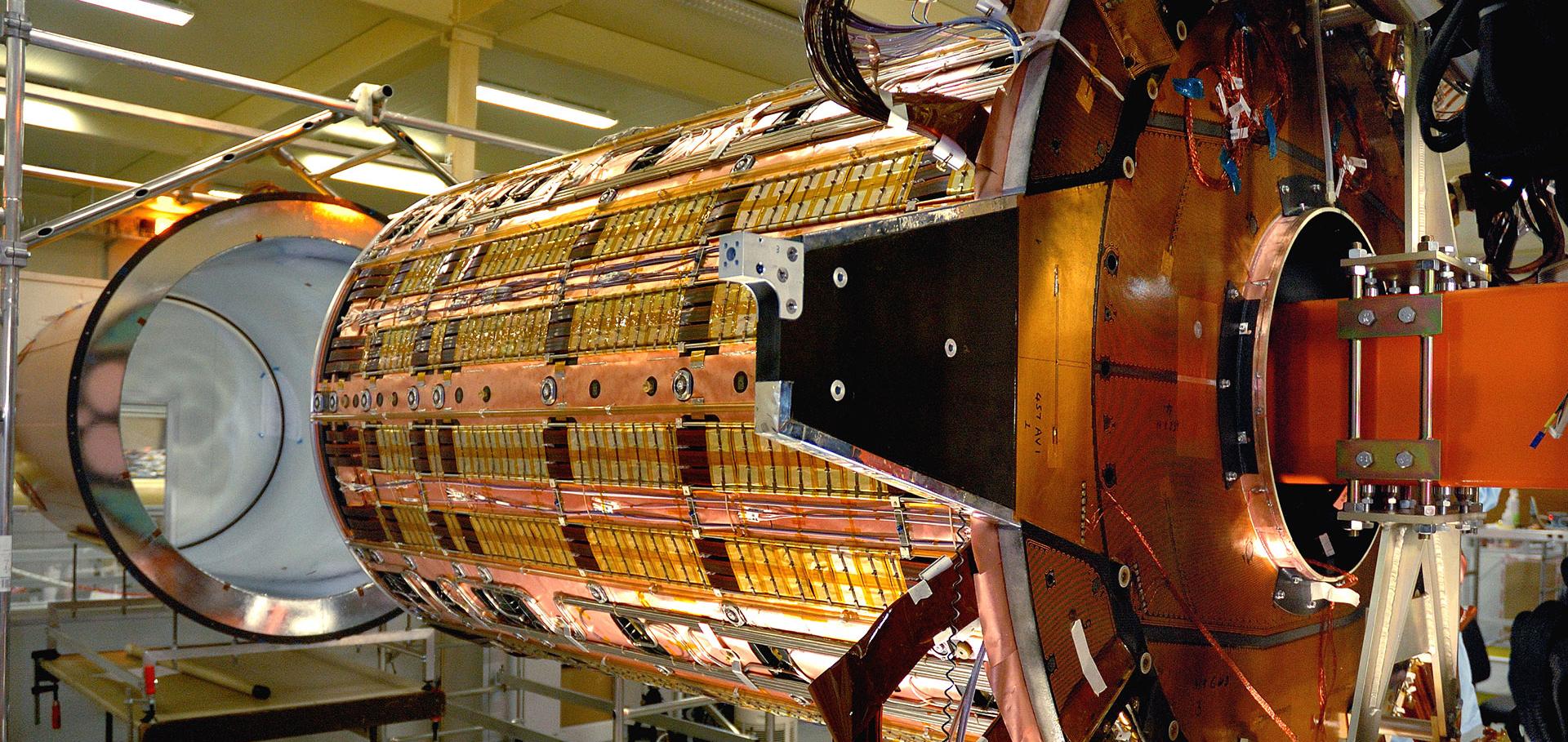
Insertion of STC into TRT at the Department of Physics, Oxford
Credit: CERN

Professor Amanda Cooper-Sarkar

Emeritus Professor

Research theme

  • Fundamental particles and interactions

Sub department

  • Particle Physics

Research groups

  • ATLAS
Amanda.Cooper-Sarkar@physics.ox.ac.uk
Telephone: 01865 (2)73406
Denys Wilkinson Building, room 659
  • About
  • Publications

Production of π0 mesons and charged hadrons in {Mathematical expression} neon and ν neon charged current interactions

Zeitschrift Fur Physik C Particles and Fields 40:2 (1988) 231-251

Authors:

W Wittek, M Aderholz, P Allport, N Armenise, JP Baton, M Berggren, FW Bullock, M Calicchio, EF Clayton, T Coghen, AM Cooper-Sarkar, O Erriquez, P Fitch, N Giannakopoulos, J Guy, E Hoffmann, PO Hulth, GT Jones, P Kasper, UF Katz, J Kern, H Klein, P Marage, E Matsinos, DRO Morrison, M Neveu, MA Parker, N Schmitz, E Simopoulou, K Varvell, A Vayaki, W Venus, H Wachsmuth

Abstract:

The average multiplicities of charged hadrons and of π+, π- and π0 mesons, produced in {Mathematical expression}Ne and νNe charged current interactions in the forward and backward hemispheres of the W±-nucleon center of mass system, are studied with data from BEBC. The dependence of the multiplicities on the hadronic mass (W) and on the laboratory rapidity (yLab) and the energy fraction (z) of the pion is also investigated. Special care is taken to determine the π0 multiplicity accurately. The ratio of average π multiplicities {Mathematical expression} is consistent with 1. In the backward hemisphere {Mathematical expression} is positively correlated with the charged multiplicity. This correlation, as well as differences in multiplicities between {Mathematical expression} and {Mathematical expression}, {Mathematical expression} scattering, is attributed to reinteractions inside the neon nucleus of the hadrons produced in the initial {Mathematical expression} interaction. © 1988 Springer-Verlag.
More details from the publisher
More details

A study of the EMC effect using neutrino and antineutrino interactions in neon and deuterium

Zeitschrift für Physik C Particles and Fields 36:3 (1987) 337-348

Authors:

J Guy, B Saitta, G Van Apeldoorn, P Allport, C Angelini, N Armenise, A Baldini, M Berggren, D Bertrand, F Bobisut, V Brisson, F Bullock, M Calicchio, P Capiluppi, R Cirio, EF Clayton, T Coghen, AM Cooper-Sarkar, O Erriquez, ML Faccini-Turluer, P Fitch, AG Frodesen, G Gerbier, G Giacomelli, PO Hulth, GT Jones, B Jongejans, P Kasper, H Klein, G Mandrioli, P Marage, A Marzari-Chiesa, RP Middleton, DB Miller, DRO Morrison, MM Mobayyen, SW O'Neale, M Neveu, MA Parker, P Petiau, A Romero, AM Rossi, J Sacton, A Sansum, A Sconza, E Simopoulou, N Schmitz, A Tenner, C Vallee, N Van Eijndhoven, K Varvell, A Vayaki, W Venus, D Vignaud, H Wachsmuth, W Wittek

Abstract:

Nearly 40000 neutrino and antineutrino interactions in BEBC are compared to measure the differences between neon and deuterium in the quark and antiquark distributions and in the nucleon structure functions. The ratio of Ne to D cross sections indicates some decrease between x∼0.2 and x∼0.6. The y distributions show there is no significant increase in the neon sea, but prefer a small decrease. Taken altogether, the x and y distributions and the measured total cross-sections indicate some change in the shape of the valence distributions. No significant dependence on A is observed for either the shape of the sea or the ratio of longitudinal to transverse cross-sections. © 1987 Springer-Verlag.
More details from the publisher
More details

Coherent production of ρ- mesons in charged current antineutrino-neon interactions in BEBC

Zeitschrift für Physik C Particles and Fields 35:3 (1987) 275-282

Authors:

P Marage, M Aderholz, P Allport, N Armenise, JP Baton, M Berggren, D Bertrand, V Brisson, FW Bullock, W Burkot, M Calicchio, EF Clayton, T Coghen, AM Cooper-Sarkar, O Erriquez, PJ Fitch, J Guy, F Hamisi, PO Hulth, GT Jones, P Kasper, UF Katz, H Klein, E Matsinos, RP Middleton, DB Miller, MM Mobayyen, DRO Morrison, M Neveu, SW O'Neale, MA Parker, P Petiau, J Sacton, RA Sansum, N Schmitz, E Simopoulou, C Vallée, K Varvell, A Vayaki, W Venus, H Wachsmuth, J Wells, W Wittek

Abstract:

Coherent production of ρ- mesons in charged current antineutrino interactions on neon nuclei is studied in the BEBC bubble chamber exposed to the CERN SPS wide band beam. The cross section is measured to be (95±25)·10-40 cm2 per neon nucleus, averaged over the beam energy spectrum. The distributions of kinematical variables and the absolute value of the cross section are in agreement with theoretical predictions based on the CVC hypothesis and the vector meson dominance model. © 1987 Springer-Verlag.
More details from the publisher

Spin alignment of ρ0 mesons produced in antineutrino and neutrino neon charged-current interactions

Physics Letters B 187:1-2 (1987) 179-184

Authors:

W Wittek, J Guy, M Adeholz, P Allport, JP Baton, M Berggren, D Bertrand, V Brisson, FW Bullock, W Burkot, M Calicchio, EF Clayton, T Coghen, AM Cooper-Sarkar, O Erriquez, PJ Fitch, MT Fogli-Muciaccia, PO Hulth, GT Jones, P Kasper, H Klein, P Marage, RP Middleton, DB Miller, MM Mobayyen, DRO Morrison, M Neveu, SW O'Neale, MA Parker, P Petiau, J Sacton, RA Sansum, N Schmitz, E Simopoulou, C Vallee, K Varvell, A Vayaki, W Venus, H Wachsmuth, J Wells

Abstract:

In a bubble chamber experiment with BEBC the spin alignment parameter η= 1 2 (2ρ{variant}00 - ρ{variant}11 - ρ{variant}-1-1) is measured for ρ{variant}0 mesons produced in deep inelastic charged-current antineutrino and neutrono interactions on neon. In the current fragmentation region η is found to be ηv=0.48±0.27 (stat.)±0.15 (syst.) for vNe and ηv=0.12±0.20 (stat.)±0.10 (syst.) for vNe interactions. © 1987.
More details from the publisher
More details

Measurement of the structure functions F2 and xF3 and comparison with QCD predictions including kinematical and dynamical higher twist effects

Zeitschrift Fur Physik C Particles and Fields 36:1 (1987) 1-13

Authors:

K Varvell, AM Cooper-Sarkar, MA Parker, RA Sansum, M Aderholz, N Armenise, JP Baton, FW Bullock, M Berggren, D Bertrand, V Brisson, W Burkot, M Calcchio, EF Claytoh, T Coghen, O Erriquez, PJ Fitch, G Gerbier, J Guy, PO Hulth, G Iaselli, GT Jones, P Kasper, H Klein, C Kochowski, P Marage, M Mermikides, RP Middleton, DRO Morrison, MM Mobayyen, S Natali, M Neveu, S Nuzzo, SW O'Neale, P Petiau, A Petrides, F Ruggieri, J Sacton, E Simopoulou, C Vallee, A Vayaki, WA Venus, H Wachsmuth, J Wells, W Wittek

Abstract:

The isoscalar nucleon structure functions F2(x, Q2) and xF3(x, Q2) are measured in the range 02<64 GeV2, 1.72<250 GeV2, x<0.7 using ν and {Mathematical expression} interactions on neon in BEBC. The data are used to evaluate possible higher twist contributions and to determine their impact on the evaluation of the QCD parameter Λ. In contrast to previous analyses reaching to such low W2 values, it is found that a low {Mathematical expression} value in the neighbourhood of 100 MeV describes the data adequately and that the contribution of dynamical higher twist effects is small and negative. © 1987 Springer-Verlag.
More details from the publisher
More details

Pagination

  • First page First
  • Previous page Prev
  • …
  • Page 646
  • Page 647
  • Page 648
  • Page 649
  • Current page 650
  • Page 651
  • Page 652
  • Page 653
  • Page 654
  • …
  • Next page Next
  • Last page Last

Footer Menu

  • Contact us
  • Giving to the Dept of Physics
  • Work with us
  • Media

User account menu

  • Log in

Follow us

FIND US

Clarendon Laboratory,

Parks Road,

Oxford,

OX1 3PU

CONTACT US

Tel: +44(0)1865272200

University of Oxfrod logo Department Of Physics text logo
IOP Juno Champion logo Athena Swan Silver Award logo

© University of Oxford - Department of Physics

Cookies | Privacy policy | Accessibility statement

Built by: Versantus

  • Home
  • Research
  • Study
  • Engage
  • Our people
  • News & Comment
  • Events
  • Our facilities & services
  • About us
  • Giving to Physics
  • Current students
  • Staff intranet