

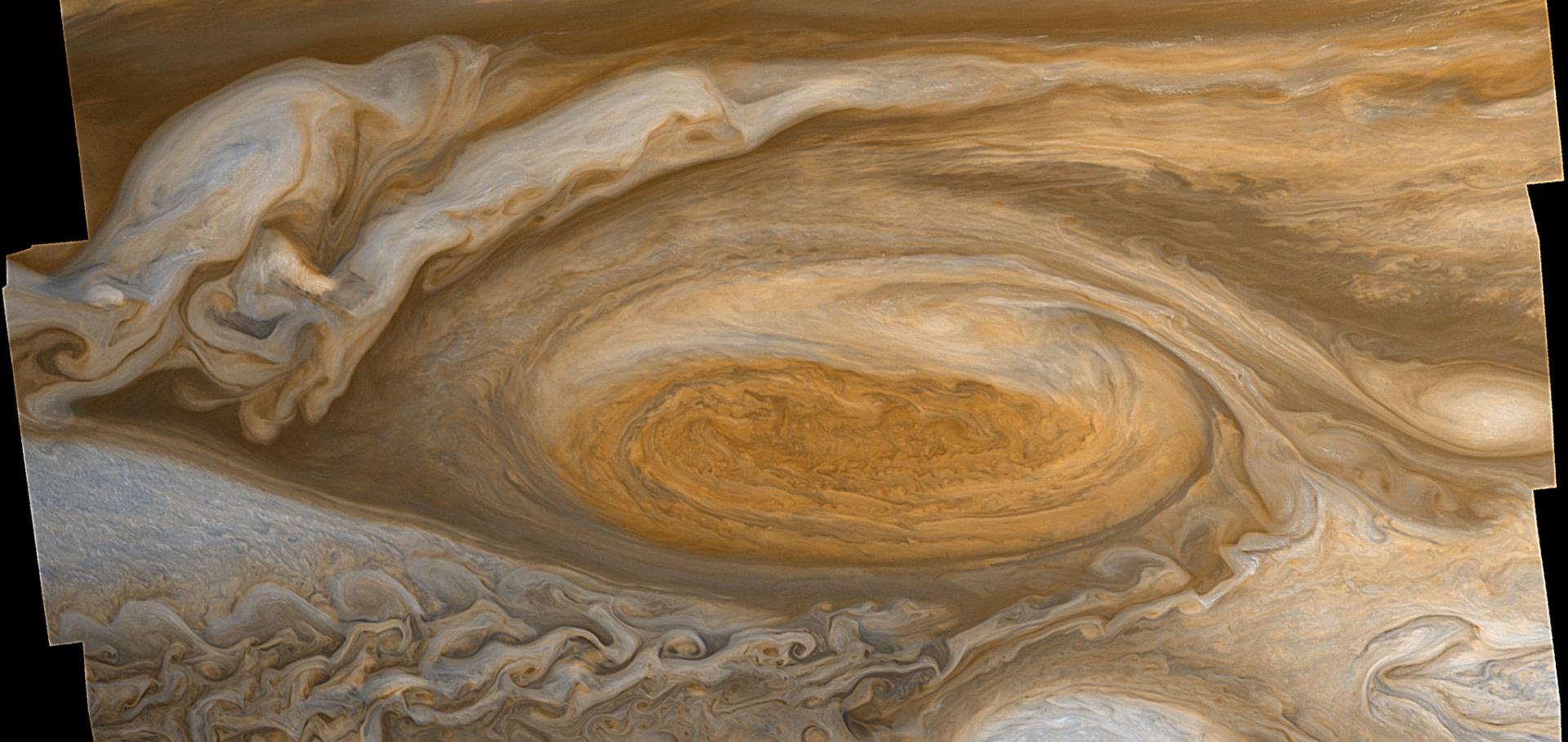

Thermal structure and dynamics of Saturn's northern springtime disturbance.
Science 332:6036 (2011) 1413-1417
Abstract:
Saturn's slow seasonal evolution was disrupted in 2010-2011 by the eruption of a bright storm in its northern spring hemisphere. Thermal infrared spectroscopy showed that within a month, the resulting planetary-scale disturbance had generated intense perturbations of atmospheric temperatures, winds, and composition between 20° and 50°N over an entire hemisphere (140,000 kilometers). The tropospheric storm cell produced effects that penetrated hundreds of kilometers into Saturn's stratosphere (to the 1-millibar region). Stratospheric subsidence at the edges of the disturbance produced "beacons" of infrared emission and longitudinal temperature contrasts of 16 kelvin. The disturbance substantially altered atmospheric circulation, transporting material vertically over great distances, modifying stratospheric zonal jets, exciting wave activity and turbulence, and generating a new cold anticyclonic oval in the center of the disturbance at 41°N.Generation of inertia-gravity waves in the rotating thermal annulus by a localised boundary layer instability
Geophysical and Astrophysical Fluid Dynamics 105:2-3 (2011) 161-181
Abstract:
Waves with periods shorter than the inertial period exist in the atmosphere (as inertia-gravity waves) and in the oceans (as Poincaré and internal gravity waves). Such waves owe their origin to various mechanisms, but of particular interest are those arising either from local secondary instabilities or spontaneous emission due to loss of balance. These phenomena have been studied in the laboratory, both in the mechanically-forced and the thermally-forced rotating annulus. Their generation mechanisms, especially in the latter system, have not yet been fully understood, however. Here we examine short period waves in a numerical model of the rotating thermal annulus, and show how the results are consistent with those from earlier laboratory experiments. We then show how these waves are consistent with being inertia-gravity waves generated by a localised instability within the thermal boundary layer, the location of which is determined by regions of strong shear and downwelling at certain points within a large-scale baroclinic wave flow. The resulting instability launches small-scale inertia-gravity waves into the geostrophic interior of the flow. Their behaviour is captured in fully nonlinear numerical simulations in a finite-difference, 3D Boussinesq Navier-Stokes model. Such a mechanism has many similarities with those responsible for launching small- and meso-scale inertia-gravity waves in the atmosphere from fronts and local convection. © 2011 Taylor & Francis.A laboratory study of global-scale wave interactions in baroclinic flow with topography I: multiple flow regimes
GEOPHYSICAL AND ASTROPHYSICAL FLUID DYNAMICS 105:2-3 (2011) PII 934802668
Corrigendum to "Breeding and predictability in the baroclinic rotating annulus using a perfect model" published in Nonlin. Processes Geophys., 15, 469–487, 2008
Nonlin. Proc. Geophys. Copernicus Publications 18 (2011) 359-359