Home
Department Of Physics text logo
  • Research
    • Our research
    • Our research groups
    • Our research in action
    • Research funding support
    • Summer internships for undergraduates
  • Study
    • Undergraduates
    • Postgraduates
  • Engage
    • For young people
    • For teachers
    • For the public
    • For alumni
    • For business
  • Support
Menu
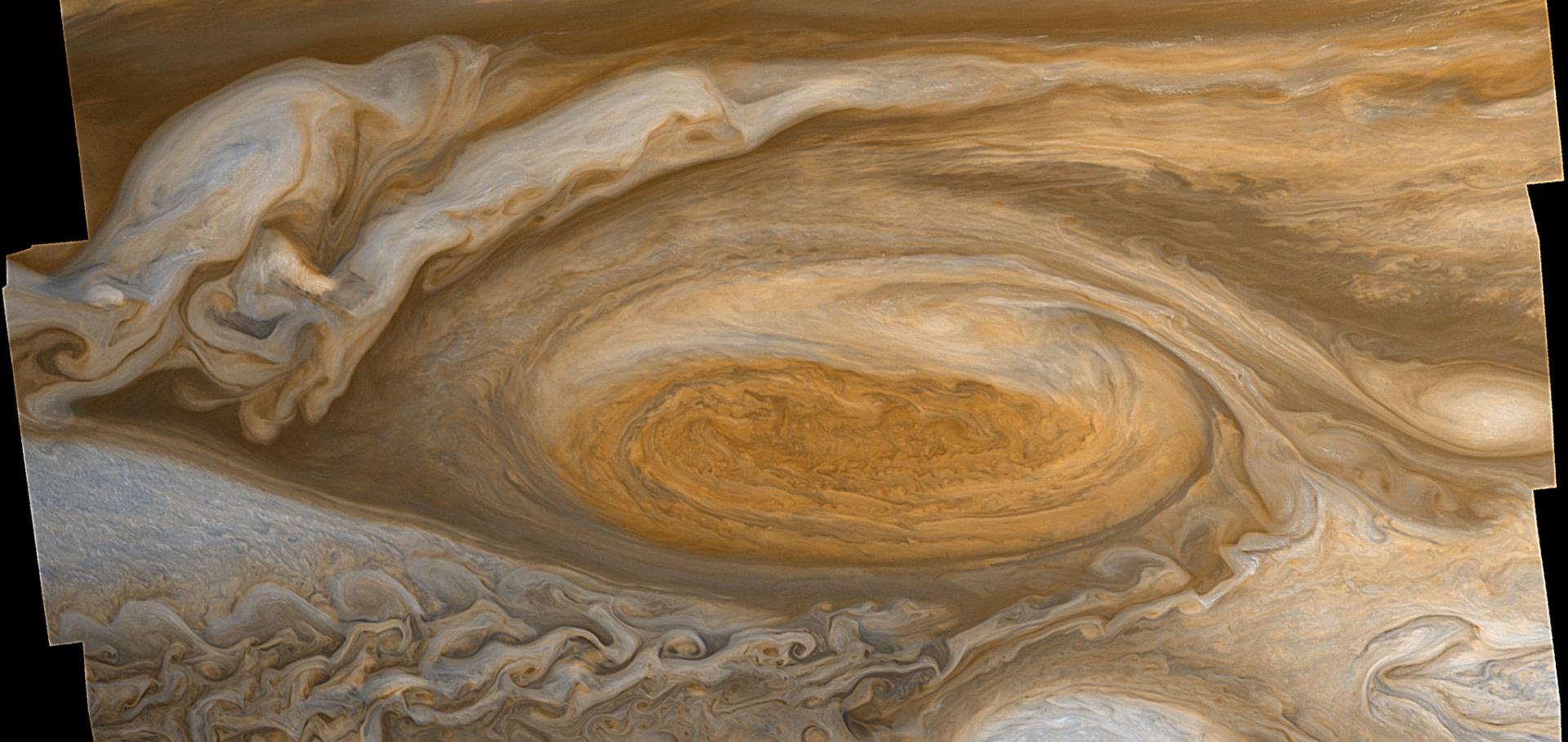
Image of Jupiter's Great Red Spot from Voyager 1

Image of Jupiter's Great Red Spot, obtained during the fly-by of Jupiter by NASA's Voyager 1 spacecraft in 1979.

Credit: NASA/JPL

Prof. Peter Read

Emeritus/researcher

Research theme

  • Climate physics
  • Exoplanets and planetary physics

Sub department

  • Atmospheric, Oceanic and Planetary Physics

Research groups

  • Geophysical and Astrophysical Fluid Dynamics
  • Planetary Climate Dynamics
Peter.Read@physics.ox.ac.uk
Telephone: 01865 (2)72082
Atmospheric Physics Clarendon Laboratory, room 210
  • About
  • Publications

Tubulence, waves, and jets in a differentially heated rotating annulus experiment

Physics of Fluids 20:12 (2008)

Authors:

RD Wordsworth, PL Read, YH Yamazaki

Abstract:

We report an analog laboratory study of planetary-scale turbulence and jet formation. A rotating annulus was cooled and heated at its inner and outer walls, respectively, causing baroclinic instability to develop in the fluid inside. At high rotation rates and low temperature differences, the flow became chaotic and ultimately fully turbulent. The inclusion of sloping top and bottom boundaries caused turbulent eddies to behave like planetary waves at large scales, and eddy interaction with the zonal flow then led to the formation of several alternating jets at mid-depth. The jets did not scale with the Rhines length, and spectral analysis of the flow indicated a distinct separation between jets and eddies in wavenumber space, with direct energy transfer occurring nonlocally between them. Our results suggest that the traditional "turbulent cascade" picture of zonal jet formation may be an inappropriate one in the geophysically important case of large-scale flows forced by differential solar heating.
More details from the publisher

Direct numerical simulation of transitions towards structural vacillation in an air-filled, rotating, baroclinic annulus

PHYSICS OF FLUIDS 20:4 (2008) ARTN 044107

Authors:

Peter L Read, Pierre Maubert, Anthony Randriamampianina, Wolf-Gerrit Fruh
More details from the publisher

Dynamics of convectively driven banded jets in the laboratory (vol 64, pg 4031, 2007)

JOURNAL OF THE ATMOSPHERIC SCIENCES 65:1 (2008) 287-287

Authors:

Peter L Read, Yasuhiro H Yamazaki, Stephen R Lewis, Paul D Williams, Robin Wordsworth, Kuniko Miki-Yamazaki, Joel Sommeria, Henri Didelle, Adam M Fincham
More details from the publisher

Inertia-Gravity Waves Emitted from Balanced Flow: Observations, Properties, and Consequences

JOURNAL OF THE ATMOSPHERIC SCIENCES 65:11 (2008) 3543-3556

Authors:

Paul D Williams, Thomas WN Haine, Peter L Read
More details from the publisher

QUAGMIRE v1.3: a quasi-geostrophic model for investigating rotating fluids experiments

GEOSCI MODEL DEV COPERNICUS GESELLSCHAFT MBH 1:1 (2008) 187-241

Authors:

PD Williams, TWN Haine, PL Read, SR Lewis, YH Yamazaki

Abstract:

QUAGMIRE is a quasi-geostrophic numerical model for performing fast, high-resolution simulations of multi-layer rotating annulus laboratory experiments on a desktop personal computer. The model uses a hybrid finite-difference/spectral approach to numerically integrate the coupled nonlinear partial differential equations of motion in cylindrical geometry in each layer. Version 1.3 implements the special case of two fluid layers of equal resting depths. The flow is forced either by a differentially rotating lid, or by relaxation to specified streamfunction or potential vorticity fields, or both. Dissipation is achieved through Ekman layer pumping and suction at the horizontal boundaries, including the internal interface. The effects of weak interfacial tension are included, as well as the linear topographic beta-effect and the quadratic centripetal beta-effect. Stochastic forcing may optionally be activated, to represent approximately the effects of random unresolved features. A leapfrog time stepping scheme is used, with a Robert filter. Flows simulated by the model agree well with those observed in the corresponding laboratory experiments.

Pagination

  • First page First
  • Previous page Prev
  • …
  • Page 35
  • Page 36
  • Page 37
  • Page 38
  • Current page 39
  • Page 40
  • Page 41
  • Page 42
  • Page 43
  • …
  • Next page Next
  • Last page Last

Footer Menu

  • Contact us
  • Giving to the Dept of Physics
  • Work with us
  • Media

User account menu

  • Log in

Follow us

FIND US

Clarendon Laboratory,

Parks Road,

Oxford,

OX1 3PU

CONTACT US

Tel: +44(0)1865272200

University of Oxfrod logo Department Of Physics text logo
IOP Juno Champion logo Athena Swan Silver Award logo

© University of Oxford - Department of Physics

Cookies | Privacy policy | Accessibility statement

Built by: Versantus

  • Home
  • Research
  • Study
  • Engage
  • Our people
  • News & Comment
  • Events
  • Our facilities & services
  • About us
  • Giving to Physics
  • Current students
  • Staff intranet