



D.Phil Projects 2026
I offer two DPhil Projects for entry in September 2027. Please get in touch for more details on the projects.
- Black hole feedback across cosmic time: Exploring Outflows with JWST and ALMA
Supervisors: Prof. Dimitra Rigopoulou and Prof. Niranjan Thatte
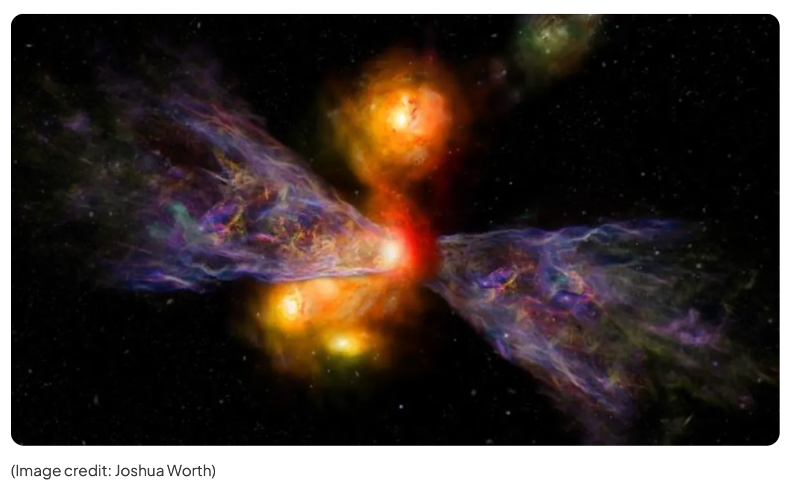
Supermassive black holes (SMBH) reside at the centres of most massive galaxies, and their growth is intimately linked to the evolution of their hosts. When actively accreting matter, these black holes power active galactic nuclei (AGN), releasing enormous amounts of energy that can drive powerful outflows and influence star formation. Understanding how AGN feedback affects the interstellar medium (ISM) and regulates galaxy growth remains one of the key outstanding questions in galaxy evolution.
The James Webb Space Telescope (JWST) provides unprecedented opportunities to investigate these processes. Its sensitivity and spatial resolution at infrared wavelengths allow us to probe the dust-obscured regions of galaxies and trace the physical conditions and kinematics of the gas surrounding actively growing black holes. This DPhil project will exploit unique NIRSpec and MIRI-MRS integral-field spectroscopy (IFS), complemented by ALMA observations, to investigate how AGN-driven outflows interact with the surrounding ISM and affect star formation. The project offers two complementary research directions, which may be pursued individually or combined.
Resolving black hole feedback in nearby galaxies
Nearby AGN provide unique laboratories for investigating the interaction between SMBH and their host galaxies in remarkable detail. But fundamental questions remain: How are nuclear outflows launched and how do they interact with the surrounding gas? Does the strength and nature of feedback depend on black hole mass and luminosity? Under what conditions does AGN activity suppress or enhance star formation?
In this project, we will use MIRI-MRS and NIRSpec integral-field spectroscopy, complemented by ALMA observations, to investigate the warm molecular and ionised gas, dust and star formation in the central regions of nearby active galaxies. A comprehensive suite of infrared emission and absorption diagnostics will be used to determine the physical conditions and excitation of the gas and to map its kinematics. By combining these measurements with spatially resolved diagnostics of star formation, we will investigate how AGN-driven outflows propagate through the nuclear regions and affect the surrounding ISM. A key goal will be to identify observational signatures that distinguish between positive and negative AGN feedback. This project is part of the GATOS collaboration and offers opportunities to work within a large international team studying the interplay between black hole activity, the ISM and star formation in nearby galaxies.
Black hole feedback at Cosmic Noon and beyond
Cosmic Noon marks the peak of star formation and SMBH growth in the Universe, making it a crucial epoch for understanding galaxy evolution. Here we will exploit proprietary JWST observations of powerful high-redshift AGN to investigate the physical and chemical conditions of the gas and the impact of large-scale outflows on their host galaxies. A major component of the project will involve advanced three-dimensional kinematic modelling to reconstruct the intrinsic geometry and dynamics of biconical outflows, enabling measurements of their mass-outflow rates and kinetic powers. Combining these results with infrared diagnostics of the ISM and star formation will provide new constraints on the role of AGN feedback during this critical epoch.
Training and Research Opportunities
The successful candidate will work with cutting-edge observational datasets and develop expertise in JWST integral-field spectroscopy, infrared spectroscopic diagnostics and spatially resolved gas kinematics. Depending on the chosen research direction, the student will also gain experience in ALMA observations, multi-wavelength analysis and advanced three-dimensional kinematic modelling.
The complementary nature of the two strands offers opportunities to connect the evolution of the AGN feedback and its impact on the host galaxy as a function of cosmic epoch. Using the detailed analysis of nearby AGN, we will formulate a parameterised models that can be fit to more distant objects, where detailed analysis is prohibited by signal to noise constraints. The evolution of parameters with cosmic time will lead to a deeper understanding of the interplay between AGN and their host galaxies. The precise balance between the two research directions can be tailored to the candidate's interests and the scientific questions they wish to address.
Further Reading: Rigopoulou et al. (2024), MNRAS, 532, 1598; García-Bernete et al. (2024), A&A, 691, 162; Donnan et al. (2026), MNRAS, 550, 1181; Veenema, Thatte & Rigopoulou (2026), arXiv:2609.30232.
2. The Dust Budget Crisis: Linking Active Galactic Nuclei and Little Red Dots
Supervisors: Prof. Dimitra Rigopoulou, Dr. Houda Haidar
One of the most exciting discoveries made by the James Webb Space Telescope (JWST) is the population of compact, red sources known as Little Red Dots (LRDs). Particularly abundant in the early Universe, many LRDs appear to host rapidly growing supermassive black holes (SMBH), potentially providing a new window onto the earliest phases of black-hole growth. Yet their properties are strikingly different from those of familiar Active Galactic Nuclei (AGN).
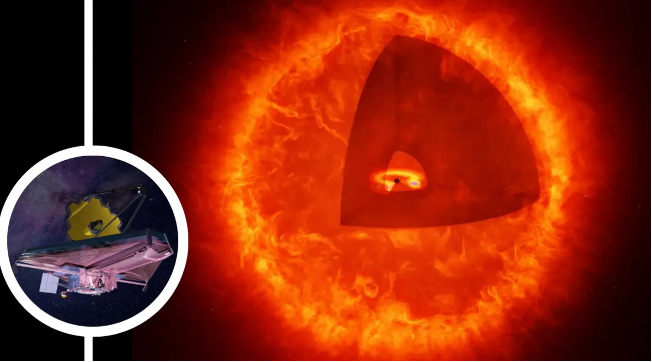
A big puzzle in understanding the nature of LRDs concerns dust. In nearby AGN, the dense gas surrounding an accreting SMBH is normally accompanied by large quantities of dust. Many LRDs, however, appear to contain extremely dense gas but surprisingly little dust —an apparent “dust budget crisis.” This raises the fundamental question: Are Little Red Dots governed by the same physical processes as AGN in the nearby Universe, or do they represent a fundamentally different phase of black-hole growth?
This DPhil project will use JWST observations to compare the gas and dust properties in LRDs with those in nearby AGN. It will investigate whether differences between the two populations can be understood as part of an evolutionary sequence, or whether new physical conditions are required to explain the growth of black holes in the early Universe. A particular focus will be to understand what happens to the dust around rapidly growing black holes. Is dust removed by powerful outflows, as observations of nearby AGN might suggest, or do LRDs grow in environments that were relatively dust-poor from the outset? These two possibilities have very different implications for the formation of the first massive black holes and the early chemical evolution of galaxies.
The student will develop expertise in JWST spectroscopy, AGN and early galaxy evolution, and the physics of gas, dust and black-hole feedback, while working on one of the most rapidly developing areas of extragalactic astrophysics.
Further Reading: Naidu et al. 2026, Nature, 656, 329; Donnan, Garcia-Bernete, Rigopoulou (2026), MNRAS 550, stag1181, Donnan, Rigopoulou & Garcia-Bernete 2024, MNRAS, 532, L75; Rigopoulou et al. 2024, MNRAS, 532, 1598