Home
Department Of Physics text logo
  • Research
    • Our research
    • Our research groups
    • Our research in action
    • Research funding support
    • Summer internships for undergraduates
  • Study
    • Undergraduates
    • Postgraduates
  • Engage
    • For young people
    • For teachers
    • For the public
    • For alumni
    • For business
  • Support
Menu
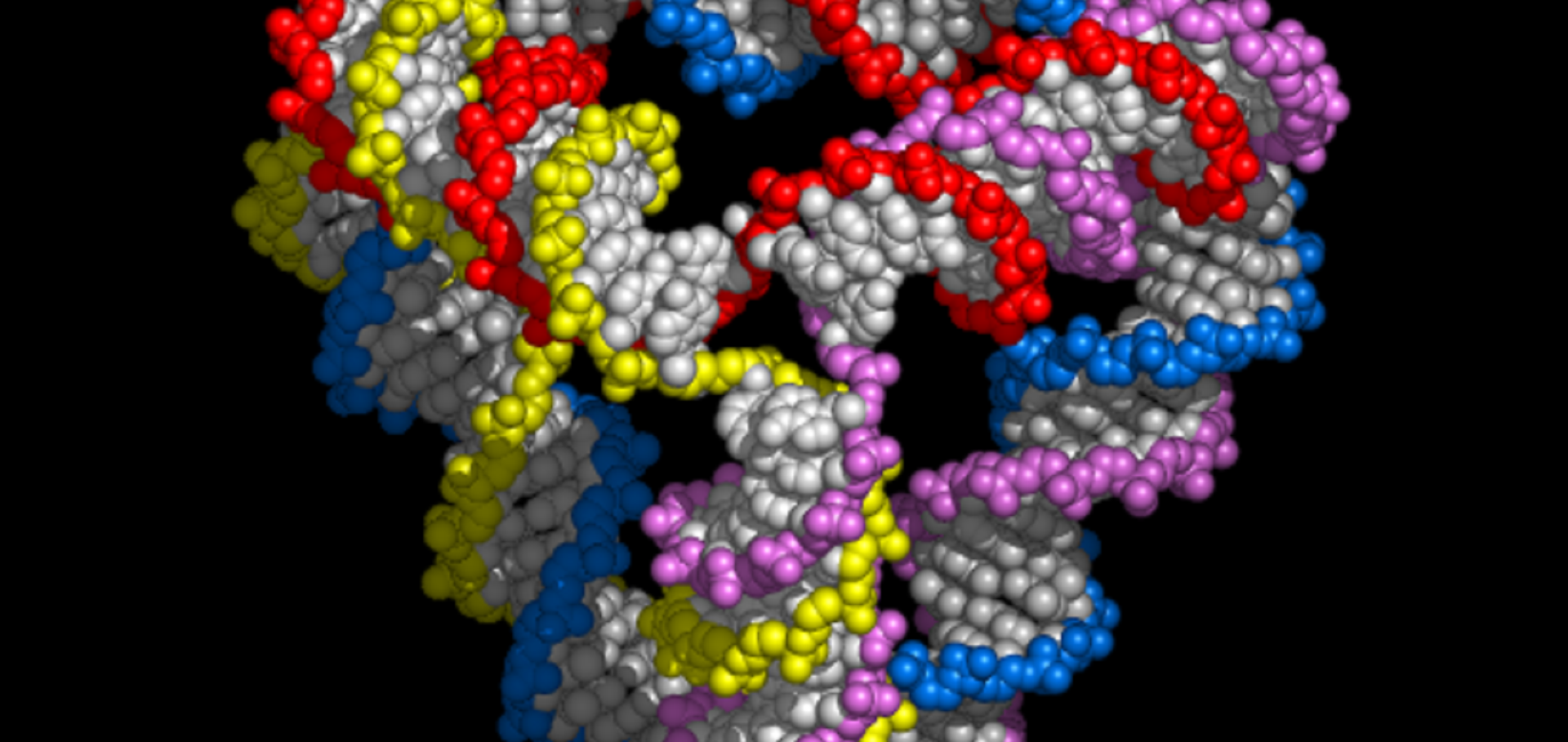
DNA tetrahedron

Professor Andrew Turberfield

Emeritus Professor of Biological Physics

Research theme

  • Biological physics

Sub department

  • Condensed Matter Physics

Research groups

  • Nucleic acid nanotechnology
Andrew.Turberfield@physics.ox.ac.uk
Clarendon Laboratory, room 275A
  • About
  • Publications

DNA-PAINT microscope data of a DNA nanostructure printer

University of Oxford (2022)

Authors:

Erik Benson, Rafael Carrascosa Marzo, Jonathan Bath, Andrew Turberfield

Abstract:

This dataset consist of reconstructed DNA-PAINT images of DNA origami based molecular devices. This is the data from the paper "A DNA molecular printer capable of programmable positioning and patterning in two dimensions". The data is structures after the figure of the paper. It is reconstructed and can be opened using the DNA-PAINT software Picasso. The data is described by what DNA paint probe was used to image it, corresponding to multiple image channels. 'P1' is the DNA-PAINT docking handle used on the frame and the canvas, 'R1' is the DNA-PAINT docking handle used on the sleeve, and 'R3' is the DNA-PAINT docking handle used on the ink patterned on the canvas.
More details from the publisher
Details from ORA

Reconfigurable T‐junction DNA Origami

Angewandte Chemie Wiley 132:37 (2020) 16076-16080

Authors:

Katherine G Young, Behnam Najafi, William M Sant, Sonia Contera, Ard A Louis, Jonathan PK Doye, Andrew J Turberfield, Jonathan Bath

Abstract:

AbstractDNA self‐assembly allows the construction of nanometre‐scale structures and devices. Structures with thousands of unique components are routinely assembled in good yield. Experimental progress has been rapid, based largely on empirical design rules. Herein, we demonstrate a DNA origami technique designed as a model system with which to explore the mechanism of assembly. The origami fold is controlled through single‐stranded loops embedded in a double‐stranded DNA template and is programmed by a set of double‐stranded linkers that specify pairwise interactions between loop sequences. Assembly is via T‐junctions formed by hybridization of single‐stranded overhangs on the linkers with the loops. The sequence of loops on the template and the set of interaction rules embodied in the linkers can be reconfigured with ease. We show that a set of just two interaction rules can be used to assemble simple T‐junction origami motifs and that assembly can be performed at room temperature.
More details from the publisher

Reconfigurable T-junction DNA Origami

ANGEWANDTE CHEMIE-INTERNATIONAL EDITION 59:37 (2020) 15942-15946

Authors:

Katherine G Young, Behnam Najafi, William M Sant, Sonia Contera, Ard A Louis, Jonathan PK Doye, Andrew J Turberfield, Jonathan Bath
More details from the publisher
Details from ORA
More details

Peptide Assembly Directed and Quantified Using Megadalton DNA Nanostructures.

ACS nano (2019)

Authors:

Juan Jin, Emily Grace Baker, Christopher W Wood, Jonathan Bath, Derek N Woolfson, Andrew J Turberfield

Abstract:

In nature, co-assembly of polypeptides, nucleic acids and polysaccharides is used to create functional supramolecular structures. Here we show that DNA nanostructures can be used to template interactions between peptides, and to enable the quantification of multivalent interactions that would otherwise not be observable. Our functional building blocks are DNA-peptide hybrids comprising de novo designed dimeric coiled-coil peptides covalently linked to oligonucleotide tags. These hybrids are incorporated in megadalton DNA origami nanostructures and direct nanostructure association through peptide-peptide interactions. Free and bound nanostructures can be counted directly from electron micrographs allowing estimation of the dissociation constants of the peptides linking them. Results for a single peptide-peptide interaction are consistent with measured solution-phase free energies; DNA nanostructures displaying multiple peptides allow the effects of polyvalency to be probed. This use of DNA nanostructures as identifiers allows the binding strengths of homo- and hetero-dimeric peptide combinations to be measured in a single experiment and gives access to dissociation constants that are too low to be quantified by conventional techniques. The work also demonstrates that hybrid biomolecules can be programmed to achieve spatial organization of complex synthetic biomolecular assemblies.
More details from the publisher
Details from ORA
More details
More details

Chiral DNA Origami Nanotubes with Well‐Defined and Addressable Inside and Outside Surfaces

Angewandte Chemie Wiley 130:26 (2018) 7813-7816

Authors:

Florence Benn, Natalie EC Haley, Alexandra E Lucas, Emma Silvester, Seham Helmi, Robert Schreiber, Jonathan Bath, Andrew J Turberfield
More details from the publisher

Pagination

  • First page First
  • Previous page Prev
  • Page 1
  • Page 2
  • Page 3
  • Page 4
  • Current page 5
  • Page 6
  • Page 7
  • Page 8
  • Page 9
  • …
  • Next page Next
  • Last page Last

Footer Menu

  • Contact us
  • Giving to the Dept of Physics
  • Work with us
  • Media

User account menu

  • Log in

Follow us

FIND US

Clarendon Laboratory,

Parks Road,

Oxford,

OX1 3PU

CONTACT US

Tel: +44(0)1865272200

University of Oxfrod logo Department Of Physics text logo
IOP Juno Champion logo Athena Swan Silver Award logo

© University of Oxford - Department of Physics

Cookies | Privacy policy | Accessibility statement

Built by: Versantus

  • Home
  • Research
  • Study
  • Engage
  • Our people
  • News & Comment
  • Events
  • Our facilities & services
  • About us
  • Giving to Physics
  • Current students
  • Staff intranet