Home
Department Of Physics text logo
  • Research
    • Our research
    • Our research groups
    • Our research in action
    • Research funding support
    • Summer internships for undergraduates
  • Study
    • Undergraduates
    • Postgraduates
  • Engage
    • For alumni
    • For business
    • For schools
    • For the public
  • Support
Menu
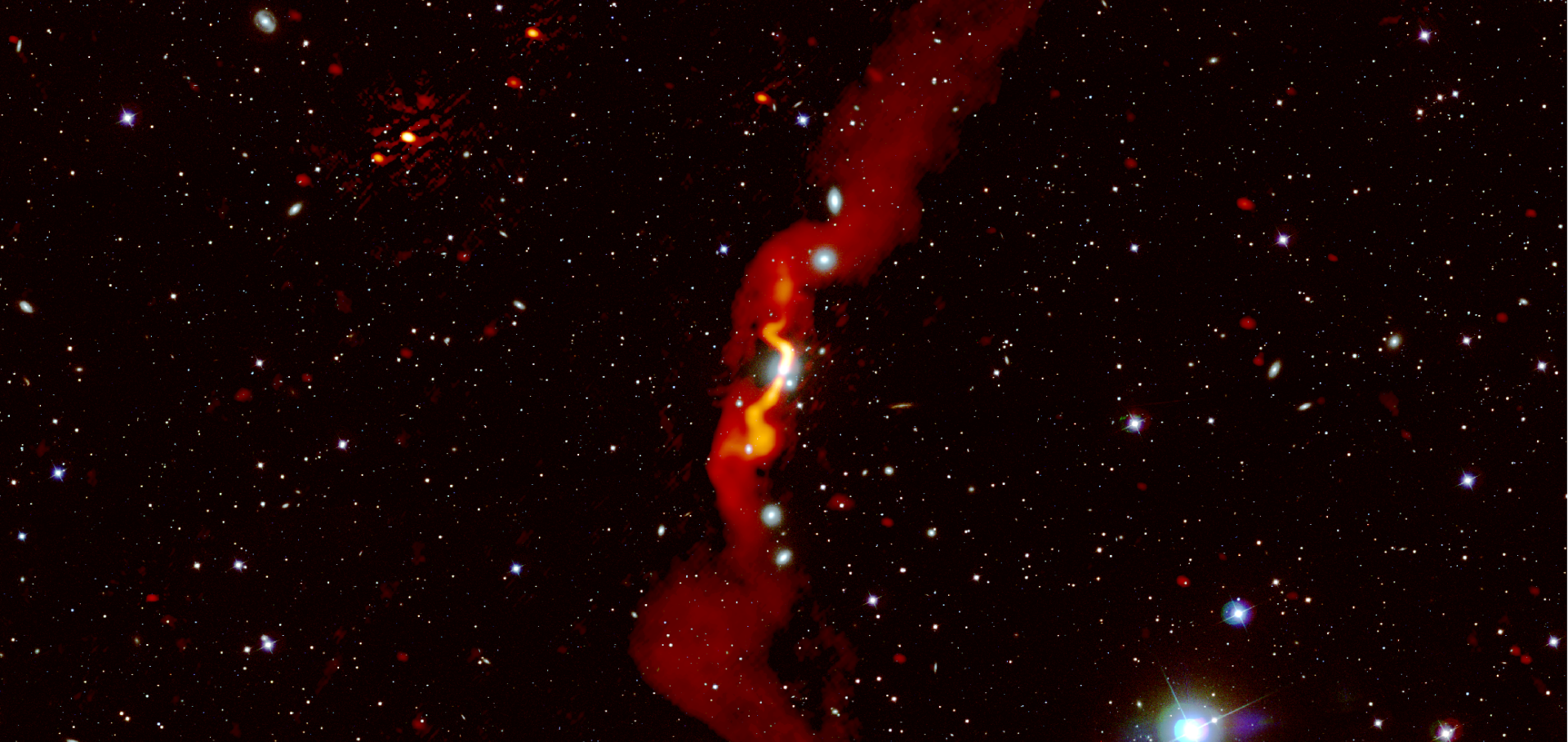
The radio galaxy 3C31, observed with LOFAR, is shown in red on top of an optical image.

The radio galaxy 3C31, observed with LOFAR by Heesen et al (2018), is shown in red on top of an optical image. LOFAR reveals the radio galaxy to be more than 3 million light years in size.

Credit: Volker Heesen and the LOFAR surveys team.

Bohan Yue

Postdoctoral Research Assistant

Research theme

  • Astronomy and astrophysics

Sub department

  • Astrophysics

Research groups

  • Galaxy formation and evolution
  • MeerKAT
  • The Square Kilometre Array (SKA)
  • Euclid
bohan.yue@physics.ox.ac.uk
Denys Wilkinson Building, room 708
Personal website
ORCID
  • About
  • Publications

Ubiquitous radio emission in quasars: Predominant AGN origin and a connection to jets, dust, and winds

Astronomy & Astrophysics EDP Sciences 691 (2024) A191-A191

Authors:

G Calistro Rivera, DM Alexander, CM Harrison, VA Fawcett, PN Best, WL Williams, MJ Hardcastle, DJ Rosario, DJB Smith, MI Arnaudova, E Escott, G Gürkan, R Kondapally, G Miley, LK Morabito, J Petley, I Prandoni, HJA Röttgering, B-H Yue

Abstract:

We present a comprehensive study of the physical origin of radio emission in optical quasars at redshifts z < 2.5. We focus particularly on the associations between compact radio emission, dust reddening, and outflows identified in our earlier work. Leveraging the deepest low-frequency radio data available to date (LoTSS Deep DR1), we achieve radio detection fractions of up to 94%, demonstrating the virtual ubiquity of radio emission in quasars, and a continuous distribution in radio loudness. Through our analysis of radio properties, combined with spectral energy distribution modelling of deep multiwavelength photometry, we establish that the primary source of radio emission in quasars is the active galactic nucleus (AGN), rather than star formation. Modelling the dust reddening of the accretion disc emission shows a continuous increase in radio detection in quasars as a function of the reddening parameter E(B − V), suggesting a causal link between radio emission and dust reddening. Confirming previous findings, we observe that the radio excess in red quasars is most pronounced for sources with compact radio morphologies and intermediate radio loudness. We find a significant increase in [O III] and C IV outflow velocities for red quasars not seen in our control sample, with particularly powerful [O III] winds in those around the threshold from radio-quiet to radio-loud. Based on the combined characterisation of radio, reddening, and outflow properties in our sample, we favour a model in which the compact radio emission observed in quasars originates in compact radio jets and their interaction with a dusty, circumnuclear environment. In particular, our results align with the theory that jet-induced winds and shocks resulting from this interaction are the origin of the enhanced radio emission in red quasars. Further investigation of this model is crucial for advancing our understanding of quasar feedback mechanisms and their role in galaxy evolution.
More details from the publisher
More details

A novel Bayesian approach for decomposing the radio emission of quasars: I. Modelling the radio excess in red quasars

Monthly Notices of the Royal Astronomical Society Oxford University Press (OUP) 529:4 (2024) 3939-3957

Authors:

B-H Yue, PN Best, KJ Duncan, G Calistro-Rivera, LK Morabito, JW Petley, I Prandoni, HJA Röttgering, DJB Smith

Abstract:

ABSTRACT Studies show that both radio jets from the active galactic nuclei (AGNs) and the star formation (SF) activity in quasar host galaxies contribute to the quasar radio emission; yet their relative contributions across the population remain unclear. Here, we present an improved parametric model that allows us to statistically separate the SF and AGN components in observed quasar radio flux density distributions, and investigate how their relative contributions evolve with AGN bolometric luminosity ($L_\mathrm{bol}$) and redshift (z) using a fully Bayesian method. Based on the newest data from LOw-Frequency ARray Two-metre Sky Survey data release 2, our model gives robust fitting results out to $z\sim 4$, showing a quasar host galaxy SF rate (SFR) evolution that increases with bolometric luminosity and with redshift out to $z\sim 4$. This differs from the global cosmic SFR density, perhaps due to the importance of galaxy mergers. The prevalence of radio AGN emissions increases with quasar luminosity, but has little dependence on redshift. Furthermore, our new methodology and large sample size allow us to subdivide our data set to investigate the role of other parameters. Specifically, in this paper, we explore quasar colour and demonstrate that the radio excess in red quasars is due to an enhancement in AGN-related emission, since the host galaxy SF contribution to the total radio emission is independent of quasar colour. We also find evidence that this radio enhancement occurs mostly in quasars with weak or intermediate radio power.
More details from the publisher
More details

Pagination

  • First page First
  • Previous page Prev
  • Page 1
  • Current page 2

Footer Menu

  • Contact us
  • Giving to the Dept of Physics
  • Work with us
  • Media

User account menu

  • Log in

Follow us

FIND US

Clarendon Laboratory,

Parks Road,

Oxford,

OX1 3PU

CONTACT US

Tel: +44(0)1865272200

University of Oxfrod logo Department Of Physics text logo
IOP Juno Champion logo Athena Swan Silver Award logo

© University of Oxford - Department of Physics

Cookies | Privacy policy | Accessibility statement

Built by: Versantus

  • Home
  • Research
  • Study
  • Engage
  • Our people
  • News & Comment
  • Events
  • Our facilities & services
  • About us
  • Giving to Physics
  • Current students
  • Staff intranet